Skip to content


A USB-C connector on one end and a USB-B connector on the other may sound like enough information for a quotation, but in a custom cable project those two connector names describe only the most visible part of the product. Two cables that look nearly identical from the outside can use different USB implementations, conductor sizes, shielding structures, jacket materials, connector housings, overmolding designs, test plans and packaging. Those differences influence material consumption, tooling, assembly processes, inspection work and the final production cost.
For an accurate USB-C to USB-B cable quotation, the manufacturer normally needs the exact connector configuration, intended devices, required data and power functions, cable length, conductor or AWG requirements, shielding, jacket material, drawing or pinout information, application conditions, testing requirements, order quantity, customization details and packaging expectations. When these items are clear, quotations are easier to compare and fewer specifications need to be revised later.
Consider a project initially described as “a 1-meter USB-C to USB-B cable.” Once engineering review begins, the USB-B interface turns out to be different from the supplier’s first assumption, the cable needs a controlled data structure, the connector must fit inside a recessed machine panel, and each finished unit requires a barcode label and individual packaging. The original price did not suddenly become inaccurate—the original product definition was incomplete. A reliable RFQ therefore begins by defining what the cable actually needs to do before asking what it costs.
What Must Be Defined Before Quoting?
Before a USB-C to USB-B cable can be quoted reliably, the exact USB-B interface, connected devices, data and power functions, connector orientation and mechanical restrictions should be established. “USB-C to USB-B” identifies the connector families but does not fully define the cable architecture. Confirming these fundamentals first prevents different suppliers from pricing different products under the same general cable description.
Which USB-B Version Is Required?
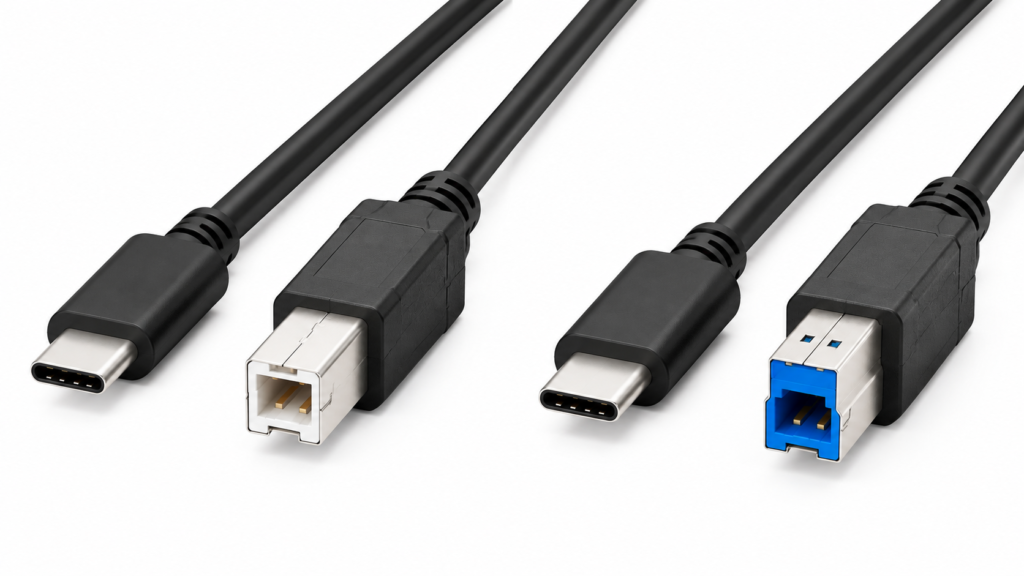
The first detail to confirm is what the project means by “USB-B.” A USB 2.0 Standard-B connector and a SuperSpeed-era USB-B connector are not simply two versions of the same physical plug. Their connector structures and applicable cable architectures differ, so a manufacturer should not choose one based on a general product name. When the device already exists, the equipment port is usually the most reliable starting point for identification.
A useful RFQ can include an exact connector specification, approved component part number, equipment model, clear close-up photos or an existing cable sample. When photographs are used, the mating face should be shown directly rather than only photographing the complete machine from a distance. Side and rear views are also helpful when the shell shape, mounting area or available clearance might affect the connector housing.
For projects involving USB 2.0 High-Speed, the specification supports a signaling rate of up to 480 Mb/s. A project requiring a SuperSpeed USB-B connection belongs to a different connector and cable arrangement, which is why the intended USB implementation needs to be identified before conductor structure, shielding and materials are finalized. The USB-C plug on the opposite end does not remove this distinction.
This issue becomes especially important in replacement-cable programs. A procurement team may receive an internal request stating only “USB-C to printer cable,” while the actual equipment is laboratory, industrial or commercial hardware with a specific port geometry. Confirming the mating interface before quotation costs almost nothing; discovering the wrong connector after molded samples are produced can affect tooling, samples, lead time and pricing.
What Devices Will the Cable Connect?
The connected equipment gives the cable specification context that connector names alone cannot provide. A USB-C laptop connected to a desktop peripheral, a service computer connected to industrial equipment, and an embedded controller connected to a measurement instrument may use broadly similar connector families, yet the way the cable is installed, handled and tested can be quite different.
Customers do not need to disclose confidential product information simply to explain an application. Descriptions such as “USB-C host computer to laboratory instrument,” “service laptop to industrial controller,” or “embedded host to equipment peripheral” can already help an engineering team understand whether the cable will be installed permanently, moved regularly, connected frequently or routed through a confined enclosure.
Environmental information can also influence specification review. A cable operating beside motors, switching power equipment or other electrical noise sources may require more attention to shielding. A cable passing through machinery may need additional abrasion or flexing consideration. A connector located inside a deep recess may require a narrow housing or a particular cable exit direction even if the electrical interface itself is standard.
Treating application information as part of the engineering specification rather than a generic form field makes quotations more useful. It gives the manufacturer enough context to question specifications that may otherwise look acceptable on paper but cause problems during installation, device validation or later production use.
What Data and Power Requirements Apply?
A USB-C plug describes a connector system; it does not automatically define every data or power capability of a USB-C to USB-B cable. The connected equipment, USB implementation and cable construction determine what functions actually need to be supported. For quotation purposes, the customer should therefore state whether the assembly is intended for data transfer, bus power, or a combination of the two.
When data is required, the project specification should identify the USB performance expected by the equipment rather than simply requesting a “high-speed” cable. When power is relevant, the equipment’s voltage and current requirements should be provided if they influence conductor selection. These inputs help prevent the cable from being either overbuilt at unnecessary cost or under-specified for the intended device.
Existing validated cables can provide useful evidence. If a current cable already operates correctly with the equipment, its connector structure, cable markings, diameter, flexibility and construction can be reviewed as a reference. This does not automatically reveal every internal specification, but it can shorten the path to a controlled replacement or customized assembly.
The key purchasing point is comparability. If one supplier assumes a basic USB 2.0 data construction while another assumes a more complex structure, their prices do not describe equivalent products. Stating the functional requirement before requesting final pricing makes supplier comparisons much more meaningful.
Is a Standard or Custom Connector Needed?
A standard connector housing can often be produced using existing components and tooling, while a custom connector may introduce overmold design, mold development, material selection, logo requirements, dimensional control and additional sample approval. The difference should be established early because connector customization can change both one-time development cost and production cost.
Mechanical restrictions are particularly important when the equipment port is recessed, surrounded by other connectors or installed inside a narrow panel opening. In those situations, an electrically correct connector can still be unusable if the molded housing is too wide, too long or oriented incorrectly. Providing enclosure dimensions or a device sample reduces this risk before tooling decisions are made.
Right-angle cable exits also need an unambiguous orientation. Terms such as “left angle” and “right angle” can be interpreted differently depending on whether the drawing is viewed from the mating face, cable side or device side. A marked drawing or physical sample is safer than relying on written direction alone.
Overmolding should also be considered as a functional structure rather than only an appearance feature. Depending on the project, it may provide strain relief, connector protection, controlled cable exit or a repeatable branded shape. Cablivo’s documented manufacturing framework treats connector protection, overmolding and strain relief as engineering variables that are reviewed according to the actual application and structure.
| Information to Confirm | Practical RFQ Example | Effect on Quotation | Useful Decision Standard |
| USB-B interface | USB 2.0 Standard-B | Determines connector and cable architecture | Match the actual device port |
| Data requirement | USB 2.0 High-Speed | Influences internal cable construction | Use the equipment specification |
| Cable function | Data + bus power | Affects conductor arrangement | State what the cable must actually carry |
| Application | Computer to industrial instrument | Helps review mechanical and environmental risks | Describe both connected devices |
| Connector exit | Straight or right-angle | Can affect housing and tooling | Confirm installation space |
| Connector housing | Standard or custom overmold | May add tooling and development | Provide drawing or sample |
| Port clearance | Restricted enclosure opening | Controls maximum housing dimensions | Provide available space |
| Reference cable | Existing approved assembly | Reduces assumptions | Send sample or detailed photos |
Which Cable Specifications Affect the Quote?
Cable length, conductor size, shielding, jacket material, cable diameter and overmolding have a direct effect on material consumption and production processes. These specifications should be selected around the application’s electrical and mechanical needs rather than simply choosing the thickest conductor or most complex shielding. A well-defined construction helps ensure every supplier is costing substantially the same cable.

What Cable Length and AWG Are Needed?
Cable length changes more than the number shown in a product listing. Every additional length of cable consumes more conductor, insulation, shielding and jacket material, and it may also influence electrical performance, voltage drop, packaging dimensions and winding requirements. A quotation should therefore use the actual finished length for each SKU rather than a general range whenever possible.
The measurement method also matters in equipment projects. “1 meter” may be perfectly adequate for a general-purpose accessory, but a controlled assembly may need a drawing showing whether the 1,000 mm dimension is measured between connector faces, overmold ends or cable exit reference points. Tolerances should be tight enough for the application without creating unnecessary manufacturing restrictions.
AWG selection affects conductor material, cable diameter, flexibility and electrical performance. A lower AWG number generally represents a larger conductor, but larger is not automatically better for every cable. An oversized conductor can increase stiffness and outside diameter, which may create termination or routing problems, while a conductor that is too small may not suit the application’s electrical requirements.
When the project already has an approved AWG, it should be included in the RFQ. If conductor size remains open, provide cable length, current requirements where relevant, required function, flexibility expectations and any outside-diameter restriction. Cablivo’s documented intake process specifically includes cable length and wire gauge/AWG among the items that can be reviewed before sampling and production.
Is Shielding Required?
Shielding is one of the easiest specifications to oversimplify. A cable may use foil shielding, braided shielding or a combined construction, and each choice affects material cost, processing, diameter and termination work. Simply writing “shielded cable” does not guarantee that different manufacturers will interpret the requirement in the same way.
If a controlled cable drawing already exists, the shielding construction should be included directly. When the design is still under review, the customer should describe the USB requirement, cable length, installation environment and any applicable electrical test criteria so the proposed shielding can be discussed in context.
This is particularly useful around electrically noisy equipment. Industrial drives, motors, switching power supplies and other nearby electronics may create a different environment from a cable used behind an ordinary office peripheral. The appropriate solution should follow the actual signal and installation requirement rather than adding materials simply to create a more impressive specification.
Cablivo’s manufacturing facts include foil-wrapping and high-speed braiding capability for signal-related cable structures. The same facts emphasize that shielding requirements need to be connected to product and project needs rather than treated as a universal construction for every cable.
Which Jacket Material Should Be Used?
The jacket influences how the cable bends, feels, wears, looks and behaves in the target environment. Materials such as PVC, TPE, TPU, PUR and other compounds may be discussed in custom cable projects, but the material name alone does not completely describe performance. Specific grades, hardness, formulation and processing characteristics can matter as much as the broad material family.
A useful RFQ explains what the jacket needs to achieve. A consumer-facing accessory may place more emphasis on flexibility, surface feel, color and appearance. An industrial assembly may prioritize abrasion exposure, routing, equipment environment or mechanical handling. A cable used in a confined enclosure may also have an outside-diameter limitation that influences the complete construction.
Color should be treated with the same level of precision as the project requires. “Black” may be sufficient for an internal equipment cable, while a retail brand might need a controlled gray, white or custom color. When visual consistency is important, an approved physical sample or recognized color reference makes sample evaluation much clearer.
Material selection should remain application-based. The company’s documented material framework allows discussions around multiple jacket and protection materials while requiring final selections to be confirmed according to the cable structure and intended use.
Do You Need Custom Overmolding?
Custom overmolding can substantially change the scope of a cable project because it can involve mold design, tooling fabrication or modification, material selection, logo treatment, dimensional inspection and additional sample development. A standard molded connector from an existing tool does not carry the same development requirements as a new branded housing created specifically for one equipment platform.
The desired function should be explained before the shape is finalized. Some projects require a compact overmold because the device port is recessed. Others require longer strain relief because the cable is handled frequently. Industrial products may need a more protective connector transition, while branded products may prioritize appearance and repeatable logo positioning.
Tooling decisions should ideally be based on controlled dimensions rather than a single photograph. Where only a reference sample exists, the manufacturer can first measure the product, confirm which dimensions need to remain unchanged and identify which features may be modified. This makes the first tooling discussion far more realistic.
Cablivo’s engineering fact set includes drawing review, connector confirmation, overmold structure review, tooling discussion, prototype development and sample revision. These activities are intended to reduce the gap between a visual concept and a repeatable production assembly rather than assuming that every custom mold can be priced accurately from a picture alone.
| Cable Variable | Typical RFQ Options | Main Quotation Impact | Selection Value |
| Finished length | 0.5 m / 1 m / 2 m / custom | Copper and material consumption | Define each SKU separately |
| Conductor | Specified AWG or engineering review | Copper, diameter and termination | Match electrical and flexibility needs |
| Shielding | None / foil / braid / combined | Material and processing | Match signal environment |
| Jacket | PVC / TPE / TPU / PUR / project material | Material grade and extrusion | Match handling and environment |
| Cable OD | Project-defined | Material volume and connector fit | Check routing limitations |
| Color | Standard or controlled custom color | Material preparation and approval | Match product requirements |
| Connector shell | Standard / custom | Existing tooling versus new tooling | Check enclosure and appearance |
| Strain relief | Standard / reinforced / custom | Mold geometry and processing | Match repeated bending conditions |
| Overmolding | Existing tool / new mold | Tooling and sample approval | Confirm before final pricing |
What Files Should You Send?
A practical USB-C to USB-B RFQ package normally includes the latest drawing, pinout or wiring information, BOM when available, connector details, reference samples or photographs, and branding or packaging files that affect the supplied product. A project can still begin without complete drawings, but the missing technical information should be identified and resolved before sampling or final production pricing.

Do You Have a Drawing or Specification?
A controlled drawing creates a common product definition between engineering, procurement, quality and the manufacturer. Instead of describing connector style, cable length, molding dimensions and labels across a long email chain, the key requirements can be placed in one revision-controlled document that all parties reference during quotation and sampling.
Revision control is particularly important. Files named “final,” “final revised” and “latest final” are common in real projects, but they create uncertainty when dimensions or material requirements differ. The RFQ should identify the current revision clearly and explain whether older samples or drawings remain relevant only as reference materials.
A useful drawing should also separate critical dimensions from reference dimensions. A USB-B connector housing that must pass through a 14 mm opening may need tight control, while a decorative dimension on an unconstrained section of cable may not. Applying unnecessarily narrow tolerances everywhere can increase production difficulty without improving the finished product.
When complete drawings do not yet exist, project review can begin with sample photographs, connector images, cable length, application details and quantity. Cablivo’s documented engineering rules explicitly allow this type of initial review, after which missing information can be confirmed before sampling.
Is a Pinout or Wiring Diagram Available?
A pinout is especially important when the wiring cannot safely be inferred from the connector names. The document shows how contacts on one end relate to contacts on the other and gives both the manufacturer and the test team a controlled electrical reference before samples are assembled.
The connector viewing direction should be clearly stated. A mating-face view and a solder-side view can appear mirrored, and misunderstanding the orientation can create a cable that looks mechanically perfect but has incorrect wiring. Pin numbers, signal names and connector references should therefore be unambiguous.
This becomes even more important when USB-style connectors are used in a proprietary device arrangement. A connector that looks familiar does not necessarily mean the internal wiring follows a standard USB assembly. Proprietary projects should never rely on assumptions simply because the plug shell resembles a common interface.
Production testers also depend on the correct reference. A cable tester can identify opens, shorts or wiring mismatches only when its test program is based on the approved pinout. Cablivo’s engineering capability framework specifically includes pinout review and wire-sequence confirmation before production preparation.
Do You Have a BOM or Reference Sample?
A BOM is useful when specific connectors, materials, terminals, shielding structures, sleeves, labels or other components are controlled by the project. It allows the quotation team to determine whether components are readily available, need substitution approval or carry sourcing conditions that may affect the final cost.
Not every line in a BOM has to be equally restrictive. Some projects require a particular manufacturer and part number because the component has already been validated. Others allow an equivalent component after engineering approval. Making this distinction visible helps suppliers quote on the same commercial basis and prevents hidden substitutions.
Reference samples provide another type of evidence. They can show connector fit, overmold shape, surface texture, cable flexibility, color and packing method more effectively than descriptive text. For replacement programs, sending the existing working cable can significantly reduce uncertainty during the first review.
A physical sample still does not reveal everything. Internal AWG, shielding coverage, material grade and electrical requirements may not be visible. The most reliable development process uses the sample to identify important physical features, then captures confirmed requirements in a controlled drawing, BOM or specification that can support sample approval and repeat production.
What Branding and Packaging Files Are Needed?
Packaging becomes part of the quotation whenever it is part of the product delivered to the customer. A simple bulk-packed industrial cable has a different cost structure from a retail-ready cable that requires individual winding, custom labels, barcodes, printed packaging and SKU-specific export cartons.
Logo files should be supplied in a format suitable for the intended production method, and the location, size and orientation should be controlled where branding matters. Packaging files may include individual bag labels, barcode lists, printed box artwork, instruction inserts and master-carton marks.
Multi-SKU programs require additional discipline. A distributor may order the same basic cable in several lengths and colors, with each combination carrying a different barcode. A simple SKU matrix linking model, cable length, color, label, packaging and carton details helps production and quality teams keep these variations separated.
Cablivo’s USB product facts include logo, connector shell, packaging style, retail box, barcode labels and target market among the customization variables that can form part of the project specification.
| RFQ Document | Minimum Useful Information | Stronger Project-Level Information | Risk Reduced |
| Cable drawing | Connector types and length | Dimensions, tolerances, OD, overmold and revision | Different products being quoted |
| Pinout | Pin-to-pin connection | Connector view and signal names | Wiring errors |
| BOM | Main components | Part numbers, approved alternatives and materials | Uncontrolled substitutions |
| Connector photos | Clear mating face | Front, side, rear and equipment port | Connector misidentification |
| Reference sample | Physical cable | Controlled versus changeable features | Appearance and fit mismatch |
| Application note | Connected equipment | Routing, movement and environment | Wrong construction choice |
| Logo artwork | Approved artwork | Position, dimensions and method | Branding inconsistency |
| SKU list | Model and quantity | Length, color, barcode and packaging | Multi-SKU errors |
| Packaging files | Packing method | Artwork, labels and carton configuration | Incorrect delivered packaging |
| Test specification | Required checks | Methods and acceptance criteria | Inspection disputes |
Which Tests and Compliance Requirements Apply?
Testing should reflect the intended function and project risk rather than adding every possible laboratory test. Depending on the cable, useful checks can include continuity, data function, connector fit, dimensional inspection, swing or bending tests, connector-life tests, appearance and packaging inspection. Compliance requirements should be identified from the actual product, market and program instead of assuming that every custom cable carries the same certifications.

What Functional Tests Are Required?
Continuity testing is a fundamental cable-assembly check because it can identify open circuits, shorts and wiring errors, but it does not demonstrate every aspect of USB performance. A cable can pass a simple continuity test while still failing the actual data or device function expected by the project.
For that reason, the required function should be defined in the specification. If the cable is expected to support USB 2.0 High-Speed operation, that requirement should be stated explicitly rather than described only as “data cable.” The applicable device function can then be considered during sample development and validation.
Device-level verification can be valuable when the cable is closely tied to specific hardware. A finished sample may pass the factory’s electrical checks yet still reveal a connector-clearance, fit or application issue when installed on the customer’s actual product. Validating representative samples on target equipment can therefore complement production-line electrical tests.
The appropriate testing frequency also depends on the project. Some electrical checks may be suitable for every finished assembly, while more time-consuming validation may be performed during sample approval or on defined inspection quantities. Cablivo’s documented USB test directions include charging function, data transfer, continuity, connector fit, swing testing, connector-life checks, appearance, packaging and pre-shipment inspection according to project requirements.
Is Connector Fit and Mechanical Testing Needed?
Connector fit should be included in sample validation when the port is recessed, tightly surrounded by an enclosure or mechanically sensitive. A plug can be electrically compatible and still fail in the final product because the molded shell interferes with the housing or the cable exit creates excessive bending.
The strongest validation uses the actual device, a representative enclosure, a mating fixture or controlled dimensional data. The sample can then be checked for full seating, housing clearance, correct orientation and realistic cable routing rather than simply verifying that the plug enters a generic connector.
Dimensional inspection becomes more important when custom overmolding is involved. Critical dimensions from the approved drawing can be checked during sample review, tooling confirmation and production inspection. Cablivo’s manufacturing fact library documents the use of precision calipers and micrometer tools to support dimensional verification in sample, tooling and production work.
This kind of mechanical verification is especially relevant to laboratory instruments, kiosks, industrial controllers and other equipment where connectors are often installed inside panels rather than exposed openly like a desktop peripheral.
Are Durability or Reliability Tests Required?
Durability requirements should come from the way the cable will actually be handled. A cable installed once behind equipment does not experience the same stress as a service cable that is bent and reconnected every day. Applying the same durability specification to both can either create unnecessary cost or fail to address the real use condition.
Swing or repeated-bending tests can be useful when the transition between cable and connector is repeatedly flexed. Connector insertion and withdrawal testing may be appropriate for products that are frequently connected. Pull-force testing can also provide useful information where terminal retention, connector attachment or molded-joint strength is important.
Test conditions should be defined carefully. A statement such as “10,000 bends” has little engineering value without the bending angle, fixture, load, bending point, speed and failure criteria. Large cycle numbers copied from another product can create an impressive specification without providing meaningful evidence for the actual application.
Cablivo’s equipment facts include multi-station cable swing testing, connector insertion and withdrawal-life testing, and tensile testing capability. These are presented as project-dependent verification options, not as evidence that every cable automatically meets a fixed durability claim.
Which Compliance Requirements Apply?
Compliance requirements need to be tied to the intended market, customer program and final equipment rather than treated as a generic group of certificates. USB-related compliance, material declarations, finished-product requirements and customer-specific documentation are different subjects and should be identified separately.
Component documentation also should not be confused with certification of the finished assembly. Using a connector or material supported by a particular declaration does not automatically mean the entire custom cable carries every certification associated with that component.
During RFQ review, the practical question is what documentation or testing must be delivered as part of the project. If a customer requires specific material declarations, third-party testing, USB-related compliance work or an internal validation report, that scope should be stated before final quotation so the required work can be evaluated properly.
Cablivo’s company rules explicitly prohibit claiming CE, RoHS, FCC, UL, REACH, medical, aerospace or other certifications without supporting evidence. The documented approach is to confirm certification and testing requirements according to the product type, target market and actual project specification.
| Test or Check | What It Evaluates | Typical Use | Practical Acceptance Question |
| Continuity test | Open, short and wiring connection | Routine assembly inspection | Is every circuit connected correctly? |
| Data-function check | Intended USB operation | Sample and functional validation | Does the cable perform the required device function? |
| Connector fit | Mechanical mating and clearance | Device-specific ports | Does the connector seat without interference? |
| Dimensional inspection | Length, OD and molded dimensions | Custom structures | Does the product match controlled dimensions? |
| Swing/bending test | Repeated flexing behavior | Frequently handled cables | Does it survive the defined test method? |
| Connector-life test | Repeated mating | Service and frequently connected equipment | Does mating remain acceptable after the specified test? |
| Tensile/pull test | Joint or termination strength | Higher-stress assemblies | Does the connection meet the project requirement? |
| Appearance inspection | Mold, jacket and visual condition | Branded and retail products | Does it match the approved reference? |
| Barcode/label check | SKU identification | Distribution programs | Is the correct label applied to each SKU? |
| Packaging inspection | Packing configuration | Export and retail orders | Does the shipment match the approved packing plan? |
How Do Quantity and Production Requirements Affect the Quote?
Quantity, tooling, sample development, SKU count, testing and packaging shape the commercial scope around the cable specification. A useful RFQ should state the sample requirement, first production quantity, expected repeat volume when reasonably known, SKU breakdown and packaging method. Asking only for a “best price” without these details gives the manufacturer too little information to calculate a stable production basis.

What Quantity Do You Need?
Quantity affects component purchasing, material preparation, line setup, molding, inspection, packaging and production economics. The same cable specification can therefore produce a different unit cost at different order volumes, even though the connector and cable structure remain unchanged.
For a developing project, it is useful to separate sample quantity from production quantity. The first production order should be stated realistically, and an estimated repeat-order range can be added if the customer already has a reasonable forecast. Inflating future volume solely to obtain a lower quotation can produce a price that no longer applies when the real purchase order is released.
SKU distribution also matters. Five thousand identical black 1-meter cables are operationally simpler than five thousand total units divided among several lengths, colors and packaging formats. Every additional SKU can require separate material preparation, identification, inspection, labels and carton control.
Cablivo’s documented MOQ begins from 500 pieces for many custom cable projects, while the final MOQ depends on connector type, cable structure, materials, overmolding, tooling, packaging and order quantity. This makes a realistic quantity especially important when comparing customized USB-C to USB-B quotations.
Do You Need Tooling or Sample Development?
Tooling is usually separate from ordinary unit pricing because it belongs to the development of a custom molded structure. If the cable uses an existing approved connector housing, new tooling may not be necessary. A custom branded shape, narrow housing, right-angle connector or specialized strain-relief geometry can create a different development scope.
Sample development gives the customer a physical opportunity to verify fit, cable handling, function, dimensions, molding, logo and appearance before production preparation. For higher-value equipment projects, this step often carries more value than trying to perfect every visual detail through email before a real assembly exists.
Sampling time should not be treated as a universal fixed number. Connector availability, material preparation, tooling complexity, cable construction and testing requirements can all influence the development schedule. Cablivo’s documented engineering rules therefore avoid promising a fixed three-day, five-day or seven-day sample period without reviewing the project.
A sample becomes most useful when approval is connected to a final drawing, BOM, material requirement and test plan. That creates a controlled production reference and reduces the risk that an approved physical cable and the manufacturing documentation later describe different products.
What Packaging and SKU Structure Are Required?
Packaging can materially change a quotation without changing the electrical cable at all. Bulk winding and carton packing involve a different set of materials and labor from individual bags, barcode labels, printed retail boxes, inserts and SKU-specific master cartons.
Cable dimensions also interact with packaging. Longer or thicker assemblies may need a larger winding diameter, larger bag or box and different carton quantity. Heavy molded connectors may need protection so they do not damage adjacent products during international transportation.
For multi-SKU programs, each version should be linked to its approved length, color, connector configuration, label, barcode, individual pack and carton mark. This information helps the production and quality teams verify that the electrically correct cable also reaches the customer under the correct commercial identity.
Cablivo’s documented project process includes labeling, packaging and shipment coordination alongside engineering review, sampling, mass production and quality inspection. Packaging is therefore treated as part of the final product specification instead of a task added only after production has finished.
How Can Re-Quoting and Production Changes Be Reduced?
Repeated quotations are usually reduced by making uncertainty visible before the price is treated as final. Each major requirement can be classified as confirmed, pending customer decision or requiring supplier engineering review. This simple distinction prevents an unresolved specification from quietly becoming an assumption inside the quotation.
Connector version, cable length, conductor construction, AWG, shielding, jacket, overmold, tooling, test requirements, quantity and packaging are among the changes most likely to affect cost. If one of these changes after quotation, a price revision may be reasonable because the physical product or production process has changed.
Quotation documents should therefore reference the relevant drawing or RFQ revision. When a customer later changes the outside diameter, adds a molded logo or requests a different packaging method, both sides can see exactly which requirement created the commercial change rather than debating which version was originally discussed.
After sample approval, the controlled package should normally include the final drawing, BOM where applicable, material requirements, approved sample, test criteria, labels and packaging information. Cablivo’s production framework follows this same progression from approved samples and final documents through material preparation, production, functional testing, labeling, packaging, outgoing inspection and shipment coordination.
| Commercial Input | Practical Example | Main Impact | Better RFQ Practice |
| Sample quantity | Project-dependent | Development material and labor | Separate from production quantity |
| First production order | 500 / 1,000 / 5,000 pcs | Purchasing and production economics | Use realistic starting volume |
| MOQ | From 500 pcs for many custom projects | Depends on structure and customization | Confirm after technical review |
| Future volume | Realistic forecast range | Material and capacity planning | Avoid inflated estimates |
| SKU count | 1 SKU versus multiple SKUs | Setup, labels and inspection | State quantity per SKU |
| Tooling | Existing or new | Development cost | Confirm before final quote |
| Sample approval | Required for new custom structures | Reduces production mismatch | Link to controlled specification |
| Packaging | Bulk / individual / retail | Material and labor | Define before price comparison |
| Barcode | None / SKU-specific | Identification and checking | Provide approved barcode list |
| Testing | Routine / project-specific | Inspection time and equipment | Define method and acceptance criteria |
| Shipment structure | Single or phased | Packing and production planning | Discuss after specification stabilizes |
| Revision control | RFQ Rev. A / Drawing Rev. B | Prevents scope confusion | Reference exact revision in quotation |
A useful USB-C to USB-B quotation is therefore not simply a price attached to two connector names. The connector configuration, data and power functions, length, conductor structure, shielding, jacket, overmolding, documentation, testing, quantity and packaging together define the product that the factory is being asked to manufacture. When those elements are visible in the RFQ, engineering, procurement and manufacturing teams can evaluate the same assembly rather than relying on different assumptions.
Projects do not need to begin with perfect documentation. A customer may start with an existing sample, connector photographs, equipment information and a target length, then gradually convert those references into an approved drawing, pinout, material specification and test plan. What matters is that unresolved details are identified before they become hidden assumptions in production pricing.
Cablivo is the overseas-facing brand of Shenzhen Tianxiaowei Electronics Co., Ltd., a Shenzhen-based custom cable, wire harness and cable assembly manufacturer with 18 years of industry experience, more than 20,000 square meters of factory space, a 1,500+ person team and three manufacturing bases. Its documented project support covers requirement review, drawing review, sample development, mass production, quality inspection, packaging, labeling and shipment coordination.
For a custom USB-C to USB-B cable project, you can send your available drawing, connector photos, existing sample, pinout or BOM, cable length, application information, required function, target quantity, testing requirements and packaging plan. If part of the specification is still incomplete, the project can begin with the information already available and the remaining technical details can be reviewed before sampling and mass-production discussion.