Skip to content


A speaker cable assembly can look deceptively simple on an RFQ sheet: a cable, two ends, a length, and a quantity. Once the project reaches engineering review, however, each of those items opens another set of questions. A change from 16 AWG to 12 AWG affects conductor usage, cable diameter, flexibility, connector entry size, packaging volume, and potentially the termination method. Replacing bare ends with banana plugs, spade terminals, or locking speaker connectors changes both the BOM and assembly process. Adding a molded strain relief can introduce tooling, while retail packaging can add barcode, labeling, artwork, and SKU-control requirements.
For an accurate speaker cable assembly quote, provide the drawing or sample reference, conductor size and construction, finished cable length, connector or termination type, polarity, application information, material requirements, testing expectations, target quantity, packaging details, and delivery requirements. If the design is not yet complete, clear sample photos and confirmed application details can still provide a practical starting point for engineering review.
The difference between a usable quotation and a rough price often comes down to how many assumptions remain hidden. Imagine two suppliers receiving the same request for “1,000 custom 3-meter speaker cables.” One assumes 16 AWG cable with stripped ends and bulk packaging. Another assumes 12 AWG cable with branded locking connectors, strain relief, polarity labels, and individual retail boxes. Both may submit reasonable numbers, but they are not quoting the same product. A useful RFQ therefore does more than ask what a speaker cable costs. It creates a shared definition of the cable before price, sampling, and production decisions begin.
What Project Files Are Needed?
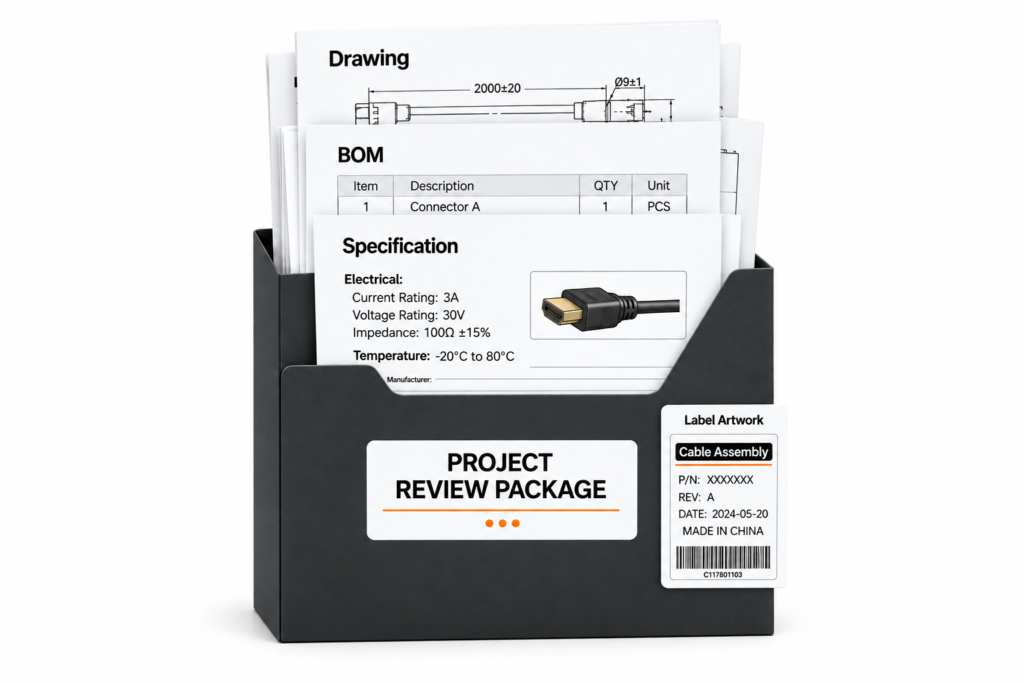
An accurate quotation begins with enough project information for the manufacturer, engineering team, and purchasing team to understand the same assembly. A controlled drawing, BOM, specification sheet, approved sample, or clear reference photographs can provide that foundation. If final documentation is unavailable, basic information such as connector details, cable length, AWG, application, target quantity, testing, and packaging can still support an initial review.

Is a Drawing or BOM Required?
A controlled drawing is usually the most efficient reference because it converts a general purchasing request into measurable product requirements. It can define finished cable length, conductor specification, End A and End B termination, connector orientation, strip length, polarity, label position, strain-relief structure, and critical dimensions. When a product must fit into an enclosure, rack, installation channel, or existing audio system, dimensions and tolerances should be documented rather than discussed only through email descriptions.
A BOM becomes especially useful when specified connectors, terminals, sleeves, wire materials, molded components, packaging items, or customer-approved component brands are involved. It gives the supplier a consistent purchasing basis and makes quotation comparisons more meaningful because each manufacturer is pricing the same component set instead of independently interpreting the word “equivalent.” For established projects, the drawing and BOM should also carry a revision number so the commercial quotation remains connected to the exact specification that was reviewed.
This discipline matters because even a small revision can influence more than one cost area. Changing a connector may affect the component price, assembly process, cable-entry range, tooling, and sample approval. Changing the AWG may alter copper consumption, cable OD, connector compatibility, coiling diameter, and packaging. Revision control helps purchasing, engineering, production, and quality teams identify whether a quotation still applies after technical changes have been made.
Can a Sample or Photo Be Used?
A physical sample can be an excellent starting point when a company is replacing an existing supplier, recreating an older speaker cable, developing another length from an approved product, or improving a current assembly. The sample allows the manufacturer to inspect the actual connector arrangement, jacket feel, polarity marking, termination style, molded details, cable handling, and packaging configuration rather than relying entirely on written descriptions.
Clear photographs are also valuable during early communication. Useful images include one full assembly view, close-ups of both terminations, mating surfaces, jacket markings, polarity identification, labels, molded areas, and packaging. Confirmed dimensions should be supplied separately instead of expecting a supplier to estimate size from a photograph. Images are particularly effective when engineering teams need to begin supplier discussions before the physical sample can be shipped.
A photograph cannot reveal every specification, however. It usually cannot confirm conductor cross-sectional area, actual strand construction, copper type, insulation material grade, hidden connector part numbers, internal termination methods, or electrical resistance. These unknowns should be identified during engineering review rather than silently assumed. Cablivo’s documented inquiry process specifically allows incomplete projects to begin with sample photos, connector photos, cable length, application details, and target quantity before remaining details are confirmed.
What Should the Drawing Show?
A useful drawing should allow production and inspection personnel to understand the finished assembly without relying on verbal memory. For speaker cable projects, the drawing normally needs to define cable construction, conductor count and gauge, finished length, termination style, polarity arrangement, connector orientation, labels, and any mechanical features such as boots, ferrules, heat-shrink sections, or overmolded strain relief.
Describing End A and End B separately reduces ambiguity. “Banana plug on both ends” may still leave questions about plug style, polarity colors, cable entry size, fastening method, and orientation. If the assembly uses a jacket stripe, conductor color, heat-shrink marker, or printed identification to distinguish positive and negative, that requirement should be visible in the controlled product information.
Packaging-related specifications also belong in the project package when they affect the delivered product. A cable sold as a matched pair, bundled by channel, coiled to a controlled diameter, labeled by length, or packed with a customer barcode should not have those conditions introduced after product pricing has already been accepted.
| RFQ Item | Example Information | What It Defines | Risk if Missing |
| Drawing | Controlled revision | Assembly dimensions and structure | Different interpretations |
| BOM | Approved material list | Connectors and components | Unapproved substitutions |
| Finished length | 3 m with defined tolerance | Material usage and installation fit | Incorrect price or fit |
| Conductor | 14 AWG, 2-core stranded | Electrical and cable structure | Wrong cable construction |
| End A / End B | Defined termination on each end | Assembly process | Incorrect connectors |
| Polarity | Red/black or defined +/− mapping | Electrical consistency | Connection errors |
| Labels | SKU, channel, length | Product identification | Warehouse confusion |
| Packaging | Bulk, pair, or retail format | Delivered configuration | Late commercial changes |
| Quantity | Quantity by SKU | Purchasing basis | Misleading unit pricing |
The more clearly these elements are defined before quotation, the easier it becomes to compare suppliers on an equal basis and move from quotation to sample approval without repeatedly reopening fundamental specifications.
Which Speaker Cable Specs Matter?
The specifications that most directly influence a speaker cable assembly are conductor gauge, conductor construction, cable length, insulation and jacket structure, flexibility, installation environment, and any required protective or shielding design. These choices affect electrical resistance, cable diameter, connector fit, copper consumption, handling, durability, and cost, so the quotation should be built around a defined cable rather than a generic request for “speaker wire.”

What AWG and Conductor Are Needed?
AWG should be confirmed early because conductor size affects far more than the amount of copper in the cable. Moving to a larger conductor generally reduces electrical resistance but increases cable diameter, weight, material consumption, and sometimes stiffness. It can also influence the cable-entry range of banana plugs, spade terminals, locking connectors, ferrules, and strain-relief components.
Common speaker cable projects may use 18, 16, 14, or 12 AWG conductors, although none of these sizes should be treated as a universal default. Selection depends on cable run length, loudspeaker load, amplifier requirements, allowable resistance, connector design, installation space, and flexibility expectations. When engineering has already approved an AWG, that specification should simply be included in the RFQ. When gauge remains open, the manufacturer needs enough application information to discuss it intelligently.
Conductor construction also matters. Speaker cables intended for flexible handling commonly use stranded conductors. If the design requires bare copper, tinned copper, a specified strand construction, or a controlled conductor standard, those details should be included in the drawing or BOM. Cablivo’s documented manufacturing system includes high-speed stranding used to prepare flexible multi-strand conductor structures for Audio / Video Cable projects.
How Long Should the Cable Be?
Cable length should be defined together with the method used to measure it. For a simple stripped-end assembly, the requirement can be straightforward. Once connectors are installed, however, purchasing and production teams need to know whether the stated dimension refers to cable-jacket length, reference point to reference point, or complete tip-to-tip assembly length.
This becomes important in equipment racks, conference systems, fixed speaker installations, custom enclosures, and professional audio systems where excess cable creates routing problems and insufficient length prevents installation altogether. A tolerance should also match the functional need. Very restrictive tolerances can increase manufacturing and inspection complexity, so they should be specified only when the product genuinely requires them.
Multiple lengths should normally be treated as separate SKUs during quotation. A 0.5-meter version and a 10-meter version may share the same conductor and connector, but conductor usage, coiling size, product weight, packaging, carton quantity, and logistics characteristics are not the same. A clear length-by-quantity matrix helps avoid averaging costs across products that are commercially different.
Do Power and Impedance Affect Cable Gauge?
Power, loudspeaker impedance, and cable run length become relevant when the conductor size has not already been approved. A speaker cable carries the amplifier’s output current, and conductor resistance forms part of that circuit. As the cable becomes longer or the load impedance decreases, cable resistance becomes a more meaningful part of the total system.
The table below shows approximate reference resistance values for common copper conductor sizes. These numbers are useful for understanding the relationship between AWG and resistance, but they should not automatically become acceptance criteria for a finished cable because actual resistance depends on conductor construction, temperature, material specification, and complete assembly design.
| AWG | Approx. Copper Area | Approx. DC Resistance at 20°C | Practical Selection Consideration |
| 18 AWG | 0.82 mm² | 20.9 Ω/km | Shorter, lighter-duty runs |
| 16 AWG | 1.31 mm² | 13.2 Ω/km | Common general speaker applications |
| 14 AWG | 2.08 mm² | 8.29 Ω/km | Longer runs or higher current demand |
| 12 AWG | 3.31 mm² | 5.21 Ω/km | Lower-resistance demanding runs |
A manufacturer should not select the “largest possible” conductor without considering connector entry size, installation space, flexibility, finished OD, and target cost. If engineering has not fixed the gauge, useful inputs include the run length, nominal speaker load, amplifier or system information, connector type, physical installation limits, and expected handling conditions.
Is Shielding or Special Jacketing Needed?
Many conventional speaker-level cables are unshielded because they carry amplifier output signals rather than low-level microphone or instrument signals. That does not mean shielding is never appropriate. Specialized equipment, unusual interference environments, hybrid constructions, or customer-defined designs may use braid, foil, or other protective structures.
Jacket selection should begin with the actual operating environment. A cable permanently installed behind an audio system has different requirements from a touring or rental cable that is repeatedly coiled, transported, stepped on, and connected. Indoor products may prioritize dimensional control and required material performance, while portable professional-audio applications may place greater emphasis on flexibility, abrasion resistance, and handling.
Material directions can include PVC, TPE, TPU, PUR, PE, or other project-specified compounds. The choice may influence flexibility, abrasion resistance, temperature behavior, weather resistance, appearance, and cost. Cablivo’s documented manufacturing capabilities include outer-jacket extrusion as well as braiding and foil-wrapping processes for Audio / Video Cable and signal-related projects when those constructions are required.
Which Connectors and Terminations Are Required?
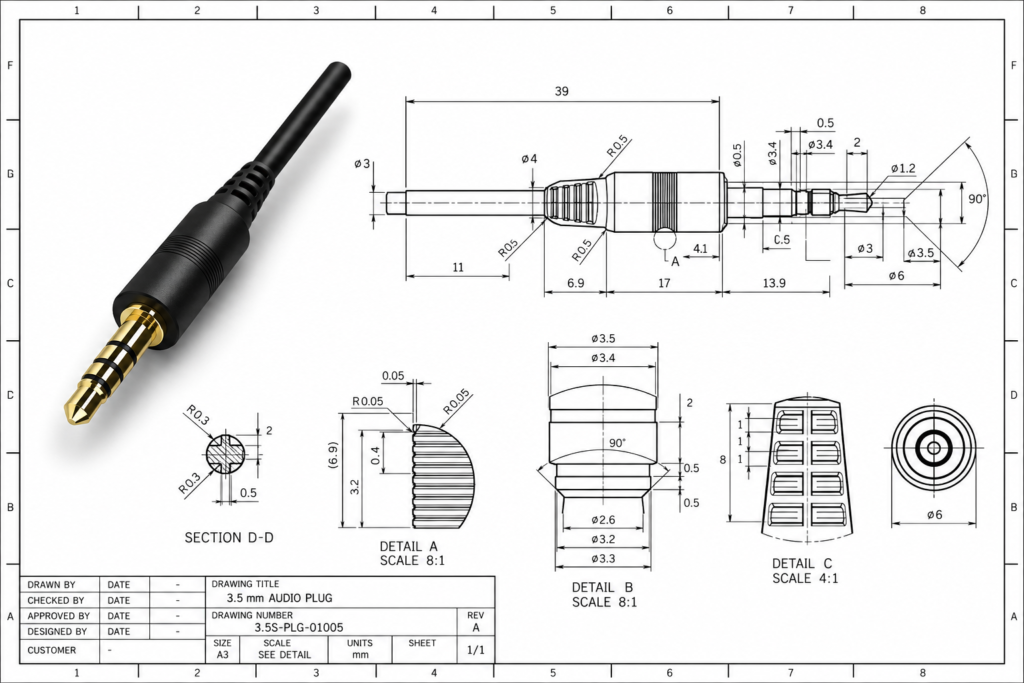
Both ends of the speaker cable should be defined precisely, including connector or terminal type, approved part number where available, pole count, polarity, orientation, cable-entry range, assembly method, and strain relief. Bare wire, ferrules, banana plugs, spade terminals, locking loudspeaker connectors, and custom molded terminations all create different BOMs and production steps even when the cable itself remains unchanged.
Which End Terminations Are Needed?
The clearest approach is to define End A and End B individually. A speaker cable may use stripped conductors on both ends, banana plugs at the amplifier and spade terminals at the speaker, locking connectors on both ends, or another equipment-specific combination. Each arrangement changes the component list and may require different crimping, soldering, assembly, inspection, and packaging operations.
Bare-wire specifications should state the strip length and whether the conductor is twisted, tinned, fitted with a ferrule, or left untreated. Banana plugs and spade terminals should be defined by size and style, with cable-entry requirements and polarity marking confirmed. If the customer has already approved a connector brand and part number, the quotation should use that exact component instead of relying on a visually similar replacement.
Professional speaker systems may also use multi-pole locking connector families. Pole count, contact assignment, and cable configuration should always be explicit. A description such as “locking speaker connector” is not sufficient for production because different models may have different electrical configurations, cable-entry ranges, assembly methods, and purchasing conditions.
Is Polarity or Channel Marking Required?
Polarity identification is functional, not decorative. Production personnel, inspectors, installers, service technicians, and end users should all be able to determine which conductor is positive and which is negative. Identification can be created with conductor color, jacket stripe, connector color, molded marking, heat-shrink, printing, or a separate label.
Multi-conductor and multi-channel assemblies require even tighter control. If a four-conductor cable carries two loudspeaker channels, every conductor and connector contact should be mapped in a wiring document. The final quality check should verify that mapping rather than testing only whether electrical continuity exists somewhere through the cable.
Long-term supply programs benefit from clear product identification as well. Length, channel, customer part number, SKU, revision, and barcode information can help distinguish visually similar assemblies during warehousing, installation, and repeat ordering. A technically correct cable shipped under the wrong SKU can still create a serious receiving or field problem.
Do Connectors Need Strain Relief?
Strain relief should be considered according to how the cable will actually be handled. A cable permanently installed inside an equipment cabinet sees different mechanical stress from a professional stage cable that may be connected, disconnected, coiled, pulled, transported, and reused frequently. The transition between flexible cable and rigid connector is often where movement becomes concentrated.
Possible solutions include the connector’s integrated cable clamp, a flexible boot, heat-shrink support, protective sleeve, or custom overmolding. When custom molding is required, the project may also need decisions about shape, dimensions, cable-exit direction, material, color, logo placement, and sample acceptance. Tooling and sample approval should therefore be discussed before the final unit price is assumed.
Cablivo’s documented manufacturing scope includes terminal processing, soldering, connector assembly support, molded cable, overmolding, connector protection, and strain-relief structures. These capabilities are most useful when the assembly structure is defined early enough for engineering and production teams to review the same design.
| Termination Type | Typical Application | Important RFQ Details | Main Risk to Control |
| Bare wire | Home audio or internal connection | Strip length and conductor treatment | Fraying or polarity confusion |
| Ferrule | Terminal-block insertion | Ferrule and wire size | Poor terminal fit |
| Banana plug | Audio equipment connection | Plug style and cable entry | Loose assembly |
| Spade terminal | Binding-post connection | Fork size and material | Mechanical mismatch |
| Locking speaker connector | Professional PA systems | Model, poles and pin mapping | Wrong connector or wiring |
| Custom molded end | Rugged or branded assemblies | Geometry, material and tooling | Tooling and approval changes |
Are Connector Part Numbers Confirmed?
An exact manufacturer and part number should be supplied whenever a connector has already been qualified. This is particularly important for locking speaker connectors, proprietary terminals, specialized plugs, and components that must mate with existing equipment. A part number gives purchasing teams a far more reliable basis than a product photograph or generic connector name.
If the component remains open, provide the mating interface, required pole count, cable OD, AWG, orientation, expected use, and any brand restrictions. The RFQ should also state whether equivalents are permitted. “No substitution,” “approved equivalent allowed,” and “supplier recommendation requested” represent three completely different purchasing instructions and should not be treated interchangeably.
Availability should also be checked before sample and mass-production schedules are confirmed. A technically suitable connector can still create a commercial problem when sourcing lead time, component MOQ, or supply availability does not match the program. Clear sourcing assumptions make the quotation more useful than a price based on components that may not actually be available when production begins.
What Testing Requirements Apply?
Testing should verify the requirements defined by the actual product and application rather than follow one identical checklist for every speaker cable. Typical checks can include continuity, polarity, resistance when specified, connector fit, dimensional inspection, pull-force evaluation, appearance, labels, and packaging. Additional bending, insertion-life, environmental, or material testing should be defined only when the project requires those checks.

Which Electrical Tests Are Required?
Continuity is one of the most fundamental checks for a terminated speaker cable assembly. Each required electrical path should be complete, with no unintended open circuit or incorrect cross-connection. Where polarity or multi-pole mapping is specified, the test should confirm that the correct conductor reaches the correct termination rather than simply establishing that current can pass through the cable.
Resistance may also be important when engineering has established a maximum conductor or complete-assembly resistance. That limit should come from the product drawing, technical specification, or approved validation criteria rather than a generic factory assumption. For more controlled projects, the specification should state whether the measurement applies to one conductor, the complete loop, or the finished assembly and should define the method when measurement conditions materially affect the result.
Cablivo’s documented quality resources include cable comprehensive testing equipment for electrical and functional checks and LCR digital-bridge equipment for projects requiring more detailed electrical parameter measurement. The practical value is not simply owning test equipment; it is having agreed pass/fail criteria before samples and production are inspected.
Are Pull or Bend Tests Needed?
Mechanical testing becomes more relevant when speaker cables will be moved, coiled, transported, connected repeatedly, or subjected to pulling near the termination. Pull-force testing can help evaluate whether terminals, crimps, connector clamps, soldered joints, or molded sections remain mechanically secure under a defined load.
There is no useful universal pull-force value for every speaker cable because the correct requirement depends on conductor gauge, terminal design, connector construction, cable clamp, overmolding, and the product specification. If a pull-force requirement matters, the RFQ should state the load, test location, test method, and failure condition instead of simply asking for a “strong connection.”
Bending or flex testing can be relevant to touring cables, rental systems, portable loudspeakers, and other products that experience repeated movement. Parameters such as bend radius, movement angle, applied load, cycle count, and failure definition should be agreed before testing. Cablivo’s documented reliability equipment includes cable swing testing and tensile testing resources for applicable projects.
Are Appearance and Label Checks Required?
Electrical function alone may not define an acceptable finished product. Appearance inspection can cover jacket damage, exposed conductor, incorrect connector colors, surface contamination, molding defects, printing position, cable cleanliness, scratches, and other workmanship conditions that affect the delivered assembly.
Labels should be checked against controlled artwork or data files. Depending on the program, labels can identify customer SKU, cable length, polarity, channel, barcode, revision, or destination. For multi-SKU projects, those markings help prevent a correct cable from being packed or shipped under the wrong product code.
Packaging inspection should verify that the approved cable, label, accessories, and packaging materials are combined correctly. This becomes increasingly important as the product matrix grows. Five cable lengths combined with two connector configurations can create ten products that look similar after coiling, making disciplined SKU and packaging control a real quality issue rather than a purely cosmetic concern.
Which Standards or Markets Apply?
Compliance requirements should be discussed according to actual product type, installation method, application, customer specification, and destination market. A consumer audio accessory, fixed professional installation cable, industrial equipment cable, and outdoor speaker connection may all have different material, marking, documentation, or testing considerations.
The RFQ should identify mandatory customer standards, target markets, required reports, specified material requirements, and any third-party testing that is already known. Certification should never be assumed simply because a cable belongs to a particular product category. The company’s documented content and engineering rules specifically require certification and testing requirements to be confirmed according to product type, target market, and project specifications rather than claiming that every cable automatically carries the same approvals.
| Inspection Item | Typical Acceptance Basis | Useful Project Input | Risk Controlled |
| Continuity | Complete required electrical path | Wiring diagram | Open circuit |
| Polarity | Matches approved mapping | +/− definition | Reversed connection |
| Resistance | Customer-defined limit | Test specification | Excessive resistance |
| Connector fit | Proper mating | Equipment or mating reference | Installation failure |
| Pull force | Defined project criterion | Load and test position | Loose termination |
| Flex test | Defined cycles and bend condition | Application requirement | Premature fatigue |
| Dimensions | Drawing tolerance | Controlled drawing | Installation mismatch |
| Appearance | Approved criteria | Sample or inspection standard | Cosmetic rejection |
| Labels | Correct artwork and SKU | Label files | Product mix-up |
| Packaging | Approved pack-out | Packaging specification | Shipment errors |
The most efficient time to discuss these checks is before the first sample is built. Adding new test requirements after sample approval can affect materials, tooling, inspection fixtures, testing time, sample quantity, production schedule, and sometimes the design itself.
How Do Commercial Details Affect the Quote?
Quantity, SKU count, component sourcing, tooling, testing, packaging, delivery destination, and schedule can influence the commercial quotation as much as the physical cable specification. A unit price is only meaningful when those assumptions are visible. Comparing two quotations without confirming that both suppliers priced the same quantity, connectors, testing scope, packaging, and tooling responsibility can create a false sense of savings.
What Quantity Is Planned?
Target quantity should be supplied even when the project is still in development. Prototype quantity, first production quantity, forecast volume, and long-term repeat demand are different commercial concepts and should be separated rather than combined into one optimistic number. The manufacturer needs a realistic current quantity to prepare a meaningful quotation, while future volume can help identify whether another material or sourcing strategy should be considered.
Quantity influences material purchasing, connector sourcing, production setup, packaging purchasing, inspection planning, and the way one-time tooling or engineering expenses are distributed. A unit price prepared for 5,000 identical cables cannot automatically be applied to 500 pieces or to 5,000 pieces divided across ten different configurations.
Cablivo’s documented project information uses an MOQ starting from 500 pieces for many custom cable projects, while the final MOQ depends on connector type, cable structure, material, overmolding, tooling, packaging, and order quantity. Multi-SKU projects should therefore identify the quantity of each SKU instead of presenting only one combined total.
Is Custom Packaging Required?
Packaging belongs in the RFQ whenever the cable must arrive in a specific commercial format. A simple protective bag, cable tie, barcode label, branded box, instruction card, retail insert, carton mark, and multi-SKU pack-out all require different materials and labor. Leaving packaging out of the initial quotation and adding it after product approval can make an apparently stable unit price change unexpectedly.
Retail programs should provide artwork files, barcode information, SKU labels, box dimensions when already known, pack quantities, and packaging references. If artwork is not ready, the quotation can clearly identify a provisional packaging assumption instead of pretending that the final packaging has already been defined.
Cable specification also influences packaging. A long 12 AWG cable occupies substantially more space after coiling than a shorter 18 AWG cable. Packaging size, carton quantity, shipping weight, and warehouse handling can therefore change even when the connector remains the same. This is particularly relevant for distributors, brands, and multi-length speaker cable programs.
Do Tooling or Sourcing Affect Cost?
Tooling becomes relevant when a speaker cable requires custom molded strain relief, customer-specific connector housings, special boots, logos, custom shapes, or fixtures that cannot be produced using existing standard tooling. Those costs should be separated from recurring unit price where appropriate so the purchasing team can distinguish one-time development investment from the cost of each production assembly.
Sourcing can have an equally important commercial effect. Exact branded connectors, proprietary terminals, specialty conductor materials, custom jacket colors, or packaging components may carry minimum purchase quantities or supplier lead times that differ from the finished cable order. A technically approved connector may therefore influence both price and production schedule.
Potential alternatives should be discussed rather than silently substituted. If an exact component has been approved, a lower-priced replacement should not be introduced simply to make the quotation look more competitive. Engineering and purchasing teams need to understand the technical and commercial effect before approving any substitution.
What Can Cause a Requote?
A requote is normally required when the product being purchased is no longer identical to the product originally priced. Changes in cable length, AWG, connector model, conductor material, molding, testing, quantity, packaging, or delivery conditions can influence one or several cost areas at the same time.
Moving from a 1-meter to a 5-meter cable directly increases conductor and jacket consumption. Changing from 16 AWG to 12 AWG affects copper usage, diameter, connector entry, weight, and potentially packaging. Adding a custom molded connector introduces tooling and another manufacturing operation. A new test requirement may require fixtures, additional samples, and inspection time. None of these changes is inherently problematic, but they should be visible.
The most practical method is to connect every quotation to a controlled product revision. When engineering updates the design, purchasing can compare the new revision against the version originally quoted and ask the manufacturer to confirm only the affected commercial items rather than restarting the entire project from memory.
| Commercial Variable | Example Change | Possible Quote Effect | Information to Confirm |
| Quantity | 500 to 5,000 pcs | Material and production economics | Quantity by SKU |
| Cable length | 1 m to 5 m | Higher cable material usage | Finished measurement |
| AWG | 16 to 12 AWG | Copper, OD and connector impact | Final conductor size |
| Connector | Standard to specified branded part | Component and sourcing cost | Exact part number |
| Overmolding | Added custom strain relief | Tooling and process cost | Drawing and material |
| Testing | Added mechanical testing | Fixtures and test time | Pass/fail criteria |
| Packaging | Bulk bag to retail box | Material and labor | Artwork and pack-out |
| SKU count | 1 to 10 SKUs | Setup and identification control | SKU matrix |
| Schedule | Standard to accelerated target | Material and planning review | Required shipment date |
| Destination | One to multiple markets | Packing and document coordination | Delivery destinations |
What Delivery Information Is Needed?
The manufacturer should know the target shipment date, destination, expected production quantity, packaging plan, and any important launch, installation, or warehouse deadline. These inputs help production teams evaluate the entire project sequence rather than offering a generic lead-time statement that ignores material preparation and engineering approval.
Production timing may depend on connector availability, conductor and jacket materials, tooling, sample development, customer approval, testing, packaging artwork, order quantity, and factory scheduling. For complex molded assemblies or multi-SKU projects, the schedule is therefore most reliable once the final specification, sample, and commercial requirements have been confirmed.
Export delivery also introduces packaging, carton marks, warehouse labels, shipment documentation, and destination-specific coordination. These details should be reviewed before finished goods are waiting in the warehouse. A realistic schedule connects engineering review, sourcing, sampling, production, testing, packaging, and shipment rather than treating production lead time as an isolated number.
A strong speaker cable RFQ is not simply a request for the lowest unit price. It is a shared technical and commercial definition of the product. Drawings, samples, BOM information, conductor specification, connectors, polarity, testing, quantities, labels, packaging, and delivery conditions all help remove assumptions before those assumptions become sample revisions or production problems.
For projects that do not yet have complete drawings, the first step can still be straightforward. Send the existing speaker cable sample or clear photos, connector close-ups, required cable length, known AWG or conductor information, application equipment, target quantity, and any available testing or packaging requirements. The remaining open items can then be identified during engineering review instead of being guessed during pricing. Cablivo’s documented inquiry process is built around collecting these project details before quotation and sampling.
Cablivo supports Audio / Video Cable projects used with speakers and related audio equipment, with project customization covering connector type, cable length, shielding, jacket material, cable color, signal requirements, packaging, and testing. Its broader custom-cable workflow connects requirement review, drawing or sample review, material and connector confirmation, sample development, testing, production preparation, labeling, packaging, and shipment coordination.
If you are developing a new speaker product, replacing an existing cable supplier, preparing a private-label audio accessory, or moving an approved prototype toward production, send the information you already have rather than waiting until every detail is perfect. A well-structured engineering review can identify what is confirmed, what is still open, and what must be resolved before the quotation becomes a production-ready commercial reference.
The result is more useful than a fast number based on assumptions. It gives engineering, purchasing, quality, and manufacturing teams the same definition of the speaker cable assembly, makes supplier quotations easier to compare, helps samples move through approval more efficiently, and creates a clearer foundation for consistent production, packaging, and repeat orders.