Skip to content


A custom wire harness for an electrical cabinet can look deceptively simple on a schematic. Several wires leave one device, pass through the cabinet, and terminate at another device, so it may seem that a supplier only needs the wire count, length, and connector type. In reality, quotation accuracy depends on how clearly the electrical function, conductor specification, terminals, pinout, physical routing, branch geometry, labeling, testing, quantities, and production expectations are defined. A missing connector part number can change sourcing cost. An undefined breakout location can make a finished harness impossible to install. An unclear test requirement can change both production time and quotation scope.
Quick Answer: For an accurate electrical cabinet wire harness quote, provide the latest drawing or schematic, BOM or wire list, connector and terminal part numbers, wire gauge, conductor specifications, pinout, main and branch lengths, cabinet routing, labels, test requirements, target quantity, packaging details, and applicable compliance requirements. When complete drawings are unavailable, clear sample photos, connector photos, dimensions, and an existing harness sample can support the first engineering review.
The difference between a rough price and a reliable production quotation often appears before manufacturing begins. Imagine two suppliers receiving the same control-cabinet schematic. One immediately calculates wire and connector cost. The other asks where each branch exits, which terminal series is approved, whether individual wire numbers are required, how much space exists in the wire duct, which connector view defines the pinout, and what continuity test must be performed before shipment. The second supplier may ask more questions, but those questions are usually the beginning of a more accurate sample and a more stable production program.
What Drawings and RFQ Files Are Needed?
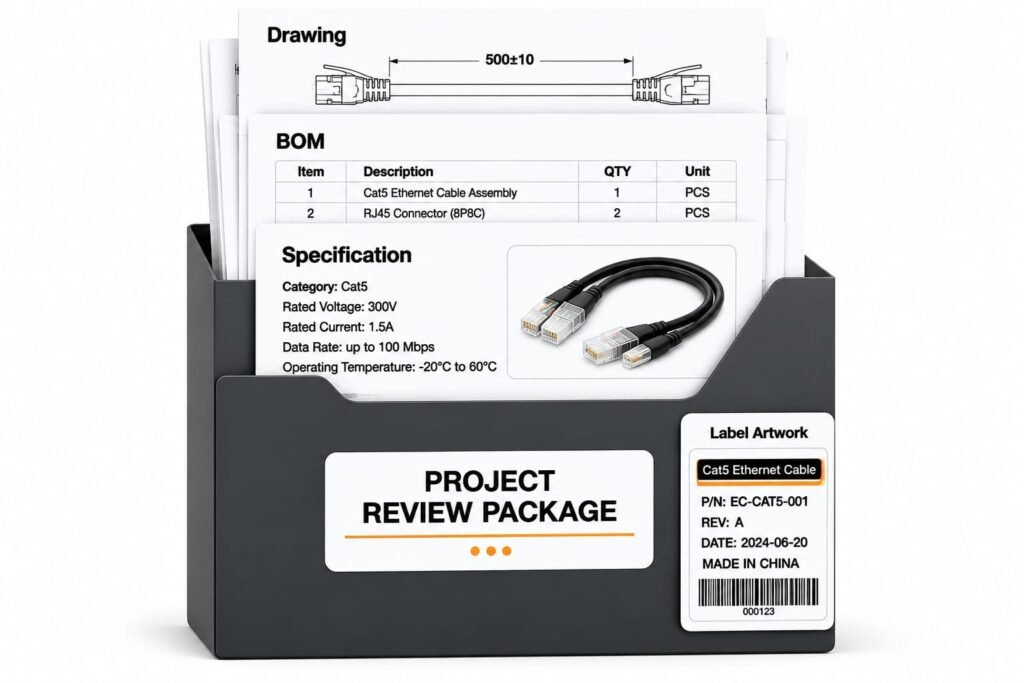
An accurate electrical cabinet wire harness RFQ normally starts with controlled engineering information. Provide the latest harness drawing, electrical schematic, BOM or wire list, connector and terminal references, pinout, cabinet layout, revision status, target quantity, and test requirements whenever those documents exist. If the project is still developing, sample photos, connector close-ups, measured dimensions, and an existing harness can establish a useful starting point.
A supplier can only quote the product that has actually been defined. Many RFQ packages appear complete because they contain several PDFs, spreadsheets, and photographs, yet the relationship between those files remains unclear. A schematic may show the correct circuit but not the physical branch location. A BOM may identify a connector housing while omitting the matching contacts. A wire list may specify length without defining whether measurement stops at the connector body, wire exit, or terminal tip. Each gap creates an assumption, and enough assumptions can turn a seemingly precise quotation into a provisional estimate.
The goal is not to create unnecessary paperwork. The goal is to establish one consistent product definition that engineering, procurement, manufacturing, testing, and cabinet assembly teams can all understand. When the drawing, BOM, pinout, and cabinet layout describe the same revision, the supplier can evaluate materials and manufacturing steps with much less uncertainty. When those documents conflict, the quotation should pause long enough to resolve the differences rather than silently choosing one version and hoping it is correct.
| RFQ Information | Example Entry | What It Controls | Main Risk If Missing |
| Harness drawing | WH-EC-104 Rev. C | Lengths, branches, terminals, sleeves | Wrong physical construction |
| Electrical schematic | SCH-22 Rev. F | Circuit relationships | Incorrect connection logic |
| BOM | BOM-104-C | Connectors, terminals, wires, labels | Material or sourcing mismatch |
| Wire list | 42 individual conductors | Wire ID, size, color, from-to points | Missing or duplicated circuits |
| Pinout | X2-01 → TB3-12 | Connector cavity assignment | Wrong wiring |
| Cabinet layout | CAB-18 Rev. B | Device positions and routing | Harness may not fit |
| Quantity | 20 samples / 800 production | Purchasing and process setup | Incorrect cost basis |
| Test requirement | Continuity to approved netlist | Inspection scope | Testing cost unclear |
| Revision status | Released for RFQ | Document control | Supplier quotes obsolete data |
Which Harness Drawing Should You Provide?
A useful harness drawing defines both electrical identity and physical construction. For a multi-branch cabinet harness, overall length is only one dimension among many. The drawing should identify main-trunk length, breakout locations, branch lengths, connector orientation, termination method, protective sleeve areas, heat-shrink locations, wire numbers, and any dimensions that affect installation. Where tolerances matter, the drawing should also distinguish critical dimensions from lengths that can tolerate more variation without creating an installation problem.
Measurement references need to be equally clear. A 500 mm branch measured from the center of a breakout to the back of a connector housing is not the same as 500 mm measured to the contact tip. If the drawing does not establish a datum, suppliers can interpret the same dimension differently. Compact control cabinets make these differences more important because a harness may need to pass through a defined wire duct, turn around a DIN-rail assembly, and reach a terminal without leaving excessive slack.
Is a BOM, Wire List, and Pinout Required?
A simple harness may be fully defined on one controlled drawing, but a larger electrical cabinet assembly usually benefits from separate BOM, wire-list, and pinout information. The BOM identifies the intended materials, including connector housings, contacts, ferrules, terminals, wires, protective sleeves, heat shrink, labels, cable ties, and packaging components when those items are controlled by the project. It also helps reveal sourcing issues before the sample is already under construction.
The wire list answers a different question by defining the individual conductors. It can identify wire number, color, gauge, origin, destination, and sometimes length. The pinout then removes ambiguity inside connectors by defining exactly which conductor enters which cavity. Connector drawings should indicate whether cavity numbers are shown from the mating face or wire-entry side. This small detail is important because an otherwise correct pinout can be mirrored when two people read the same connector from opposite directions.
How Should Revisions Be Controlled?
Quotation accuracy depends on revision control almost as much as technical detail. If purchasing sends Revision B to a supplier while engineering has already changed the branch layout or pinout in Revision D, both files may look professional while describing different products. Every important RFQ document should therefore carry a drawing number, revision, date, or release status that allows all teams to confirm they are discussing the same version.
Clarifications should also become part of the controlled product definition. If an engineer confirms by email that Branch C needs another 40 mm, the final drawing should eventually be revised rather than leaving that change trapped in correspondence. By the time the sample is approved, the drawing, BOM, pinout, wire list, and test requirements should reflect the agreed configuration. That approved documentation becomes the reference for production preparation, inspection, labeling, repeat orders, and later revisions.
What If No Complete Drawing Is Available?
Real projects do not always begin with production-ready CAD files. An older machine may have a replacement harness but no accessible drawing. A system integrator may have an electrical schematic without a mechanical harness drawing. A prototype cabinet may still be changing while procurement needs an early cost estimate. In these cases, useful engineering review can begin with verified information rather than waiting for every document to become perfect.
Provide clear overall photos, connector close-ups, terminal markings, wire printing, measured lengths, branch locations, cabinet photographs, device destinations, application conditions, and target quantity. A physical sample can be particularly useful when connector identity or branch geometry cannot be confirmed from photographs. The important distinction is between confirmed facts and open questions. A responsible quotation process identifies what still needs confirmation before sampling or mass production instead of treating incomplete information as though it were final.
Which Electrical and Wire Specs Must Be Defined?
Every conductor should be defined by function as well as physical size. An accurate RFQ normally identifies voltage or signal purpose, conductor size, wire construction, insulation requirements, color, connector and terminal type, grounding, shielding, and pinout. These details determine whether the proposed wire and termination system can suit the electrical function, cabinet environment, installation method, and manufacturing process expected by the project.
Electrical cabinets commonly contain several types of circuits in the same enclosure. A conductor feeding a power-distribution device may need a different wire size and terminal structure from a PLC control signal. An analog sensor line may require shielding or drain-wire handling that is irrelevant to a simple relay circuit. A protective-earth conductor may follow specific identification and termination requirements. Describing all of these only as “cabinet wires” removes the information a manufacturer needs to review materials and termination methods intelligently.
Wire gauge is therefore only one piece of the specification. Insulation diameter can affect whether a wire fits a contact or seal. Strand construction can influence flexibility. Material selection can affect temperature performance, abrasion resistance, oil resistance, and routing behavior. The connector family must match the mating device, while the chosen terminal must match both the housing and conductor. A quotation becomes more reliable when these relationships are defined before the supplier starts calculating material cost.
| Item | Typical RFQ Description | Selection Question | What Must Be Confirmed |
| Circuit function | 24 VDC control | Power, control, signal, ground? | Electrical purpose |
| Wire size | 18 AWG / about 0.82 mm² | Does it suit circuit requirements? | Approved gauge |
| Wire color | Blue | Does cabinet convention require it? | Color coding |
| Connector | Exact manufacturer PN | Is the housing already approved? | Housing and mating part |
| Terminal | Exact terminal PN | Is it compatible with wire size? | Contact and tooling |
| Pinout | X1-1 → TB4-06 | Is cavity numbering unambiguous? | Point-to-point mapping |
| Shielding | Foil or braid if required | Is interference control needed? | Shield structure |
| Ground/drain | Defined by schematic | Where should it terminate? | Grounding arrangement |
| Insulation | Project-specified material | Heat, oil, abrasion, flexibility? | Material requirement |
What Voltage and Current Does the Harness Carry?
The manufacturer needs enough electrical information to understand the role of each conductor. A 24 VDC PLC output, a higher-current power branch, and a sensitive analog signal can all appear in the same cabinet while requiring different wire, terminal, shielding, or routing decisions. The supplier does not need to redesign the electrical cabinet, but it does need to know the operating conditions that directly influence the harness.
When current differs significantly among branches, list the requirement by circuit group rather than providing a single current value for the complete assembly. If a circuit experiences inrush current, carries encoder signals, uses communication data, or performs protective grounding, identify the function. Voltage and project requirements can also affect insulation and testing discussions. Giving the manufacturer this context reduces the risk of selecting a technically convenient wire that does not match the actual electrical duty.
Which Wire Gauge and Material Are Required?
Wire gauge should be stated clearly instead of estimated from photographs or an old sample. AWG and metric cross-sectional area are both widely used, and approximate reference values can help communication: 24 AWG is about 0.205 mm², 22 AWG about 0.326 mm², 20 AWG about 0.518 mm², 18 AWG about 0.823 mm², 16 AWG about 1.31 mm², 14 AWG about 2.08 mm², and 12 AWG about 3.31 mm². These values are useful references, not substitutes for engineering selection.
The insulation or jacket system should also reflect the real operating environment. A harness located inside a clean, stationary cabinet may have different needs from wiring exposed to oil mist, high temperature, abrasion, repeated motion, or frequent maintenance. If engineering has already approved a specific wire manufacturer or standard, include it. If alternatives may be considered, state who can approve them. The supplier should not silently substitute material simply because another option looks similar or is easier to purchase.
Which Connectors and Terminals Are Used?
Connector accuracy is one of the most important parts of an electrical cabinet harness RFQ because similar-looking products can use different keying, contacts, plating, seals, or mating interfaces. When the design is already frozen, provide the exact connector manufacturer and part number. If the mating connector or equipment-side interface is known, include that information as well so fit and orientation can be checked before sampling.
The matching terminal deserves the same attention. A housing part number does not automatically identify the correct contact. Wire range, insulation diameter, plating, seal requirements, and application tooling may all matter. Terminal-block connections also need a defined termination method, such as ferrules, ring terminals, spade terminals, pins, stripped wire, or another specified end treatment. These choices affect material cost, crimping, tooling, inspection, installation efficiency, and ultimately quotation accuracy.
How Should Pinout and Wire Sequence Be Defined?
A useful pinout is a point-to-point instruction rather than a connector name. Each conductor should have a defined origin, destination, cavity position, wire identity, and relevant electrical function. A clear record might state that Connector X2 cavity 03 connects through a specific wire number to Relay K4 terminal A1. That format is more reliable than an instruction such as “blue wire to relay,” which becomes difficult to manage when several wires share the same color.
Connector views should clearly identify whether the numbering is shown from the mating side or wire-entry side. Wire numbers should also match the schematic and physical labels used inside the cabinet. Once the final point-to-point information is approved, it can become the basis for continuity testing. That creates a direct link between engineering definition and production verification rather than relying on visual inspection alone.

How Should Cabinet Routing and Harness Layout Be Specified?
An electrical cabinet harness should be quoted as an installed assembly rather than a loose collection of connected wires. The RFQ should define main-trunk length, breakout positions, branch lengths, equipment destinations, wire-duct routing, fixing points, bends, moving-door sections, connector orientation, protective sleeving, and identification requirements. A harness can pass every electrical test and still fail if its branches cannot physically reach their intended cabinet locations.
The physical environment inside the cabinet determines whether a harness can be installed efficiently. PLC modules, terminal blocks, relays, power supplies, contactors, circuit breakers, and other components may sit on different DIN rails and different sides of wire ducts. Some conductors travel vertically before turning horizontally. Others cross between cabinet sections. Door-mounted equipment adds movement requirements that do not exist for fixed components. These relationships need to appear somewhere in the engineering information supplied to the manufacturer.
For multi-branch assemblies, physical construction is therefore part of the functional specification. Main-trunk length, branch count, breakout position, branch length, connector allocation, label number, installation route, protective sleeve, and packing method all affect what must actually be manufactured. The cabinet layout turns an electrical connection map into a three-dimensional installation problem, which is why quoting only from a schematic can create dimensional risk.
| Layout Item | Example | Why It Matters | Common Failure |
| Main trunk | 1,250 mm | Establishes overall routing | Bundle cannot reach final zone |
| Branch A | 320 mm to TB1 | Connects terminal block | Too short after duct routing |
| Branch B | 480 mm to relay bank | Controls breakout geometry | Wrong breakout location |
| Door branch | 760 mm to HMI | Allows door movement | Tension during opening |
| Breakout position | 420 mm from datum A | Defines branch exit | Branch exits behind hardware |
| Sleeve length | 250 mm | Protects contact area | Abrasion during installation |
| Connector direction | Cable exit downward | Controls fit and clearance | Connector interferes with module |
| Label location | Near termination | Supports identification | Label hidden inside duct |
The dimensions above are illustrative examples. Actual harness dimensions should come from the cabinet layout, installation method, and approved drawing.
What Main and Branch Lengths Are Required?
For a straight cable, overall length may be enough. For a multi-branch electrical cabinet harness, it usually is not. The manufacturer needs main-trunk length, breakout positions, branch lengths, and consistent measurement references. If a branch is measured from the center of a breakout to a connector body, that method should be used consistently across the drawing rather than mixing several different end points.
Installed routing also matters more than straight-line distance. A branch that appears to require only 500 mm may need to enter a vertical wire duct, turn into a horizontal duct, pass around another component, and then rise to its terminal. Service loop should be intentional rather than accidental. Too little allowance can place stress on terminals, while excessive length can fill the wire duct and complicate maintenance. Tolerances should follow the installation need instead of being unnecessarily tight everywhere.
Which Cabinet Components Does Each Branch Connect?
Every branch should connect to a stable device reference used in the electrical documentation. Typical destinations include PLC modules, terminal blocks, relays, contactors, circuit breakers, power supplies, I/O modules, HMI units, sensor interfaces, actuators, switches, and cabinet-door devices. Reference designators such as PLC1-X2, TB3, K4, QF2, or PS1 remain more reliable than informal descriptions such as “upper plug” or “left branch.”
A consistent device-reference system helps much more than quotation. Wire labels, drawings, pinout files, assembly instructions, test netlists, and troubleshooting documents can all reference the same equipment identifiers. That becomes particularly valuable in long-term programs where the same cabinet family may have several harness revisions or different regional configurations. Stable identification reduces confusion during installation, later maintenance, and repeat production.
How Should Installation Routing Be Shown?
A cabinet-layout drawing is one of the most useful supporting files for a complex harness because it shows where the electrical components exist in physical space. Annotated cabinet photographs can also be useful during prototype development. They can identify DIN rails, wire ducts, fixed brackets, sheet-metal edges, moving doors, cable entries, restricted openings, or areas where protective sleeving may be required.
Routing can also influence assembly sequence. A large connector may not pass through a narrow cabinet opening after it has been installed on the harness. In that case, engineering may need to decide whether the connector is terminated after routing or whether cabinet assembly order changes. Discovering this issue during RFQ review is far more manageable than discovering it after finished harnesses have arrived at the assembly line.
Are Wire Numbers and Labels Required?
Wire numbers help an electrical cabinet remain understandable long after initial installation. The technician troubleshooting the machine years later may not be the engineer who designed it, so clear conductor and branch identification can reduce the time required to trace a circuit back to the schematic. The RFQ should specify whether individual wires, connectors, branches, or complete assemblies require labels and what information those labels need to carry.
Label position, material, orientation, and readability should also be considered. A technically correct label hidden deep inside a closed duct has limited practical value. Customer part numbers, revision codes, barcodes, batch information, or destination identifiers may also be required for multi-SKU programs. When these details are defined before quotation, printing, application, inspection, and packaging effort can be included in the manufacturing plan rather than added after sample approval.

What Testing and Quality Requirements Are Needed?
Testing requirements should be defined before quotation because different inspection levels require different fixtures, equipment, cycle time, documentation, and labor. Continuity and point-to-point verification are common starting points for cabinet harnesses, while some projects may also require short-circuit detection, polarity checks, insulation or Hi-Pot testing, pull-force verification, dimensional inspection, connector-fit checks, label inspection, or application-specific reliability testing.
A phrase such as “100% tested” does not yet define a useful acceptance plan. One supplier may interpret it as a simple continuity check, while another builds a dedicated fixture that checks every intended connection and detects unintended shorts. Both may technically test every harness while quoting very different processes. Engineering should therefore define what is tested, how it is tested, what reference controls the test, and what constitutes an acceptable result.
Testing becomes more meaningful when it connects directly with controlled product information. The drawing establishes dimensions, the pinout establishes electrical relationships, the terminal specification establishes termination requirements, and the packaging specification defines final presentation. Manufacturing and inspection can then verify the product against information already approved by engineering instead of creating separate interpretations at each stage.
| Test or Inspection | What Must Be Defined | Acceptance Reference | Main Risk Controlled |
| Continuity | Circuits to verify | Approved netlist | Open circuit |
| Short-circuit check | Unintended connections | Approved netlist | Cross-wiring |
| Pinout verification | Connector cavities | Final pinout | Wrong cavity assignment |
| Polarity | Relevant DC circuits | Electrical schematic | Reverse connection |
| Hi-Pot / insulation | Voltage, duration, limit | Project specification | Insulation failure |
| Pull-force check | Terminal/wire combination | Terminal requirement | Weak crimp |
| Dimension check | Critical lengths | Harness drawing | Installation failure |
| Visual inspection | Sleeves, labels, terminals | Approved sample or drawing | Assembly defects |
| Connector fit | Specified mating part | Connector specification | Mating problem |
| Packaging inspection | Quantity and protection | Packing specification | Shipping or SKU error |
Which Electrical Tests Should Be Quoted?
Continuity testing is particularly useful for multi-conductor cabinet harnesses because the basic requirement is not simply that each wire conducts electricity, but that every intended point-to-point relationship is correct. A test program built from the approved netlist can verify connections such as Connector X2 cavity 03 to Terminal Block TB4 position 11 and can also identify unintended cross-connections between circuits.
Other electrical checks depend on the application. Polarity can matter for DC devices and polarized connectors. Insulation or dielectric testing may be required for certain power circuits, but test voltage, duration, leakage limits, and acceptance criteria should come from the actual project specification. If test records must be retained for traceability, that requirement should be stated during quotation because recorded data may require different equipment and production handling from a simple pass/fail check.
How Should Crimp Quality Be Verified?
A reliable crimp starts before the wire reaches the terminal press. Conductor size, strand construction, insulation diameter, terminal series, plating, and application tooling need to be compatible. Strip length is also important because too little exposed conductor can prevent proper conductor capture, while excessive stripping may leave bare strands outside the intended crimp area. Strands should not be damaged unnecessarily during preparation.
Pull-force verification can be included when required, but acceptance values should come from the terminal manufacturer, customer specification, or applicable project requirement rather than using one number for every terminal. For repeat production, process stability matters as much as one isolated test result. Controlled tooling, setup verification, in-process inspection, and defined sampling or testing frequency help preserve the same termination quality from approved samples into larger production releases.
Are Environmental Tests Required?
Environmental testing should follow real operating conditions rather than being added simply because a test sounds impressive. A harness located inside a clean, stationary indoor control cabinet may have different validation needs from wiring exposed to oil mist, high humidity, repeated movement, outdoor temperature variation, vibration, or corrosive conditions. The useful question is whether the test result will influence a real material, design, or purchasing decision.
Depending on the project, relevant evaluations may include temperature and humidity exposure, bending or flex testing, corrosion-related testing, material performance evaluation, pull testing, or other application-specific checks. When environmental requirements are still being developed, engineering can provide operating conditions first. The manufacturer can then help identify which material and verification questions need resolution before the final sample and production specification are frozen.
Which Compliance Requirements Apply?
Compliance requirements should be defined according to the finished equipment, destination market, project scope, and customer specification instead of assuming every electrical cabinet harness follows one universal standard. The RFQ should identify any required wire approvals, material requirements, connector restrictions, machine standards, cabinet requirements, or approved-component lists that directly affect the cable assembly.
The harness manufacturer should understand which requirements actually apply to its scope without claiming certifications that have not been established for the specific project. If compliance review is still in progress, that status should remain visible in the RFQ so open material or testing assumptions can be identified before the final quotation. Clear boundaries are more useful than adding a long list of standards that may not be relevant to the actual equipment.

What Quantity and Commercial Details Affect the Quote?
A reliable production quotation needs commercial context in addition to engineering specifications. Provide engineering-sample quantity, first production quantity, expected repeat demand, SKU count, connector sourcing restrictions, tooling needs, packaging requirements, delivery destination, and schedule expectations. These variables affect material purchasing, setup, testing preparation, labor planning, packaging, and production efficiency, so the same technical harness can have a different cost structure at different project stages.
Wire harness pricing cannot be reduced to copper length alone. A short harness with many branches, connectors, terminals, ferrules, labels, protective sleeves, and controlled test points may require more manufacturing work than a longer but simpler assembly. Quantity changes the way engineering, setup, material preparation, and testing costs are distributed. The most useful RFQ therefore explains both what the harness is and how the project expects to purchase it.
Commercial clarity also helps separate recurring unit cost from one-time project requirements. A custom fixture, terminal applicator, electrical test fixture, special packaging solution, or overmolding tool may need to be handled differently from the recurring material and assembly cost of each harness. Procurement teams can compare quotations more intelligently when they understand which costs belong to development, which belong to production, and which depend on order quantity.
| Commercial Variable | Example | Quote Impact | Purchasing Question |
| Engineering samples | 10 pcs | Higher setup cost per unit | What must the sample validate? |
| Pilot build | 100 pcs | Process verification | Is the design already frozen? |
| First production | 800 pcs | Material purchasing and planning | Is forecast reliable? |
| Annual forecast | 6,000 pcs | Long-term sourcing view | Are scheduled releases expected? |
| SKU count | 8 variants | Setup, labeling, material control | Can common materials be shared? |
| Custom tooling | Required / not required | One-time project cost | Who owns the tooling? |
| Connector sourcing | Specified original PN | Availability and MOQ | Are alternatives allowed? |
| Packaging | Individual bag + label | Added material and labor | Is factory-specific packing needed? |
| Destination | Overseas assembly plant | Packing and documents | Are special labels required? |
The quantities in this table are examples used to explain quotation logic. Actual order quantities, tooling, packaging, and production planning should be confirmed for each project.
How Many Harnesses Do You Need?
A single annual forecast rarely provides enough information for a useful quotation. A project may begin with a small engineering sample, move through a pilot cabinet build, and then enter larger production releases. These stages distribute engineering review, setup, purchasing, and test preparation differently. A forecast of 10,000 pieces is less useful if the first purchase order will be much smaller and materials must be bought specifically for that initial release.
SKU count matters as well. One harness ordered at 1,000 pieces is operationally different from ten related harnesses ordered at 100 pieces each. Multi-SKU programs require separate BOM control, assembly instructions, labels, test data, packaging, and inventory handling even when many materials are shared. For many custom cable projects, Cablivo’s working MOQ starts from 500 pieces, while the final requirement depends on product structure, connector, material, tooling, overmolding, packaging, and order conditions.
Do You Need Samples Before Production?
Samples are most valuable when they answer defined engineering questions. Before the sample is built, decide whether the team needs to validate connector fit, branch dimensions, wire sequence, cabinet routing, terminal engagement, sleeve length, label location, electrical function, or several of these factors at once. A sample that merely resembles the drawing but is never installed in the real cabinet provides much less useful information.
Feedback from the sample should become controlled project data. If Branch B needs another 40 mm, revise the drawing. If connector orientation changes, update the assembly information and pinout. If a protective sleeve interferes with routing, document the revised length. Once the sample, drawing, BOM, and test requirements agree, the project has a stronger basis for repeatable production because manufacturing no longer has to reconstruct the final specification from scattered comments.
What Packaging and Labeling Are Required?
Packaging affects quotation and the efficiency of the destination assembly line. Some cabinet manufacturers want one complete harness per bag, while others prefer several harnesses in bulk packaging but require branches to be tied and separated. Sensitive connectors may need protective caps, foam, trays, or another form of protection. Long multi-branch harnesses may also need controlled coiling so they arrive without tangling or excessive stress at breakout points.
Packaging labels can include harness part number, revision, quantity, customer code, barcode, batch, destination, or SKU information. Multi-SKU orders may require carton separation and clearly differentiated labels so similar harnesses are not mixed during cabinet assembly. Discussing these requirements before quotation prevents an approved sample from later accumulating packaging and labeling work that was never included in the original production cost.
How Do Sourcing and Tooling Affect the Quote?
A technically simple harness can become commercially difficult when one critical connector, terminal, or wire is difficult to source. The RFQ should identify whether original-brand components are mandatory, whether approved alternatives already exist, and whether a supplier is permitted to propose substitutions. Connector MOQ, distributor availability, and purchasing lead time can influence price and schedule even when the assembly process itself is uncomplicated.
Tooling may include terminal applicators, assembly fixtures, electrical test fixtures, custom molds, or specialized production aids depending on the product structure. One-time tooling should be separated from recurring unit cost when practical so procurement can understand the cost structure. Production lead time should also be confirmed after reviewing material availability, connector sourcing, tooling, testing, quantity, sample approval, and packaging rather than relying on one fixed promise for every project.
When documentation is still incomplete, a useful RFQ can begin with the drawing or schematic, BOM, connector information, sample photos, application details, target quantity, and any known testing or packaging requirements. Cablivo’s documented project approach includes requirement review, drawing review, BOM review, connector confirmation, wire-sequence and pinout review, prototype development, testing, packaging, and production preparation, allowing open technical points to be identified before sampling and mass production discussion.
A more accurate wire harness quotation usually begins with better information rather than more suppliers. Before sending an RFQ, check whether another engineer could open the project package and determine what every wire connects to, which materials and components are approved, how the harness physically fits the cabinet, how finished assemblies will be tested, and what quantities will actually be purchased. If several of those answers remain unclear, the manufacturer will either need to ask more questions or make assumptions that may later affect the sample, price, or delivery plan.
Cablivo supports custom cable, wire harness, and cable assembly projects through requirement review, drawing and BOM review, connector confirmation, sample development, production preparation, electrical and functional testing, labeling, packaging, and shipment coordination. The objective is not to attach a quick price to an incomplete sketch, but to understand enough of the project to reduce avoidable differences between the RFQ, engineering sample, approved specification, and production release.
For a new electrical cabinet wire harness project, send the latest drawing or schematic, BOM or wire list, connector and terminal part numbers, pinout, wire gauge, branch dimensions, cabinet layout, target quantity, test requirements, and packaging plan when they are available. When the documentation is still incomplete, clear sample photographs, connector close-ups, application information, and measured dimensions can provide a practical starting point for identifying the technical details that still need confirmation before quotation or sampling.
A useful quotation should do more than place a price beside a drawing. It should show that the supplier understands the harness that engineering expects to install, the materials procurement expects to purchase, the test conditions quality teams expect to verify, and the repeatability production teams expect after sample approval. When those expectations are aligned early, the conversation moves from asking only how much the harness costs to determining whether the exact assembly can be sampled, verified, manufactured, packaged, and supplied consistently for the electrical cabinet program.