Skip to content


“SC/APC to SC/APC, five meters, please quote” sounds specific, but it can still leave several important decisions unresolved. Two assemblies can use the same connector family and overall length while differing in fiber specification, simplex or duplex construction, cable diameter, jacket, bend performance, optical acceptance criteria, test documentation, labeling, and packaging. Those differences influence material selection, connector sourcing, inspection steps, production planning, and the final commercial quotation, especially when the cable is intended for an engineering project rather than ordinary stock replacement.
To quote an SC APC to SC APC fiber cable assembly accurately, the supplier normally needs the connector configuration, simplex or duplex structure, fiber specification, cable diameter and jacket, finished length, installation conditions, optical performance criteria, inspection and testing requirements, order quantity, labeling, packaging, reference drawings or samples, and any project-specific standards. Clear specifications reduce assumptions, quotation revisions, and sample-to-production differences.
The important question is not simply whether a supplier can give a price. It is whether that price represents the same cable your engineering team expects to approve, your quality team expects to inspect, and your purchasing team expects to reorder six months later. Cablivo’s documented fiber-optic project scope treats fiber type, connector type, length, jacket, cable protection, bend requirements, application environment, transmission requirements, packaging, labeling, and testing as project-specific information that should be confirmed rather than assumed. A useful RFQ therefore turns a short product name into a repeatable manufacturing specification.
What Connector Details Should Be Confirmed?
An accurate quotation should identify both connector ends as SC/APC, define simplex or duplex construction, and state any connector manufacturer, component, housing, boot, orientation, or approved-equivalent requirements. Connector names describe the interface, but they do not always define every mechanical detail of the finished assembly. Clear connector information reduces compatibility errors and makes supplier quotations easier to compare on the same technical basis.
Are Both Ends SC/APC?
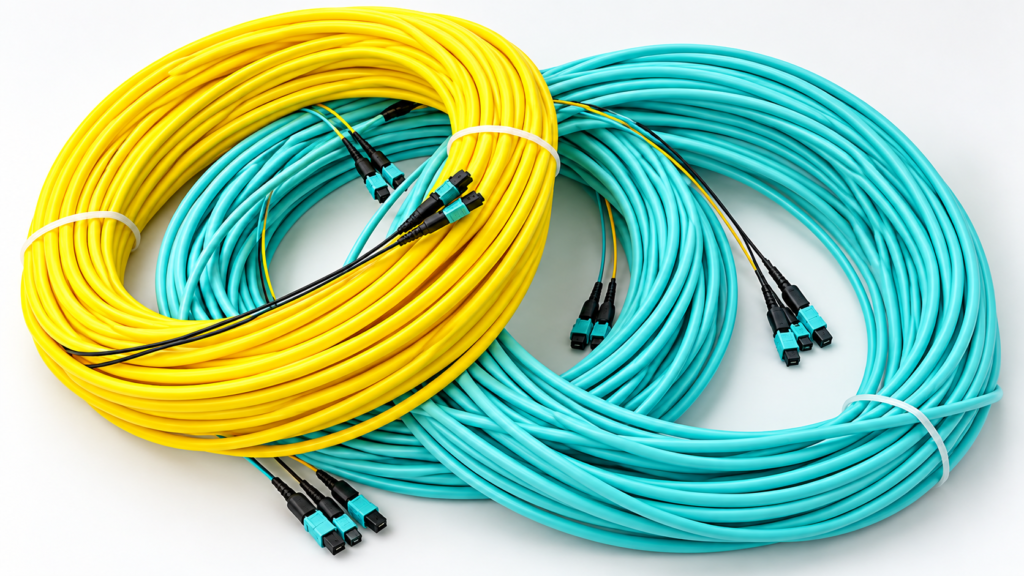
The clearest specification is to write End A: SC/APC; End B: SC/APC rather than simply stating “SC fiber cable.” SC describes the connector family, while APC identifies the polished optical interface. The distinction matters because other SC constructions, including UPC versions, use a similar general body but should not be treated as the same optical interface. Green housings are commonly associated with APC connectors, yet color alone should never be the controlling identification method in a production drawing or purchase specification.
For equipment projects, each cable end should ideally have a consistent identifier that also appears on the drawing, sample record, inspection sheet, and packaging instruction. This becomes especially useful when several related SKUs use different connector combinations. If an assembly eventually changes from SC/APC-to-SC/APC to SC/APC-to-LC/APC, clear End A and End B definitions prevent the revision from being hidden inside a vague cable description and make future repeat orders easier to control.
Is Simplex or Duplex Required?
SC/APC-to-SC/APC does not identify how many optical paths the assembly contains. A simplex cable normally carries one fiber path, while a duplex assembly contains two fibers and may use paired connectors, clips, zipcord construction, or another customer-defined arrangement. This affects connector quantity, cable construction, assembly work, packaging, inspection, and material cost, so the configuration should be fixed before comparing quotations from different manufacturers.
Duplex projects can also introduce practical questions that do not exist on a basic simplex cord. The engineering drawing may need to identify A/B legs, connector orientation, separation length, polarity, or whether both fibers remain joined through most of the cable. When these details are important to the equipment installation, a simple drawing is far more reliable than an email sentence. The goal is not to add paperwork, but to make sure the quoted product is mechanically and optically the same product that will later be approved.
Are Specific Connector Components Required?
Some projects only require a compatible SC/APC interface and permit the manufacturer to select a suitable connector within agreed technical requirements. Other projects have an approved BOM and require a particular connector manufacturer, housing series, boot geometry, ceramic ferrule, strain-relief design, or customer part number. These two situations should not be quoted as though they are identical because component sourcing and approval requirements can be quite different.
If a connector has already passed equipment validation, include its manufacturer reference and part number whenever possible. When substitutions are permitted, define whether an alternative requires engineering approval, sample approval, or written change authorization before production. Cablivo’s verified engineering scope includes connector confirmation, drawing review, BOM review, sample review, and prototype development, which supports this type of controlled project evaluation rather than assuming compatibility from a general product name.
Is a Reference Sample Available?
A reference sample can answer questions that are difficult to communicate through text alone. It may reveal cable outside diameter, connector housing shape, boot length, jacket feel, bend behavior, duplex arrangement, label position, coil method, and packaging protection. This is particularly useful when an existing cable is being reproduced, localized to another supply source, or modified for a new version of the same equipment.
A sample should still be supported by written requirements because it cannot reliably communicate fiber standard, optical acceptance limits, test wavelength, documentation needs, compliance expectations, or which physical features are mandatory. A practical approach is to define the sample as a mechanical or appearance reference while allowing controlled performance requirements to come from the drawing and specification. That prevents an old sample from accidentally becoming the specification for features that were never intended to remain unchanged.
| Connector Item | Typical Options or Data | What Should Be Confirmed | Purchasing Value |
| End A interface | SC/APC | Connector and polish type | Prevents APC/UPC mismatch |
| End B interface | SC/APC | Connector and polish type | Confirms complete optical interface |
| Ferrule | SC commonly uses 2.5 mm ferrule architecture | Approved connector design | Supports compatibility review |
| Fiber count | 1, 2, or project-defined | Simplex or duplex | Affects structure and component count |
| Connector brand | Open or specified | Part number when controlled | Prevents unauthorized substitution |
| Boot style | Standard, short, or custom | Drawing or approved sample | Helps with equipment clearance |
| Connector identification | Green commonly used for APC | Written specification remains controlling | Reduces visual identification errors |
| Alternative components | Allowed / restricted | Approval method | Makes quotations easier to compare |
| Reference sample | Available / unavailable | Which features the sample controls | Reduces interpretation risk |
Which Fiber and Cable Specifications Are Required?
The RFQ should define the fiber category, specific fiber standard when required, fiber count, cable outside diameter, jacket requirement, color, and any additional protection. SC/APC identifies the connector interface, not the complete cable construction. Different fiber and jacket choices can change bending behavior, routing density, mechanical protection, compliance requirements, and material cost even when both finished assemblies look similar from the outside.
Which Fiber Type Is Needed?
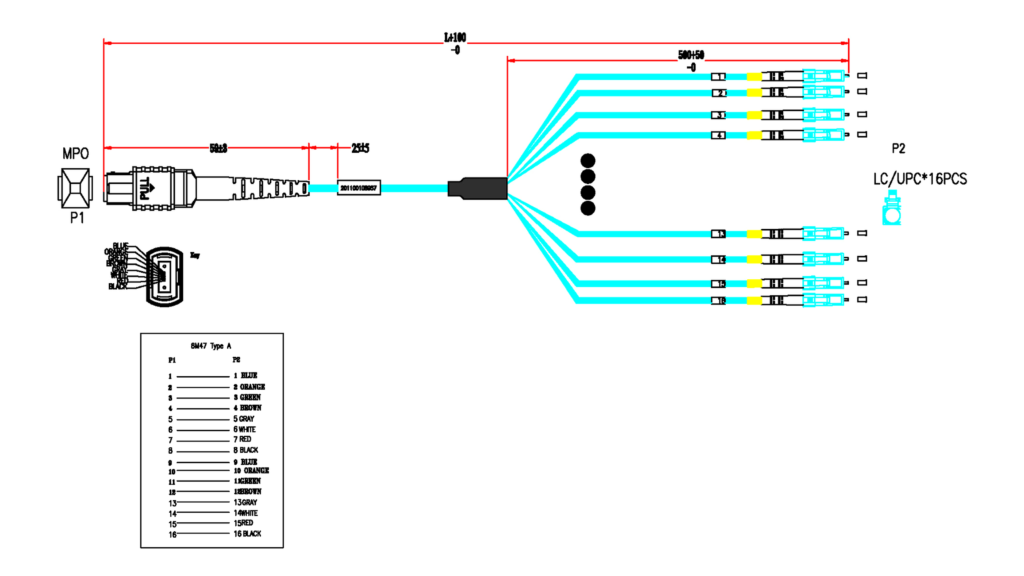
SC/APC assemblies used in telecom and data systems are commonly associated with single-mode fiber, but “single-mode” alone may still be too broad when an engineering specification controls the exact fiber. OS2 is a common single-mode cabling category, while project documentation may identify specific fiber recommendations such as G.652.D, G.657.A1, or G.657.A2. G.657-family fibers are often considered where improved bending performance is valuable, particularly in compact routing environments.
The correct choice should come from the installed system, equipment requirements, approved BOM, application geometry, and customer specification rather than from a general assumption that one fiber is universally better. A replacement cable may need to match an existing approved design, while a new product may have more freedom to evaluate bend-insensitive fiber. During quotation, it is useful to separate fixed requirements from options that the manufacturer can review so that the commercial comparison does not hide an unapproved fiber substitution.
What Cable Diameter Is Required?
Finished patch-cord diameters around 1.6 mm, 2.0 mm, and 3.0 mm are commonly encountered in the industry, although many other constructions exist. Diameter influences routing density, flexibility, connector boot compatibility, mechanical protection, cable-management space, and the amount of physical material in the assembly. A thinner cable may fit high-density equipment more easily, while a larger construction may be preferred when compact routing is less important.
The number itself should never be selected without considering where the cable will be installed. If the assembly passes through a cable channel, enclosure, gland, guide, grommet, or custom fixture, the permitted outside diameter should be included in the drawing. When an existing product is being reproduced, measure the reference construction and identify whether its diameter is mandatory or simply preferred. That distinction gives the manufacturer room to propose alternatives where appropriate without silently changing a dimension that affects equipment fit.
Which Jacket Type Is Needed?
Jacket selection should follow the actual installation environment and target-market requirements. Common fiber-cable descriptions may include LSZH, riser-rated, plenum-rated, or other project-defined jacket constructions, but these terms should not be used as generic quality labels. Each classification relates to particular environmental or installation expectations, and the required standard should be identified when compliance is part of the project.
Color can also have practical value. Yellow is commonly associated with single-mode patch cords, while green is commonly used on APC connector housings, yet custom identification schemes and private-label programs may use different colors. If color is needed for maintenance identification, equipment matching, or brand presentation, it should be controlled in the drawing or approved sample. If a specific material or flame classification is mandatory, supporting documentation should be confirmed instead of assuming that every jacket carrying a similar description has the same compliance status.
Is Special Cable Protection Needed?
A standard indoor patch cord can be completely appropriate in a protected rack or cabinet, but the same construction may not suit a cable exposed to abrasion, frequent service handling, constrained mechanical routing, or other physical stress. Some projects may therefore require protective sleeves, reinforced sections, armored structures, additional tubing, or improved connector protection depending on the actual installation risk.
The most useful RFQ describes the problem rather than asking generally for a “stronger” cable. If abrasion is the concern, show where the cable contacts the enclosure. If repeated handling is expected, describe how often technicians disconnect or reposition it. If routing is tight, show the available space and bend path. Additional protection can increase diameter, stiffness, weight, assembly complexity, and cost, so it should solve a clearly defined problem. Cablivo’s verified fiber project scope includes cable protection and bend requirements as project-specific confirmation items.
| Cable Parameter | Common Industry Direction | Suitable Situation | Key RFQ Question |
| Fiber category | OS2 single-mode | Telecom and data applications | What does the system specification require? |
| Fiber specification | G.652.D | Conventional single-mode applications | Is this already defined in the BOM? |
| Bend-insensitive fiber | G.657.A1 / A2 | Compact routing and tighter pathways | Is improved bend performance necessary? |
| Cable OD | Around 1.6 mm | High-density routing | Is available installation space limited? |
| Cable OD | Around 2.0 mm | General equipment patching | Does it match the approved construction? |
| Cable OD | Around 3.0 mm | Larger cord construction | Is routing density less critical? |
| Jacket | Project-defined LSZH | Where relevant material behavior is required | Which specification applies? |
| Jacket | Riser / plenum / project-specific | Building installation environments | What is the installation classification? |
| Protection | Sleeve, reinforced, armored, or custom | Abrasion or mechanical exposure | What physical risk must be controlled? |
| Color | Standard or custom | Identification and branding | Is color functional or cosmetic? |
How Should Length and Application Be Defined?
The RFQ should state finished cable length, measurement reference points, allowable tolerance, installation environment, routing space, movement conditions, and bend limitations. A nominal description such as “5 m” can still create disagreement if the customer and manufacturer measure from different points. Application information also gives essential context for selecting fiber, cable diameter, jacket, boot geometry, and mechanical construction.

What Is the Required Cable Length?
Cable length should be treated as an engineering dimension whenever the assembly must fit a controlled equipment layout. Instead of writing only “5 m,” the drawing should identify the measurement reference points when dimensional fit matters. Depending on the product, that may mean measuring between connector reference points, boot exits, or other defined locations. The important issue is that engineering, production, and quality teams use the same method.
Use one unit system consistently across drawings, purchase orders, inspection documents, and packaging specifications. Millimeters are often convenient for controlled dimensional drawings, while meters remain practical for standard patch-cord purchasing. If one project contains several length variants with identical connector and fiber construction, a controlled SKU matrix is usually easier to manage than multiple informal messages. For example, 1 m, 2 m, 3 m, 5 m, and 10 m versions can share one base specification while length remains the controlled variable.
Is a Length Tolerance Required?
Manufactured cable assemblies naturally have dimensional variation, so a project with tight installation constraints should define an acceptable tolerance or ask the manufacturer to propose one for approval. There is no universal tolerance that is appropriate for every length and construction. The suitable range depends on the finished length, measurement method, cable structure, production process, equipment layout, and the amount of spare cable the installation can accommodate.
A short internal equipment cable may require tighter control because excess length creates routing problems, while a longer patch connection may tolerate more variation without affecting installation. The critical point is consistency: the same measurement method used to approve the sample should also be used during production inspection. Once the final drawing or approved sample is released, it should remain the dimensional reference for repeat orders. Cablivo’s documented inquiry process specifically treats cable length as project information that should be submitted for review.
Where Will the Cable Be Installed?
Application context can explain more than a long collection of generic specifications. An SC/APC-to-SC/APC cable used between a patch panel and telecom device may prioritize predictable routing and organized cable management, while a data-center installation may place more emphasis on density, labeling, and maintenance access. Industrial communication equipment may introduce enclosure routing, abrasion points, or service-access considerations that are not obvious from the connector description.
Test equipment can create another pattern because the cable may be disconnected and reconnected more frequently. Rather than stating only “network use,” describe both connection points, whether the cable remains static, how technicians access it, and how much routing space is available. Cablivo’s documented fiber application scope includes telecom equipment, data centers, network systems, industrial communication systems, test equipment, optical modules, and enterprise network projects, which illustrates the range of environments that may require different project discussions.
Are Bend or Routing Limits Important?
Optical fiber should not be routed as though it were an ordinary electrical lead that can be folded tightly into any unused corner. Excessive bending can affect optical behavior and may place unnecessary mechanical stress on the finished assembly. Bend requirements depend on both the optical fiber and the complete cable construction, so a fiber with improved bending characteristics does not remove the need to respect the finished cable’s routing limits.
For compact equipment, photographs or drawings showing cable channels, clips, panel corners, equipment doors, connector exit directions, and available clearance can be extremely valuable. These details may influence the selected fiber, cable outside diameter, boot geometry, and strain-sensitive areas. A simple installation sketch frequently prevents more misunderstanding than a broad statement such as “flexible cable required,” because it shows exactly which geometric problem the finished assembly needs to solve.
| Application Factor | Basic Request | Better Project Definition | Practical Value |
| Finished length | “5 m” | “5,000 mm nominal from defined reference points” | Reduces measurement disagreement |
| Length tolerance | Not stated | Drawing tolerance or supplier proposal for approval | Supports repeatability |
| Installation | “Indoor” | “Inside telecom rack between panel and equipment” | Helps evaluate construction |
| Movement | Unknown | Static, occasional, or repeated handling | Supports mechanical review |
| Routing space | Not stated | Channel and bend area shown | Helps select cable diameter |
| Bend requirement | “Flexible” | Routing geometry or minimum available radius | Avoids vague interpretation |
| Connector exit | Undefined | Direction shown in equipment drawing | Helps prevent installation interference |
| SKU lengths | Separate messages | Controlled length matrix | Simplifies quotation and BOM management |
| Environment | “Network use” | Data center, telecom device, test equipment, etc. | Gives engineering context |
What Optical and Quality Requirements Should Be Stated?
The RFQ should identify measurable optical and quality criteria, including insertion loss, return loss where required, test wavelength, connector end-face inspection, dimensional checks, test-report scope, and applicable project standards. Terms such as “premium,” “high quality,” or “low loss” do not define a production acceptance rule. A numerical or documented requirement allows engineering, production, quality, and purchasing teams to evaluate the same finished assembly.

What Insertion Loss Is Required?
Insertion loss describes optical power lost through a connection or assembly and is normally expressed in decibels. In commercial SC/APC connector and patch-cord specifications, maximum values around 0.3 dB per connector are commonly encountered, while lower-loss grades may also be available. This number should be treated as an industry reference point rather than an automatic acceptance requirement for every custom project.
The actual limit should come from the customer’s system power budget, equipment design, approved connector specification, and test method. When performance is important, the RFQ should state the maximum allowable insertion loss together with the required test wavelength or test procedure. Two quotations based on different optical limits are not technically equivalent even if the product descriptions look identical. A tighter loss requirement may also require tighter component selection, assembly control, and inspection, so the target should reflect what the application truly needs instead of being specified only to sound more demanding.
What Return Loss Is Required?
Return loss measures reflected optical power and is particularly relevant to APC interfaces because the angled polish is used in applications where controlling back reflection matters. Commercial APC specifications often reference return-loss values of 60 dB or higher, but the actual project requirement should come from the approved optical system specification rather than being copied from a generic patch-cord data sheet.
When return loss is controlled, the RFQ should state the minimum acceptance value and any required test wavelength. Common single-mode test wavelengths include 1310 nm and 1550 nm, although the customer’s system and qualification plan should define which measurement is relevant. Phrases such as “excellent return loss” are not suitable acceptance criteria because they cannot be inspected consistently. A numerical requirement allows sample validation and production testing to follow the same pass/fail rule and makes performance comparisons between suppliers significantly more meaningful.
Is End-Face Inspection Required?
The connector end face may appear to be a very small detail, but contamination, scratches, pits, or damage around the optical interface can influence connection performance even when the cable looks perfect externally. Projects with formal optical-quality requirements may therefore include microscopic end-face inspection and may reference a standard such as IEC 61300-3-35 or a customer-specific inspection procedure.
The inspection scope also needs definition. Some projects may require detailed inspection only during sample qualification, while others may require lot-level or individual inspection according to their quality plan. The RFQ should specify whether inspection images or records are needed and how traceability should be handled. Connector protection after inspection matters as well: protective dust caps, controlled handling, and suitable packaging help preserve the condition that was verified during final inspection until the assembly reaches the customer’s installation site.
Are Test Reports Required?
“Test the cable” and “provide traceable test data with the shipment” are different requirements. Formal reports add data collection, record control, identification, and document preparation to the manufacturing process, so the expected documentation should be defined before quotation. Depending on the project, records may include insertion loss, return loss, end-face inspection, cable length, visual inspection, label verification, packaging inspection, or another customer-defined acceptance item.
Traceability should also be considered. A project may require individual serial-number results, lot-level reports, sample qualification records, or only a general inspection record for the production batch. More documentation is not automatically better; it is valuable when it supports a real quality or customer requirement. Cablivo’s documented quality approach supports incoming inspection, in-process inspection, outgoing inspection, and project-based testing while requiring the actual testing scope to follow the product and customer specification.
| Quality Item | Common Reference or Industry Direction | What Should Be Defined | Purchasing Check |
| Insertion loss | Around ≤0.3 dB per connector is commonly encountered | Maximum allowable value and test method | Are quotations based on the same limit? |
| Return loss | ≥60 dB commonly associated with APC specifications | Minimum project value | Does the system require a controlled RL value? |
| Test wavelength | 1310 nm / 1550 nm commonly used for single-mode testing | Required wavelength or test plan | Can results be compared consistently? |
| End-face inspection | IEC 61300-3-35 may be specified | Scope and acceptance criteria | Are records required? |
| Fiber type | OS2 / project-defined specification | Exact standard if controlled | Does it match system documentation? |
| Cable length | Drawing requirement | Measurement method and tolerance | Can QC reproduce the measurement? |
| Visual inspection | Supplier or customer-defined criteria | Connector, jacket, marking, workmanship | Are cosmetic requirements clear? |
| Test records | Individual, lot, batch, or sample | Data format and traceability | Is documentation included in pricing? |
| Connector protection | Dust caps and controlled packaging | Handling and packing requirement | Will inspected end faces stay protected? |
| Standards | Exact applicable document when required | Relevant standard and revision | Are unsupported blanket claims avoided? |
What Information Should Be Included in the RFQ?
A useful RFQ combines technical specifications with project and purchasing information. It should include quantity, drawings, connector references, fiber and cable requirements, optical acceptance criteria, sample needs, labeling, packaging, documentation, delivery destination, and timing expectations. Not every item must be finalized before contacting a manufacturer, but the RFQ should clearly distinguish fixed specifications from details that remain open for engineering evaluation.

What Quantity Is Needed?
Quantity affects more than the multiplication used to calculate total order value. It can influence connector purchasing, fiber and jacket sourcing, production setup, inspection planning, packaging method, and the commercial feasibility of customized components. State the quantity required for the current quotation and separate engineering samples from planned production wherever possible so the supplier can understand the actual project stages.
If a reliable forecast exists, it can also be useful to provide expected repeat demand, but the forecast should be identified clearly as an estimate rather than a committed purchase order. For example, a project might need several engineering samples followed by an initial production order and later scheduled releases. Cablivo is positioned as a project-based custom cable and cable-assembly manufacturer rather than a one-piece retail supplier, and its verified company facts document an MOQ starting from 500 pieces, making quantity an important part of project fit and quotation review.
Which Files Should Be Sent?
A controlled engineering drawing is often the fastest way to remove ambiguity from a fiber-cable quotation. It can define length, connector configuration, cable outside diameter, identification positions, tolerance, and dimensional reference points more reliably than several rounds of email. Other useful supporting materials may include a BOM, connector part numbers, fiber specifications, equipment-interface drawings, sample photographs, and an approved physical reference.
Revision control is equally important because even a technically excellent drawing can create risk if the manufacturer, purchasing team, and quality team are using different versions. Drawings and BOMs should therefore carry clear revision identifiers and dates. When information is still incomplete, submit the available files and mark unresolved items rather than filling gaps with assumptions. Cablivo’s documented inquiry process specifically encourages submission of drawings, sample photos, BOM data, connector models, cable length, quantity, application, packaging, and testing requirements for project review.
Are Labels or Packaging Customized?
Packaging is easy to postpone until late in the project, but it can affect both quotation and production planning. Fiber assemblies may require dust caps, individual bags, controlled coil diameter, connector separation, customer SKU labels, barcodes, inner boxes, carton markings, or other packing arrangements. Multi-SKU distributor programs can become especially complex when one cable construction is supplied in several lengths, each with different labels and carton quantities.
If customized identification is required, provide label dimensions, content, barcode format, position, and artwork when available. When artwork is not yet final, the RFQ should still indicate that custom labeling will be part of the program so the manufacturer can include the necessary handling and inspection process. Packaging also has a direct quality function because connectors that pass end-face inspection need to remain protected during handling, transport, and storage. Cablivo’s fiber project scope explicitly treats labeling and packaging as specification items to be confirmed.
Is a Sample Required Before Production?
For a customized SC/APC-to-SC/APC assembly, a sample provides a practical checkpoint between the written specification and mass production. It allows engineering teams to verify connector fit, cable routing, dimensions, jacket construction, labeling, optical behavior, and packaging before a larger production commitment. The sample request should state quantity, required tests, approval responsibilities, and whether written sign-off is needed before production release.
Sample timing should not be treated as a universal fixed promise because it may depend on connector availability, fiber and jacket sourcing, project-specific materials, packaging, testing, and any special tooling or construction requirements. Cablivo’s verified content boundaries likewise state that sampling time depends on product structure, connector availability, material preparation, tooling, and testing needs. After approval, the final drawing, BOM, approved sample status, optical limits, labels, and packaging requirements should become controlled references for production and future repeat orders.
| RFQ Field | Information to Provide | Example Format | Why It Matters |
| Product | Full assembly description | SC/APC to SC/APC fiber cable assembly | Establishes product family |
| Connector A / B | Interface and polish | SC/APC / SC/APC | Prevents interface mismatch |
| Configuration | Simplex / duplex | Simplex | Defines connector and fiber count |
| Fiber | Category and specification | OS2, G.657.A1 if required | Controls optical cable selection |
| Cable OD | Required outside diameter | 2.0 mm | Affects routing and connector construction |
| Jacket | Material / classification | Project-defined LSZH | Supports material review |
| Length | Finished dimension | 5,000 mm | Determines material and fit |
| Tolerance | Approved dimensional limit | Drawing-defined | Controls inspection |
| Optical performance | IL / RL / wavelength | Project-defined | Determines testing |
| Quantity | Sample and production | Sample + production quantity | Supports sourcing and planning |
| Drawing | Revision-controlled file | Rev. B | Reduces interpretation errors |
| Reference sample | Physical or photo reference | Available | Supports construction review |
| Label | SKU / barcode / position | Customer artwork | Adds identification requirements |
| Packaging | Bag, protection, carton | Project-defined | Affects labor and materials |
| Test records | Individual / lot / sample | Lot report required | Adds QC documentation |
| Delivery | Destination and timing | Customer warehouse / project date | Supports logistics planning |
| Approval process | Sample sign-off | Written approval before production | Defines production release point |
A complete quotation does not require every technical decision to be frozen before the first conversation with a manufacturer. What matters is making the status of each requirement visible. Connector interface, application, quantity, and critical optical requirements may already be fixed, while cable diameter, jacket, packaging, or a specific connector series may still be open for engineering review. Separating fixed requirements, preferred options, and unresolved items allows technical evaluation to happen without disguising assumptions inside the quoted price.
For an SC/APC-to-SC/APC fiber cable assembly project, sending the available drawing, reference sample or photographs, connector information, fiber specification, finished length, application conditions, optical acceptance requirements, quantity, labeling, packaging, testing, and delivery expectations gives the project team a much stronger starting point. Cablivo’s verified business scope includes fiber optic cable supply as part of its broader custom cable and cable-assembly project support, together with requirement review, connector confirmation, sample development, production, quality inspection, packaging, labeling, and shipment coordination. When some details are still undecided, they can be reviewed before sampling rather than guessed during quotation, helping turn an initial RFQ into a specification that is easier to approve, manufacture, inspect, and repeat.