Skip to content


A private label USB-C cable can look like a straightforward product until several manufacturers are asked to quote it. One factory may assume a basic charging cable, another may calculate a higher-power construction, and another may include custom molded housings, branded retail packaging, barcode labels or additional testing. All three quotations may say “USB-C cable,” yet they may be pricing substantially different products. This is one reason an unusually low quotation should never be evaluated before the underlying specification is checked.
To quote a private label USB-C cable accurately, a manufacturer normally needs the connector configuration, charging and data requirements, cable length and construction, materials, color, connector housing, logo specifications, packaging files, SKU and barcode requirements, target quantity, target market, testing requirements, sample expectations and shipping information. A clear RFQ allows the manufacturer to price the product that the customer actually intends to approve and purchase rather than a collection of assumptions.
The practical point is that USB-C describes an interface family, not a complete cable specification. Two cables with identical-looking USB-C connectors can differ in charging capability, data performance, conductor structure, shielding, electronic components, jacket materials and intended application. Private label requirements then add another layer involving appearance, branding, packaging and inventory control. The quotation therefore becomes more accurate when the project is described as a complete product rather than simply “a USB-C cable with our logo.”
Imagine a product team approving attractive retail artwork only to discover during sampling that the cable construction was quoted for a different charging requirement, the chosen housing cannot accommodate the intended branding method, or the barcode structure changes for each length and color. None of those problems began in production. They began when important project information remained undefined. A strong RFQ moves those decisions to the beginning, where they are easier and less expensive to solve.
What USB-C Specifications Are Needed?
An accurate USB-C quotation begins with the electrical and mechanical product specification. The manufacturer should know the connector configuration, intended charging capability, required data performance, finished cable length, conductor requirements where known, shielding needs, jacket material, color, connector housing and application. These details define what must actually be manufactured and tested, while “USB-C” by itself only identifies part of the interface.

Connector and Power Requirements
The first specification to confirm is what sits at each end of the cable and what the cable must accomplish between those two devices. USB-C to USB-C, USB-A to USB-C, straight plugs, right-angle plugs and custom molded housings can require different components, assembly processes and tooling. Connector orientation, shell shape, cable exit direction and available installation space can also matter when the cable is designed for a specific device instead of general retail use.
Power requirements should be described with the intended application rather than marketing phrases such as “super fast charging.” USB-C cable programs may involve different power capabilities, and the correct construction depends on the power source, connected device, conductor structure, cable length and relevant USB Power Delivery requirements. A cable intended for phones and portable accessories does not necessarily need the same construction as one intended for notebooks, docking equipment or higher-power electronics.
Providing the actual use case gives engineering teams a much stronger starting point. If the project replaces an existing cable, send the current specification, device information or reference sample. If it is new development, explain the target device category and required charging performance. This helps the manufacturer evaluate conductor size, connector construction, electronic components and validation requirements before a price is finalized.
Data and E-Marker Needs
Charging capability and data capability should be confirmed separately because a USB-C connector does not automatically define what data performance a cable supports. Some projects primarily require charging, while others need charging plus basic data transfer, higher-speed data, docking functionality or other performance. Those requirements can change internal pair construction, shielding, components and testing, even when the cable looks almost identical from the outside.
The same principle applies when an E-marker is relevant to the intended cable implementation. It is better to define the required power and data performance first and allow the cable architecture to follow those requirements than to add electronic features simply because they appear in competing product descriptions. Conversely, removing a required component just to lower the quoted price can create a cable that no longer matches the intended specification.
This distinction becomes important when comparing suppliers. If one factory prices a simpler charging-oriented construction while another prices a cable intended for higher power or data performance, the prices are not directly comparable. Procurement teams should therefore compare the assumptions behind each quotation before using the unit price as the primary decision point.
Length, Conductors, and Shielding
Cable length is easy to communicate but still needs a clear measurement basis. A project may define overall finished length, cable-only length between connector housings or another drawing-based dimension. When installation space or packaging size matters, even a small misunderstanding about where the measurement starts and ends can create problems during sample approval or repeat production.
Conductor construction affects current carrying capability, voltage drop, flexibility, cable diameter and material cost. If the engineering team already has an AWG requirement, include it in the RFQ. If that information is still open, provide the intended power, cable length, flexibility, application and dimensional constraints so the manufacturer can discuss a suitable structure instead of copying an arbitrary conductor size from an unrelated product.
Shielding should also follow the actual performance requirement. Foil shielding, braided shielding and combined structures can be useful where signal protection is required, but additional shielding should not be treated as decoration. The appropriate arrangement depends on data performance, electromagnetic environment, cable diameter and flexibility goals. Material selection may involve copper or tinned copper conductors together with PVC, TPE, TPU, PUR, silicone, PE or other suitable jacket and insulation materials according to the specific product and application.
| RFQ Item | Practical Specification Example | What It Helps Determine | Important Check |
| Connector pair | USB-C to USB-C | Connector and assembly structure | Confirm both ends and orientation |
| Power requirement | Application-defined charging level | Conductor and electronic requirements | Match actual device use |
| USB PD | Required, not required or pending review | Power implementation | Avoid using “fast charging” alone |
| Data function | Charging only or defined data performance | Pair structure, shielding and testing | Do not infer from connector shape |
| E-marker | According to required cable implementation | Electronic component scope | Confirm before sampling |
| Cable length | Defined finished length | Material usage and electrical design | Define measurement method |
| Conductor | Customer-defined AWG or engineering-selected | Current, voltage drop and diameter | Review with length and power |
| Shielding | None, foil, braid or combined as required | Signal integrity and cable structure | Base on application |
| Jacket | PVC, TPE, TPU, PUR or another approved material | Flexibility, appearance and durability | Confirm actual material |
| Cable color | Standard or customer-defined | Material and appearance control | Approve physical sample if critical |
Jacket, Color, and Housing
The jacket is not simply an outer color layer. Material selection affects flexibility, surface feel, abrasion behavior, cable diameter, processing method and the way the finished product behaves in its intended environment. A flexible retail charging accessory and a cable used around industrial equipment can require different priorities even if both use a USB-C interface.
Color requirements should be separated into cable jacket color, connector housing color, logo color and any accessory or packaging colors. Terms such as “navy blue” or “warm white” are often too subjective for a controlled private label project. Where accurate brand matching matters, the customer should provide a defined color reference and approve a physical sample before mass production.
Connector housing requirements can influence tooling and development cost as well. A standard molded housing is typically simpler than a custom shape with a logo recess, unusual cable exit, dedicated strain-relief geometry or branded appearance. Drawings, renderings, reference products and critical dimensions allow tooling feasibility to be reviewed before sampling. This is especially important when the connector design is part of the visual identity of the finished retail product.
What Private Label Details Are Needed?
Private label requirements should be treated as part of the production specification rather than decoration added after the cable has been quoted. The manufacturer needs approved logo files, placement requirements, color references, SKU information, barcode data, packaging structure, artwork and carton requirements. If those items are missing, the initial quotation may cover the cable while substantial branding and packaging costs remain unresolved.

Logo and Brand Appearance
“Custom logo” is not a complete production instruction because the logo may appear on one connector housing, both connector housings, a metal shell, cable tie, product label, retail box, insert or outer carton. Each location may use a different process and may have different practical limits for size, orientation and repeatability.
A simple placement drawing is usually more reliable than a written description. It should identify the intended location, orientation, approximate dimensions and any important spacing requirements. When the two connector ends are visually different, the artwork file should also make clear which orientation is correct for each side. These details are easier to control before the first sample than after tooling or printing preparation has already started.
The application method should also be discussed. Printing, laser marking, molded branding, recessed marks and other processes produce different visual effects and may affect setup or tooling. If the brand already requires a particular process, state it. If only the appearance has been decided, provide a clear reference so feasible manufacturing options can be compared before approval.
Artwork and Production Files
Artwork quality directly affects production clarity. A low-resolution image copied from a website may communicate what a logo looks like but may not provide the geometry, dimensions or color information needed for reliable manufacturing. Final production files should clearly identify the approved logo version and distinguish it from alternative horizontal, vertical, symbol-only or monochrome variations.
Packaging files need similar control. Retail box artwork, labels, inserts, barcode graphics, warnings and carton marks should be identified by revision so the purchasing, packaging and production teams are working from the same approved file. This becomes particularly important when several departments are involved and updated files are exchanged over a long sampling period.
A useful rule is that regulatory wording, barcodes, SKU identifiers, instruction content and marketplace labels should be provided or formally confirmed by the customer. The manufacturer can help with production layout and packaging execution, but customer-controlled commercial or regulatory information should not be invented. This approach reduces the risk of producing a technically correct cable in commercially unusable packaging.
SKU and Barcode Control
Private label programs often become more complicated as the product family expands. One USB-C cable may become several lengths, multiple colors, different charging configurations or different regional packaging versions. Many of those variants can look almost identical after the cables are coiled and placed on a packaging line, which makes SKU and barcode control an operational issue rather than just an administrative one.
A clear SKU matrix should connect every product code to its cable specification, color, length, logo, packaging, barcode and order quantity. If several packages use the same physical cable, that relationship should be documented. If the same cable receives different barcodes in different markets, that distinction should also be visible before packaging production begins.
Good SKU control becomes even more valuable during repeat orders. Instead of reconstructing an old project from emails, both customer and manufacturer can refer to an approved item code and its controlled specification. This reduces confusion in purchasing, material preparation, packaging, warehousing and shipment and makes multi-SKU supply programs easier to manage.
| Private Label Item | Information to Provide | Practical Approval Standard | Risk if Left Open |
| Logo artwork | Final production-quality file | Approved logo revision | Wrong version produced |
| Logo position | Dimensioned image or drawing | Checked against sample | Misaligned branding |
| Logo method | Printing, marking, molding or approved process | Visual sample approval | Process changes after quote |
| Cable color | Customer color reference | Physical sample if critical | Batch appearance difference |
| Connector color | Separate reference where needed | Approved molded sample | Housing mismatch |
| SKU | Unique code per variant | SKU-to-specification matrix | Product mix-up |
| Barcode | Customer-approved file | Verified against correct SKU | Inventory errors |
| Retail artwork | Approved dieline and artwork | Controlled revision | Obsolete packaging printed |
| Insert/manual | Approved file | Correct language and version | Wrong content packed |
| Carton mark | Final shipping mark | Checked against PO and SKU | Warehouse confusion |
Packaging for the Sales Channel
Packaging should be chosen around how the product moves through the supply chain. A cable delivered to an equipment manufacturer may require protective bulk or industrial packing with clear identification. A retail accessory program may instead need a printed box, inner tray, cable tie, insert, barcode label and customer-specific outer carton.
These choices affect more than presentation. Packaging material, printing, kitting labor, box dimensions, units per carton, shipping volume and inspection work can all change the project cost. A quotation for a bulk-packed cable should therefore not be compared directly with one that includes finished private label retail packaging.
Available packaging directions may include bags, retail boxes, color boxes, window boxes, blister or clamshell packaging, industrial packing, export cartons, private label packaging, multi-SKU packing and kitting where the actual product and sales channel support them. The best choice is not necessarily the most elaborate option. It is the packaging structure that protects the cable, communicates the required product information and fits the customer’s warehousing and sales process.
Which Order Details Affect the Quote?
Quantity matters, but an accurate quotation also depends on how that quantity is divided among SKUs, whether new tooling is needed, what materials and connectors must be prepared, whether branded samples are required, how many packaging versions are involved and where the goods will be delivered. Two projects with the same total quantity can therefore have very different production and commercial structures.

Quantity and MOQ
A meaningful unit price needs a realistic quantity. Asking for a manufacturer’s “best price” without stating expected volume usually forces the quotation team either to ask another question or to make assumptions that may not match the eventual purchase order. The quantity should therefore be included from the beginning, even if the project is still at an early evaluation stage.
For many custom cable projects at Cablivo, MOQ starts from 500 pieces, while the final MOQ depends on connector type, cable construction, material, overmolding, tooling requirements, packaging plan and order structure. That means a relatively standard private label cable and a multi-color custom molded retail program may not share exactly the same commercial conditions.
Where useful, purchasing teams can request prices for a realistic first order and one or two later volume levels. This helps evaluate how the product behaves commercially as the program grows. Forecasts should remain realistic, however. Inflating annual volume purely to obtain an attractive quotation often creates a price that cannot be maintained when the actual purchase order is much smaller.
SKU Mix and Variant Complexity
Total quantity does not always describe the real production load. A 6,000-piece order could be one cable configuration produced continuously, or it could be twelve 500-piece SKUs with different lengths, colors, labels and packaging. Those two programs require very different material planning, line changeovers, sorting, artwork control and warehouse management.
A SKU matrix should therefore separate the total order into individual configurations. Different colors may require separate material preparation, different lengths change cable consumption and cutting requirements, and different power or data specifications can require different internal constructions. Even when the physical cable is identical, regional packaging or barcode versions can create separate packing operations.
This information allows the manufacturer to identify which processes and materials can be shared and which must be controlled separately. It also makes quotation revisions easier because a change to one SKU can be evaluated without reopening the entire product family.
| Order Structure | Example | Cost or Planning Effect | Procurement Check |
| Single SKU | 5,000 pcs of one configuration | Simplest production planning | Confirm one approved specification |
| Multi-length | 1 m and 2 m versions | Different cable consumption | Separate quantities by length |
| Multi-color | Four color variants | Separate material/color preparation | Confirm quantity per color |
| Multi-performance | Different power/data versions | Different internal structures | Treat as separate specifications |
| Multi-packaging | Same cable, several boxes | Additional artwork and packing control | Separate barcode and artwork |
| Multi-SKU | Length, color and package combinations | Higher sorting complexity | Provide SKU matrix |
| First order + repeat | Initial launch followed by replenishment | Different economics at different volumes | Quote committed quantity clearly |
| Custom molded version | New connector housing | Tooling and sampling may apply | Confirm tooling before comparison |
Tooling and Sample Development
Custom connector shapes, molded strain relief, recessed logos, unusual cable exits and branded housings may require tooling. Tooling should normally be discussed separately from the recurring cable price so the customer can distinguish development cost from unit manufacturing cost.
A drawing, reference sample, rendering or dimensional requirement allows the engineering team to evaluate whether an existing structure can be used or whether a new mold needs to be discussed. This is particularly important for connector housings because small cosmetic changes can sometimes affect tooling, assembly or strain-relief geometry more than expected.
Sampling should also have a defined purpose. A functional engineering sample, a color and logo sample, and a fully packaged pre-production sample are not always the same thing. The project team should state what each sample is intended to validate so the manufacturer can plan the correct materials, artwork and testing.
Sample timing should not be assumed to be identical for every project. It can depend on connector availability, material preparation, product structure, tooling requirements, branding complexity and testing needs. Complex molded or multi-variant programs should therefore be reviewed before a sample schedule is treated as final.
Market, Delivery, and Logistics
The target market can affect packaging, labeling, documentation and compliance discussions, so it should be included in the RFQ even when the technical cable specification is otherwise identical. A retail program for North America may require different commercial preparation from a cable supplied to an industrial equipment manufacturer or a distributor managing several regional SKUs.
Shipping destination becomes important when freight, export cartons, customer-appointed forwarders, fulfillment labels or packing optimization are part of the requested quotation. At the early stage, country and general destination may be enough. More detailed forwarder and carton requirements can be confirmed before shipment preparation.
Export delivery commonly involves coordination around packing lists, commercial invoices, carton information and customer-appointed freight partners. Lead time should also be treated as project-specific because material availability, connector sourcing, tooling, order quantity, testing and packaging can all affect scheduling. A realistic delivery plan is more useful than a fixed promise made before those variables have been reviewed.
What Testing and Compliance Details Are Needed?
Testing should verify the functions and risks that actually matter for the approved USB-C cable. Depending on the project, checks may cover charging, data transfer, continuity, connector fit, bending or swing performance, connector life, appearance, logo position, labels, packaging and pre-shipment review. Compliance requirements should be evaluated separately according to the actual product, target market and customer specification.

Functional and Electrical Testing
Testing should begin with the functions promised in the specification. If the cable is sold for a defined charging capability, the test plan should verify the intended charging function. If data transfer is part of the product specification, data performance should be evaluated according to the approved requirement rather than assumed because the connectors physically fit.
Continuity testing is commonly useful for cable assemblies because it can help identify open circuits or incorrect connections. Other electrical checks depend on the actual cable structure and application. The goal is not to create the longest possible test list but to connect each test to a known product requirement or failure risk.
For USB cable projects, testing discussions may include charging function, data transfer, continuity, connector fit, bending or swing evaluation, connector life, appearance, logo position, packaging and pre-shipment inspection. If the customer already maintains a test specification, it should be provided during RFQ review. When no formal test plan exists, the application and intended performance should guide the manufacturer’s engineering discussion.
Mechanical and Reliability Checks
USB-C cables are handled, bent, coiled, inserted and removed repeatedly in many real applications. Mechanical reliability can therefore matter even when the cable passes its initial electrical tests. Potential checks may include connector fit, pull force, tensile evaluation, bending or swing testing, connector insertion-and-withdrawal life and strain-relief inspection.
Test conditions should follow the product’s actual use. A cable installed with minimal movement inside equipment may not need the same mechanical evaluation as a portable charging cable that is bent near the connector several times a day. Similarly, an industrial cable exposed to repeated movement may place more importance on strain relief and jacket behavior than a cable used primarily on a desk.
Specific test cycles, pull-force values, bending counts or other numerical pass criteria should come from a confirmed customer requirement, applicable specification or agreed project test plan. Inventing impressive-looking numbers can make a page appear technical without making the product more reliable. A credible manufacturer should instead explain which tests can be discussed and define the parameters before testing begins.
| Test Area | Typical Purpose | When It Becomes Important | RFQ Information Needed |
| Charging function | Verify intended charging use | Charging and USB PD projects | Required power/application |
| Data transfer | Verify data function | Storage, docks and data devices | Required performance |
| Continuity | Check electrical path | Most cable assemblies | Electrical structure |
| Connector fit | Confirm physical mating | Device-specific cables | Mating device/reference |
| Swing/bending | Evaluate repeated movement | Frequently handled cables | Test method if specified |
| Connector life | Evaluate repeated insertion/removal | High-use connectors | Acceptance requirement |
| Pull/tensile | Evaluate connection strength | Strain-relief concerns | Customer-defined criterion |
| Appearance | Check visual consistency | Private label programs | Approved sample |
| Logo position | Check branding | Branded connectors | Approved artwork |
| Packaging inspection | Verify SKU and package | Retail/multi-SKU orders | Approved packing files |
| Pre-shipment review | Check final order | Bulk production | PO and final specification |
Branding and Packaging Inspection
Private label quality control does not end when the cable works electrically. A product with the wrong logo, color, barcode, SKU or package can create significant commercial problems even if its charging and data performance are correct. For that reason, brand and packaging checkpoints should be part of the final product definition.
Relevant visual checks may include connector appearance, cable color, logo size and position, package artwork revision, barcode, SKU, inserts, accessories, quantity per package and carton marks. The approved sample and final artwork should be used as the reference rather than relying on subjective comments after production has started.
This becomes especially important for multi-SKU orders. A one-meter and two-meter cable in the same color can look nearly identical once coiled, while several power or regional packaging variants can be even harder to distinguish on a packing line. Controlled SKU files, barcode information and packaging references help reduce the chance that a correct cable is packed under the wrong commercial identity.
USB-IF and Market Compliance
USB-related certification and logo use should be discussed separately from ordinary private label artwork. The ability to physically print a symbol is not the same as having the appropriate qualification or permission to use a certification-related mark. If the finished product or packaging is expected to carry specific USB-related performance or certification claims, those requirements should be defined before final artwork is approved.
Target-market compliance needs similar care. It is not accurate to assume that every USB-C cable automatically carries the same CE, RoHS, REACH, FCC, UL or other certification status. Requirements can vary with product scope, material, destination market, customer channel and specific project expectations.
The safer and more useful approach is to provide the required compliance or documentation list during RFQ review. Material declarations, third-party testing, product markings and packaging claims can then be discussed based on real project requirements and available supporting documents. This prevents certification terminology from becoming generic sales language disconnected from the actual cable being manufactured.
How Should You Submit the RFQ?
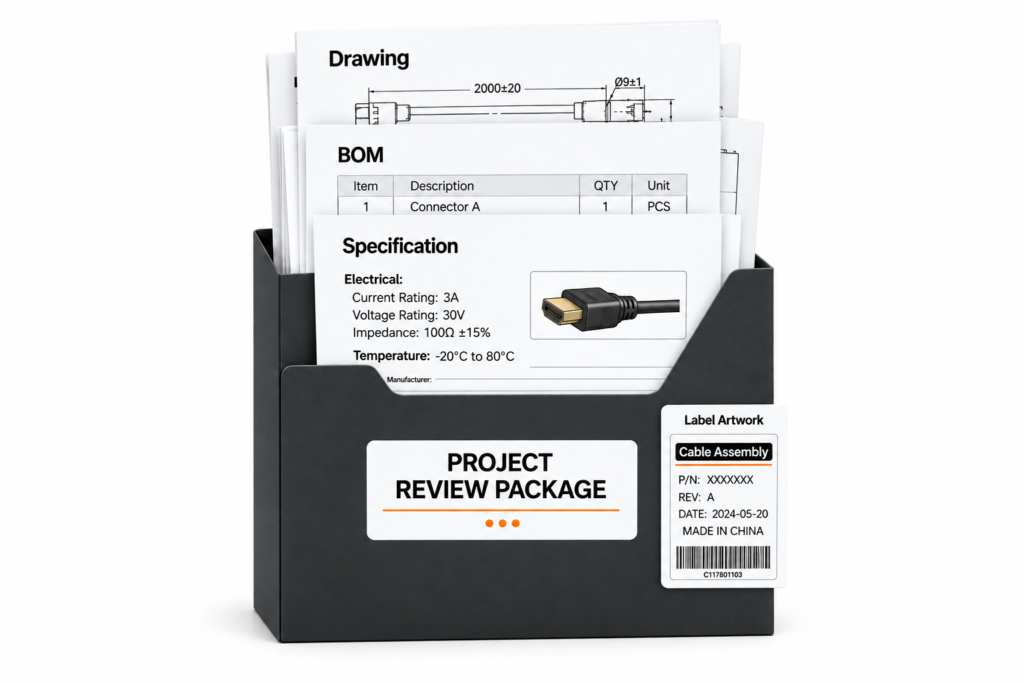
An effective USB-C RFQ combines the technical, branding, packaging, commercial and testing information into one controlled project package. Send the drawings and files already available, identify any requirements that remain open and make clear which items are mandatory. A concise but complete RFQ allows suppliers to quote the same product and reduces assumptions that otherwise emerge during sampling.
Technical RFQ Package
The technical package should begin with the connector at each end, charging requirement, data function, cable length, conductor requirement where known, shielding, jacket, connector housing, color and intended application. Drawings are valuable when dimensions, connector orientation, housing shape or cable exit direction are important to the finished product.
If the project replaces an existing cable, add clear sample photographs, connector close-ups, device information and any existing specification. A BOM can be especially useful when specific components are already controlled by the customer. If the cable is still in development, it is acceptable for some items to remain open as long as they are identified rather than silently left for the supplier to assume.
A complete drawing is not always required for the first engineering discussion. Sample photos, connector photos, cable length, intended application and target quantity can provide a useful starting point when formal documentation is still being prepared. The manufacturer can then identify which missing details must be confirmed before sampling.
Branding and Packaging Package
The second part of the RFQ should explain what turns the cable into the customer’s finished branded product. Include logo files, placement, approved color references, SKU list, barcode files, packaging concept, final artwork when available, inserts, labels and carton requirements. The revision status of each file should be clear so preliminary design material is not mistaken for production-ready artwork.
The sales channel should also be identified because packaging needs differ between industrial supply, retail stores, distributors, ecommerce channels and fulfillment centers. A manufacturer can only quote the complete finished product when it understands what package is expected to leave the factory.
| RFQ Package | Minimum Useful Information | Stronger Project Input | What Remains Open if Missing |
| Product | Connector, length, application | Drawing, BOM or sample | Construction assumptions |
| Power | Intended charging requirement | Device/power specification | Electrical design |
| Data | Charging only or data requirement | Defined performance | Pair and shielding design |
| Appearance | Cable and housing color | Approved color reference | Color matching |
| Logo | File and location | Dimensioned placement drawing | Process and size |
| SKU | Code per variant | Full SKU matrix | Sorting control |
| Barcode | Required or not | Final barcode artwork | Label production |
| Packaging | Bulk or retail direction | Final dieline/artwork | Packaging cost |
| Quantity | Target volume | Quantity per SKU | MOQ and planning |
| Testing | Key functional needs | Customer test specification | Test scope |
| Compliance | Target market | Required document list | Compliance scope |
| Shipment | Destination | Forwarder/carton requirements | Logistics scope |
Sample Approval and Change Control
Sampling works best when the project team agrees in advance on what the sample is intended to prove. Engineering may be checking charging, data, dimensions and connector fit, while the brand team is evaluating color, logo and cable feel. Procurement may need confirmation of the cost structure, and the packaging team may be checking box fit, barcode position and presentation.
Before a sample is made, separate requirements into confirmed items, open items and items that will be validated through the sample. After review, document any requested changes rather than relying on scattered email comments. Adjustments to jacket feel, cable length, color, logo size, connector housing or packaging should become part of the controlled specification for the next sample or production stage.
Once the sample has been approved, production preparation can refer to the final drawing, BOM, sample, testing requirements, labeling and packaging files. This helps reduce sample-to-production mismatch and makes future repeat orders easier to manage because the approval basis is clear.
Complete RFQ and Supplier Comparison
A complete RFQ does not need to be a complicated document. It needs to remove the assumptions that materially affect product performance, manufacturing cost, branding, testing and delivery. Someone who was not present in the original discussion should be able to review the package and understand what cable is being purchased, how it should perform, how it should look and how the finished SKU should be packed.
Once the specification is controlled, supplier comparison becomes more meaningful. A lower price can be evaluated against connector construction, power and data capability, cable length, conductor, shielding, jacket, molding, logo method, packaging, testing and SKU structure instead of being accepted at face value. This is particularly important with private label products because packaging or branding differences can make two apparently similar quotations fundamentally different.
Cablivo is the overseas-facing brand of Shenzhen Tianxiaowei Electronics Co., Ltd., supporting custom cable projects from requirement review and sampling through mass production, testing, packaging, labeling and shipment coordination. The manufacturing base includes 18 years of cable-industry experience, more than 20,000 square meters of factory space, a team of more than 1,500 people and three manufacturing bases supporting custom cable, cable assembly and related production programs.
For a private label USB-C cable project, the most useful starting information includes connector requirements, target charging and data functions, cable length, reference sample or drawing, material preferences where known, logo artwork, packaging plan, quantities, target market and testing requirements. When drawings are incomplete, clear sample photographs and application information can still support an initial engineering review before the remaining specifications are confirmed.
The objective is not simply to obtain the lowest number on a quotation sheet. It is to define the same product clearly enough that engineering, procurement, manufacturing, quality and packaging teams are all working toward the same approved result. When technical specifications, brand requirements, packaging files and order structure are confirmed before pricing and sampling, the quotation becomes a much more reliable foundation for product development, mass production and long-term supply.
If you are preparing a private label USB-C cable program, send Cablivo your available drawings, reference samples or photos, connector information, charging and data requirements, cable length, target quantity, logo files, packaging requirements, target market and testing expectations. The project can then be reviewed against the actual specification before sampling, production planning and a custom quotation are discussed.