Skip to content


A network cable assembly can look deceptively simple on a purchasing list: two connectors, a cable, a length and a quantity. Yet those four pieces of information can still describe many technically different products. A shielded cable is not quoted the same way as an unshielded one. A standard molded boot is different from a custom strain-relief structure. A cable installed in an office network cabinet can have very different environmental and mechanical priorities from one routed through industrial automation equipment. Even two assemblies that look almost identical can use different connector constructions, wiring schemes, jackets, shielding methods, testing requirements or packaging configurations. The quotation becomes reliable only when the supplier knows which characteristics are fixed, which are optional and which remain open for engineering review. That is why experienced procurement and engineering teams treat an RFQ as the beginning of specification control rather than simply asking several factories for a unit price.
Quick Answer: For an accurate network cable assembly quote, provide the cable category, connector type, finished length, wiring or pinout, shielding, jacket, boot structure, application, quantity, drawings or BOM when available, testing requirements, labeling and packaging. Clearly mark any unresolved specifications instead of allowing the manufacturer to make assumptions that may later change materials, processing, tooling, testing or cost.
The practical difference becomes obvious when a sample reaches the bench. Imagine an engineer receiving a request that says only, “RJ45 cable, black, two meters, 2,000 pieces.” Before meaningful costing can begin, someone still needs to ask whether the cable is shielded, which connector construction is required, what wiring should be used, whether a particular cable category is mandatory, how the finished length is measured, what test method is expected and how the product should be packed. A quote can still be issued with assumptions, but those assumptions should be visible. The more clearly the RFQ defines the product, the more useful the quotation becomes for comparing suppliers, approving samples and moving into stable production.
What Specifications Are Needed for a Quote?
An accurate quote normally requires the cable category, connector configuration, finished length, wiring or pinout, shielding, jacket, boot or overmold structure, application, quantity and testing requirements. When a specification has not yet been decided, identify it as an open item. A transparent open point is much safer than an unstated assumption that later changes the product or price.
A network cable assembly should be considered as one interconnected system rather than a collection of unrelated parts. Changing the shielding can affect cable diameter, flexibility, connector selection and termination work. Changing the jacket can influence routing, abrasion behavior, molding compatibility and appearance. Specifying a particular connector brand can affect sourcing and availability. Adding a custom molded boot may require tooling and sample validation. Even a tighter finished-length tolerance can introduce additional inspection work. This is why a technically useful RFQ should show the manufacturer which specifications are mandatory and where engineering alternatives are still acceptable.
When the project is already mature, the specification may come from an approved customer drawing, equipment requirement or existing product standard. Earlier-stage projects often begin with less information. In that situation, the equipment interface, intended network performance, physical installation and environmental conditions become especially valuable because they allow the manufacturer to identify which details still need to be confirmed. The goal is not to force a customer to finish every engineering decision before requesting commercial feedback. The goal is to make the basis of that feedback clear enough that later changes are understandable.
| Specification | Example RFQ Entry | What Must Be Confirmed | Quote Risk if Missing |
| Cable category | Customer-required category | Required category or performance specification | Wrong construction or test basis |
| Connector | Shielded RJ45 plug | Type, shielding, part number, equivalent policy | Component and fit may differ |
| Finished length | 2.0 m | Measurement method and tolerance | Material and inspection unclear |
| Wiring | T568B or custom pinout | Contact-to-conductor mapping | Functional sample error |
| Shielding | Foil, braid or combined | Shield structure and termination | Diameter and processing may change |
| Jacket | Project-specified material | Environment, color and OD limits | Application suitability unclear |
| Boot / overmold | Standard or custom | Geometry, hardness and tooling | Tooling cost may be omitted |
| Quantity | 2,000 pcs | SKU split and future volume | Wrong production basis |
| Testing | Wire map plus defined performance test | Test limit and record format | QC cost cannot be established |
| Packaging | Bulk or individual | Winding, labels, bags and cartons | Delivered cost understated |
Which Cable Category Is Required?
The required cable category should be stated whenever it has already been defined by the equipment design, customer specification or system requirement. Simply asking for “a good Ethernet cable” creates an avoidable engineering decision for the manufacturer because the appropriate construction depends on actual performance and installation needs. The project may call for Cat5e, Cat6, Cat6A, Cat7, Cat8 or another defined configuration, but the category should come from the project requirement rather than being selected only because a higher number appears more advanced.
When the category is still open, provide the intended equipment, required data performance, installation environment and any system-level specification already known. This gives the engineering team useful boundaries without pretending that the final cable design has already been selected. Higher performance requirements can influence pair geometry, shielding, connector compatibility, overall diameter, process control and test expectations. In many projects, the best RFQ question is therefore not “What is the highest category you can make?” but “Which construction is appropriate for this equipment, environment and specified network performance?”
Which Connector Details Are Needed?
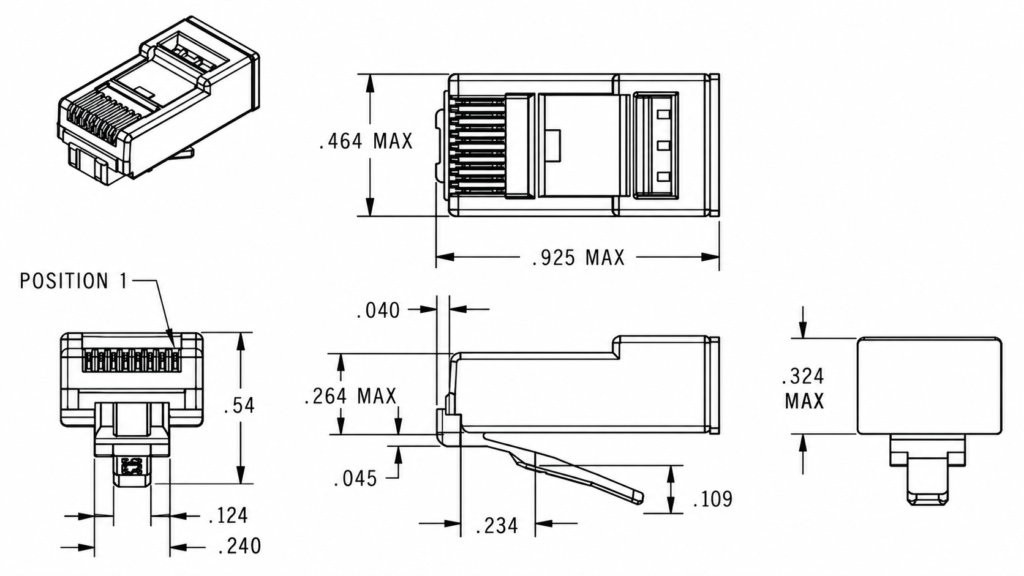
Connector information should be precise enough that purchasing, engineering, sample production and mass production are all discussing the same component. “RJ45 connector” can still leave several important questions unanswered, including shielded or unshielded construction, plug or jack form, latch protection, compatible cable diameter, panel-mount structure, boot design, orientation and any customer-controlled manufacturer or part number. A connector that looks similar in a photograph may still have a different internal structure or termination method.
When a particular connector has already been approved, include its manufacturer and exact part number if available. If alternatives are acceptable, make that clear and define the conditions the substitute must meet. This distinction can have a substantial effect on material availability and quotation stability. It becomes even more important in equipment-integrated assemblies where connector clearance, cable exit direction, mating force, strain relief or repeated plugging may affect actual use. Connector confirmation before sampling helps prevent a cable from being electrically correct but mechanically unsuitable for the intended equipment.
Is a Pinout or Wiring Scheme Required?
A wiring definition should be provided whenever the assembly cannot safely be treated as a standard patch cord. The manufacturer needs to know how each conductor connects from one end to the other, including any project-specific pin assignment, shield connection or nonstandard termination. A product can look completely correct on the outside while being electrically incompatible with the equipment because one conductor has been terminated to the wrong contact. That makes wiring confirmation one of the highest-value checks in a custom cable RFQ.
For a conventional configuration, the RFQ can reference an agreed wiring scheme. Equipment-specific cables are better supported by a drawing or explicit pin map that identifies Connector A and Connector B contact positions. When no formal document exists, an approved physical sample or continuity reference can help build the initial map, but the resulting wiring should still be confirmed before production. A controlled pinout becomes especially valuable later because the same document can be used during sample verification, functional testing and repeat-order production.
How Should Cable Construction Be Defined?
Cable construction should be described according to the needs of the application rather than by adding as many features as possible. Relevant details can include conductor construction, pair arrangement, shielding, drain wire, jacket material, overall diameter limitations, flexibility, cable color, boot style and special routing requirements. If the cable has to pass through a narrow enclosure or bend tightly beside another component, those mechanical restrictions may be just as important as the connector or cable category.
Shielding is a good example of how one choice affects the whole assembly. Foil, braid, drain-wire and combination shielding can influence signal protection, cable diameter, flexibility, connector termination, manufacturing complexity and inspection. Jacket selection creates similar trade-offs because a material chosen for flexibility may behave differently from one chosen for abrasion resistance or environmental exposure. Instead of asking for the “best material” or “maximum shielding,” a stronger RFQ explains the environment and performance requirement so that the structure can be reviewed against a real use condition.
Which Files Should You Send?
Send the latest controlled drawing, BOM, connector datasheets, pinout, sample photos, test requirements, label artwork and packaging specification when available. The purpose is not to create more paperwork. It is to make sure the quotation, prototype and future production are based on the same revision and that the manufacturer understands which document controls each technical or commercial requirement.
A well-organized RFQ package answers two questions quickly: what exactly is being quoted, and which source should be followed if different files disagree? It is common for a supplier to receive a drawing with one connector, a BOM with another part number and a reference sample that reflects an older design. All three can be useful, but they should not all appear equally authoritative. A short note such as “Quote to Drawing Rev D and BOM Rev C; physical sample is for boot appearance only” can prevent significant confusion.
Drawings, BOMs and samples also solve different types of problems. A drawing is usually best for dimensions, length, connector location, pinout and mechanical configuration. A BOM is better for part numbers, approved manufacturers and material control. A sample can communicate feel, fit and appearance but may not reveal its internal conductor structure, exact polymer grade or verified electrical performance. The strongest RFQ package uses each source for the information it can reliably provide rather than treating every document as interchangeable.
| File or Reference | Useful Contents | Best Used For | Common Problem to Avoid |
| Assembly drawing | Length, connectors, pinout, dimensions | Finished product definition | Old revision included |
| BOM | Cable, connectors, components | Material costing | Part numbers conflict |
| Connector datasheet | Dimensions and mating details | Component confirmation | Photo used as sole reference |
| Pinout | Contact mapping | Electrical configuration | Wiring assumed |
| Sample photos | Overall product and details | Early review | Hidden structure guessed |
| Physical sample | Fit, size, flexibility | Reverse review | Every feature copied blindly |
| Test specification | Tests, limits and records | QC planning | “100% test” without definition |
| Label artwork | Dimensions and content | Identification | Arrives after pricing |
| Packaging specification | Winding, bag, carton | Packing quotation | Added after cable approval |
| Revision matrix | Current file versions | RFQ control | Mixed revisions used |

Do You Have a Drawing?
A useful drawing does not need to look complicated. It needs to remove manufacturing ambiguity. For a network cable assembly, the drawing can show the overall configuration, connector at each end, finished cable length, important dimensions, boot or molded geometry, pinout reference and label position. Tolerances should be added where they serve an actual functional purpose rather than applied automatically to every dimension. A tolerance that is unnecessarily tight can add inspection complexity without creating real value for the application.
Revision control is just as important as the drawing itself. A technically perfect drawing is still risky if the supplier does not know whether it is the latest version. The drawing number, revision, BOM revision and any current deviation should therefore be aligned before quotation. When another specification controls a particular feature, such as a connector part number or customer cable standard, reference that source clearly. This creates a traceable path from quotation to sample approval and later to production.
Is a BOM Available?
A BOM gives the manufacturing and purchasing teams a controlled list of what is expected inside and around the finished assembly. It can include the cable, connectors, boots, molded components, sleeves, heat-shrink materials, labels, packaging items and other accessories. For ongoing programs, it may also identify approved manufacturers or components that cannot be substituted. This makes the BOM especially valuable when outwardly similar components can create different sourcing, performance or approval conditions.
The substitution rule should be explicit. “Part ABC-100 only” is commercially different from “ABC-100 or approved equivalent.” The first ties the project to the availability and pricing of one controlled component. The second creates sourcing flexibility but still requires agreed acceptance criteria. Multi-SKU programs benefit from linking each BOM version to its correct length, color, connector, label and packaging configuration. That relationship becomes important when an annual quantity looks large in total but is divided among many smaller variants.
Can Samples Replace Missing Drawings?
A sample can be an excellent starting point when formal documentation is incomplete, particularly for replacement-supplier projects or products that have been purchased for years without an updated engineering file. Visible properties such as connector form, finished length, cable diameter, boot shape, color, label position and general flexibility can often be inspected directly. Wiring can also be checked when the sample is available for electrical review.
The limitation is that a sample does not automatically reveal everything that matters. Exact conductor construction, polymer formulation, certified performance, material grade and some electrical characteristics may not be identifiable simply by looking at or measuring the product. The safer approach is to treat the sample as evidence and create a list of confirmed, measured and unknown characteristics. Unknown properties can then be clarified with the customer or defined for the new project rather than being presented as facts discovered from appearance alone.
Which Specifications Must Match the Sample?
A manufacturer should know which characteristics of the reference sample are mandatory and which are merely examples. “Make it exactly the same” sounds clear but can actually create unnecessary work. The connector mating fit may be critical, while the cable color may be allowed to change. The current boot may need improvement because it interferes with the equipment. The existing cable may have acceptable appearance but unsuitable flexibility for a revised installation. These priorities should be stated rather than inferred.
A practical sample-comparison sheet can classify connector type, mating fit, finished length, cable diameter, flexibility, jacket appearance, boot geometry, wiring, shielding, labels and packaging as must match, reference only or open for improvement. Once a new sample is approved, the confirmed specification should become the controlled basis for mass production. This creates a cleaner transition than continuing to rely on an old physical reference whose internal details may never have been fully documented.
How Do Application and Testing Affect the Quote?
Application and testing define what the assembly has to do and how acceptance will be judged. Tell the manufacturer which equipment the cable connects, where it will operate, whether movement or interference matters and what electrical, transmission, mechanical, visual or packaging checks are required. A phrase such as “industrial Ethernet cable” or “100% tested” does not provide enough detail for accurate engineering or costing.
Two assemblies using similar RJ45 connectors can experience completely different operating conditions. One may sit inside a climate-controlled network cabinet, while another is routed through industrial equipment close to motors or power wiring. A third may be frequently connected and disconnected during maintenance. The product drawing may not reveal those differences, yet they can influence shielding, jacket choice, strain relief, connector protection and test requirements. Application details therefore turn a list of parts into an understandable engineering problem.
Testing should be treated with the same precision. A continuity or wire-map check verifies basic electrical connection but does not represent every possible network-performance measurement. Transmission-related evaluation, shielding checks, mechanical testing and environmental testing each answer different questions. The RFQ should identify the test method, acceptance basis and required record format when these items are important. Otherwise, two suppliers may both say “tested” while including very different inspection scopes in their prices.
| Test or Review Item | What It Helps Check | Typical Project Use | RFQ Detail Needed |
| Wire map / continuity | Opens, shorts, wrong wiring | Terminated assemblies | Approved wiring reference |
| Connector fit | Mechanical mating | Equipment cables | Mating interface |
| Finished length | Assembly dimension | Custom lengths | Nominal length and tolerance |
| Shield continuity | Shield path | Shielded assemblies | Termination requirement |
| Insertion loss | Signal attenuation | Performance-controlled projects | Test limit and setup |
| NEXT | Pair-to-pair crosstalk | Defined network performance | Applicable limit |
| Return loss | Signal reflections | Higher-performance cabling | Test configuration |
| Mechanical review | Strain, pull or mating behavior | Equipment applications | Acceptance method |
| Visual inspection | Molding and workmanship | Mass production | Approved appearance criteria |
| Label / packaging check | SKU and shipment accuracy | Multi-SKU projects | Artwork and packing specification |

What Is the Cable Used For?
The application description should identify the equipment at both ends of the cable and the role the assembly performs. “Connects an industrial controller to an Ethernet switch inside an automation cabinet” is far more useful than “industrial use.” Likewise, “short internal network connection between two modules” immediately raises different questions from an outdoor security-camera connection or a network cable repeatedly handled by service technicians.
Network cable assemblies can be used with routers, switches, communication equipment, industrial networks, data systems, network cabinets, security equipment, IoT devices and automation systems. The important point is not to create a long list of possible industries. It is to tell the supplier which one describes the current project. Once the use case is clear, engineering teams can identify restrictions such as connector clearance, cable routing, flexibility, shielding, repeated movement or the need for more protective packaging during transportation.
Where Will the Cable Operate?
Describe the actual operating environment rather than relying on general terms such as “rugged,” “industrial” or “high temperature.” Useful conditions can include indoor or outdoor placement, cabinet routing, repeated movement, abrasion, humidity, temperature range, oil exposure, UV exposure, vibration, electromagnetic interference or sealing needs. When a requirement can be measured, provide the value or applicable customer specification instead of expecting a material name alone to prove suitability.
This distinction matters because a jacket material does not automatically guarantee that the finished cable satisfies every temperature, oil, weather, flame or flexibility requirement associated with that polymer family. Finished-product performance depends on the actual construction and validation conditions. A technically responsible RFQ therefore starts with the environment and acceptance requirement. Material selection can then be reviewed against those conditions rather than selected because a particular material has a strong marketing reputation.
Which Tests Are Required?
Testing should be divided into basic assembly checks and project-specific performance validation. Basic production checks may include continuity, wire map, connector fit, finished length, appearance, labels and packaging. Depending on the project, additional transmission, shielding, mechanical or environmental testing may also need to be defined. These requirements should appear in the RFQ early because test equipment, fixtures, sampling frequency, record keeping and traceability can affect both production planning and cost.
The phrase “test to Cat6A,” for example, should still be supported by a defined test configuration and acceptance basis. Likewise, “100% testing” means very little unless the test itself is identified. One project may require every unit to receive continuity and wire-map verification, while another may also require documented transmission measurements or batch-level reports. When the customer identifies exactly what needs to be demonstrated, the quotation can include the correct inspection scope rather than relying on a generic statement about quality control.
Are Compliance Requirements Defined?
Compliance requirements should be linked to a specific product, target market, customer program or documented standard. State what documentation is required, whether a particular material declaration is necessary, which testing standard applies and whether an approval relates to a component, the bulk cable or the finished assembly. This is more reliable than asking a supplier whether “the cable has all certifications,” because different markets and products can require different evidence.
Cablivo’s factual documentation requires certification and testing claims to be confirmed according to the actual product type, target market and project specification. The company should not present every network cable as automatically carrying CE, RoHS, FCC, UL, REACH or specialized industry approvals without evidence applicable to the exact product. This approach is useful for procurement teams because it keeps the quotation tied to the documentation the real project needs rather than to broad promotional claims.
How Do Quantity and Packaging Affect the Quote?
Quantity, SKU structure, labeling and packaging influence more than the final unit price. They affect material purchasing, connector sourcing, production setup, inspection, winding, packaging materials, inventory control and shipment preparation. State the sample requirement, first production quantity, realistic repeat volume, SKU breakdown and packaging configuration so the quotation reflects how the order will actually be manufactured and delivered.
A request for 10,000 pieces can describe very different production situations. It may mean one identical cable manufactured in a large batch, or ten lengths at 1,000 pieces each with different labels and packaging. The second program requires more changeovers, material control, work instructions, label verification and inventory separation even though the total number of pieces is identical. For this reason, the number of SKUs can be almost as important as the headline quantity during quotation.
Packaging deserves similar attention because the same cable may be delivered in very different forms. A bulk-packed assembly sent directly to an equipment factory is commercially different from a product individually wound, barcode-labeled, bagged, boxed and packed for distribution. Connector latches, molded boots and other exposed structures may also need protection during international transportation. Defining these requirements early prevents the commercial team from approving a cable price and then discovering that labeling and packaging materially change the delivered cost.
| Commercial Variable | RFQ Example | What Changes in Production | Procurement Value |
| Sample quantity | 5 samples | Prototype setup and review | Confirms fit |
| Production quantity | 2,000 pcs | Material and scheduling | Realistic unit costing |
| SKU count | 4 lengths × 500 pcs | More setups and control | Reveals true complexity |
| Connector policy | Exact part only | Fixed sourcing source | Clarifies risk |
| Equivalent allowed | Approved alternative | More flexibility | Supports supply continuity |
| Custom boot | New molded geometry | Tooling and molding | Separates tooling cost |
| Bulk packaging | 50 pcs/carton | Simple handling | Factory-use programs |
| Individual packaging | 1 pc/bag | Extra materials and labor | Distribution programs |
| Custom label | SKU + barcode | Printing and inspection | Better identification |
| Test records | Lot report | Data recording | Supports documentation |

What Quantity Should You Specify?
Provide the quantity that reflects how the project is genuinely expected to be purchased. A useful RFQ can separate development samples, the first production order and any realistic repeat demand. This distinction allows the manufacturer to understand the difference between prototype economics and stable-production economics. An inflated annual forecast may produce a more attractive theoretical unit price, but it does not help procurement if the actual order will be released at a much smaller volume.
The volume should also be divided by SKU where applicable. Five thousand pieces of one configuration are different from five thousand pieces spread across multiple lengths, colors, connector types or labels. For long-term projects, an approximate forecast can still be valuable when clearly identified as planning information rather than a purchase commitment. Cablivo’s documented MOQ guidance states that many custom cable projects start from 500 pieces, while the final MOQ depends on connector type, cable structure, materials, tooling, packaging and order conditions.
Which Packaging Is Required?
Packaging should describe both presentation and physical protection. State whether cables will be individually wound, tied, bagged, boxed or bulk packed and whether the connector, latch, molded boot or other structure needs additional protection. Export carton quantity, carton marks and internal arrangement can also be important when the products must arrive ready for a factory line, distribution warehouse or retail packing operation.
The correct solution depends on the program. Bulk packaging can be appropriate when the cable is consumed on an assembly line, while individual packaging may be required for distribution or aftermarket sales. A retail program can introduce printed cards, boxes, inserts or barcodes. These requirements should not be guessed from the cable itself. Packaging is part of the finished deliverable and should therefore be reviewed during quotation rather than treated as an unrelated step after the product has already been approved.
Do You Need Custom Labels?
Labels become particularly important when a program contains several lengths, regions, equipment versions or customer part numbers. The RFQ should identify the required label size, position, data fields, artwork revision and relationship to each SKU. A cable label, bag label, inner-box label and outer-carton mark are different identification points and should not automatically be treated as one item.
For larger programs, a simple SKU matrix can link the customer part number, internal code, cable length, connector configuration, cable color, label artwork, barcode and packaging version. This can prevent a technically correct cable from being packed or shipped under the wrong identification. In many long-term supply programs, label control is therefore not a cosmetic detail. It becomes part of production traceability, warehouse handling and the customer’s ability to receive the right version without opening every package.
Which Project Details Affect Lead Time?
Lead time depends on the real product configuration and supply situation. Connector availability, custom cable materials, tooling, sample approval, quantity, test requirements, packaging materials, label artwork and SKU complexity can all affect the schedule. The customer can provide a requested delivery date, but the manufacturing lead time should be confirmed only after the technical and material requirements have been reviewed.
A controlled connector with limited availability creates a different schedule from a commonly available component. A custom molded boot adds tooling and sample validation. Specialized packaging may require separate artwork or materials. For this reason, Cablivo’s documented content boundaries avoid unsupported universal promises such as fixed three-day sampling or guaranteed production timing for every product. Sample and production schedules are instead evaluated according to structure, connector sourcing, material preparation, testing, quantity and packaging conditions.
What If Your RFQ Is Incomplete?
An incomplete RFQ can still begin a useful engineering review. Send the information already available, such as connector photos, an existing sample, cable category, approximate or required length, application, quantity and known testing needs, then clearly mark unresolved items. The objective of the first review is to identify what must be confirmed before the quotation, prototype and production specification can become technically reliable.
Many real projects do not begin with a complete engineering package. A purchasing team may inherit a cable with no current drawing. An engineer may know the equipment interfaces but still be evaluating the jacket. A distributor may have an approved physical sample but no controlled BOM. These situations are manageable because missing information can be identified and closed. The more dangerous situation is when missing information is silently replaced with assumptions that later appear to be confirmed requirements.
A good project record therefore distinguishes three categories: customer-confirmed information, information measured or observed from an existing sample and manufacturer-proposed information. This prevents an engineering suggestion from accidentally becoming a customer requirement and provides a clearer path from early review to specification freeze. The process becomes progressively more controlled as drawings, BOM, connector data, wiring, materials, test criteria and packaging are confirmed.
| RFQ Status | Example | Can Review Start? | What Should Happen Next |
| Drawing + BOM complete | Controlled revisions | Yes | Check consistency and quote |
| Drawing, no BOM | Geometry known | Yes | Confirm materials and part numbers |
| BOM, partial drawing | Materials known | Yes | Confirm dimensions and wiring |
| Physical sample only | Existing cable available | Yes | Measure and identify unknowns |
| Photos + connector | Early concept | Yes | Confirm length and construction |
| Category unknown | Application known | Yes | Review required performance |
| Testing unknown | Product mostly defined | Yes | Define acceptance test |
| Packaging unknown | Cable defined | Yes | Quote baseline and flag open item |
| Connector unavailable | Controlled part | Yes | Check sourcing or alternatives |
| Only “need network cable” | No technical detail | Limited | Application and interfaces needed |
What Information Can Start a Review?
A useful early-stage inquiry can be relatively simple when the information is concrete. Send photographs of both connector ends, any visible connector or cable references, the required or approximate finished length, the connected equipment, the intended application, the expected quantity and any known category, shielding or testing requirement. When an existing product is being replaced, explain whether the objective is to duplicate the current assembly or solve a problem found in the existing design.
This additional context can be surprisingly valuable. A customer may be changing suppliers because the connector latch breaks, the cable is too stiff, the boot interferes with adjacent equipment, the packaging damages the connector or the current supplier cannot maintain the required configuration. These details help the engineering team understand which characteristics should be preserved and which should be improved. Cablivo’s inquiry framework can begin with drawings, sample photographs, BOM information, connector details, cable length, target quantity, application, testing and packaging requirements rather than requiring every field to be complete before discussion starts.
Which Details Can Be Confirmed Later?
Some specifications can remain open during an early feasibility or budget discussion, provided their status is clearly identified. Final jacket selection, connector supplier, shielding construction, boot geometry, label artwork, packaging configuration or test method may sometimes be confirmed after the first review. The important point is to show whether each item is fixed, optional or pending so that the quotation does not hide assumptions.
This is especially valuable when comparing suppliers. One quotation may use the specified connector while another silently substitutes a lower-cost alternative. One supplier may include the required inspection while another prices only a basic continuity check. If those assumptions are invisible, the lower price can look more competitive even though it represents a different product. A quotation should therefore be compared not only by unit price but also by the technical basis, included testing, packaging and any open commercial conditions.
How Can Engineering Review Reduce Quote Changes?
Engineering review reduces quotation changes by identifying conflicts before they become material or production commitments. The drawing can be checked against the BOM, connector models can be reviewed against the cable structure, wiring can be compared with the pinout and the proposed shielding can be considered against the application. Custom molding, tooling, test requirements and packaging can also be identified before they appear as late-stage additions.
A preliminary price can still be useful before every detail is closed when the assumptions are visible. A quotation might state that the price is based on a two-meter finished length, a specified shielded connector, a defined cable construction, standard boot, continuity testing and bulk packaging, while a transmission test requirement remains pending. This gives procurement a commercial reference while clearly showing what may still affect the final price. The goal is not to delay quotation. It is to make the relationship between technical decisions and commercial changes understandable.
What Should Be Frozen Before Production?
Before mass production begins, the final drawing, BOM, connector specification, wiring or pinout, cable construction, finished length, critical tolerances, test requirements, labels, packaging and approved sample should be aligned where they apply. This creates one controlled baseline for purchasing, production, quality inspection and repeat orders. Later changes can then be handled through revision control rather than informal instructions hidden in email threads.
The approved sample is particularly helpful when appearance, connector fit, cable flexibility or molded geometry matters, but the physical sample should support the written specification rather than replace it. A repeat-order program is more stable when the manufacturer can work from controlled documents and an approved reference instead of reconstructing the product from memory every time a purchase order arrives. This discipline is what turns an initial custom cable inquiry into a supply program that can be repeated with clearer expectations.
Cablivo is the overseas-facing website brand of Shenzhen Tianxiaowei Electronics Co., Ltd., a Shenzhen-based custom cable, wire harness and cable assembly manufacturer. The documented company base includes 18 years of industry experience, more than 20,000 square meters of factory space, a team of more than 1,500 people and three manufacturing bases, with project support covering requirement review, sampling, production, testing, packaging and shipment coordination.
If you are preparing a Network Cable Assembly RFQ, the most effective first step is not writing a longer inquiry. It is sending a clearer one. Share your drawing or existing sample, BOM if available, connector information, required cable category, finished length, wiring or pinout, application, target quantity, testing requirements, label files and packaging plan. If some specifications are still open, identify them clearly. The available information can then be reviewed before sample development and mass-production discussion, helping the quotation reflect the product you actually intend to purchase.