Skip to content


An LC/APC to LC/APC fiber cable assembly can look surprisingly simple on a purchase request: two green LC connectors, a length, and a quantity. In reality, those few words can describe several different finished assemblies. Fiber specification, simplex or duplex construction, cable diameter, jacket material, bend requirements, connector configuration, optical performance, labeling, packaging, test documentation, and even the way finished length is measured can change what a manufacturer must source, terminate, inspect, pack, and quote. When several suppliers receive an incomplete RFQ, each may quietly fill the missing fields with different assumptions. The prices can then appear comparable on a spreadsheet even though the products behind those prices are not actually the same.
To quote an LC/APC to LC/APC fiber cable assembly accurately, provide the connector configuration, fiber type, simplex or duplex construction, finished cable length, cable diameter, jacket requirement, application environment, optical performance criteria, test requirements, quantity, packaging, labeling, documentation requirements, and any available drawings, BOMs, part numbers, photos, or reference samples. Clearly identify any specifications that are still open for engineering confirmation.
The real cost of an incomplete RFQ rarely appears in the first quotation. It appears later when a sample reaches the engineering bench and somebody notices the wrong jacket, an unexpected cable diameter, an unsuitable boot, an undefined optical acceptance limit, or a length measured from a different reference point. The quotation must then be revised, another sample may be needed, and purchasing has to explain why a project that looked simple has stopped moving. A good RFQ is therefore not paperwork for paperwork’s sake. It is one of the cheapest ways to remove uncertainty before it reaches sampling and production.
What LC APC Specs Are Required?
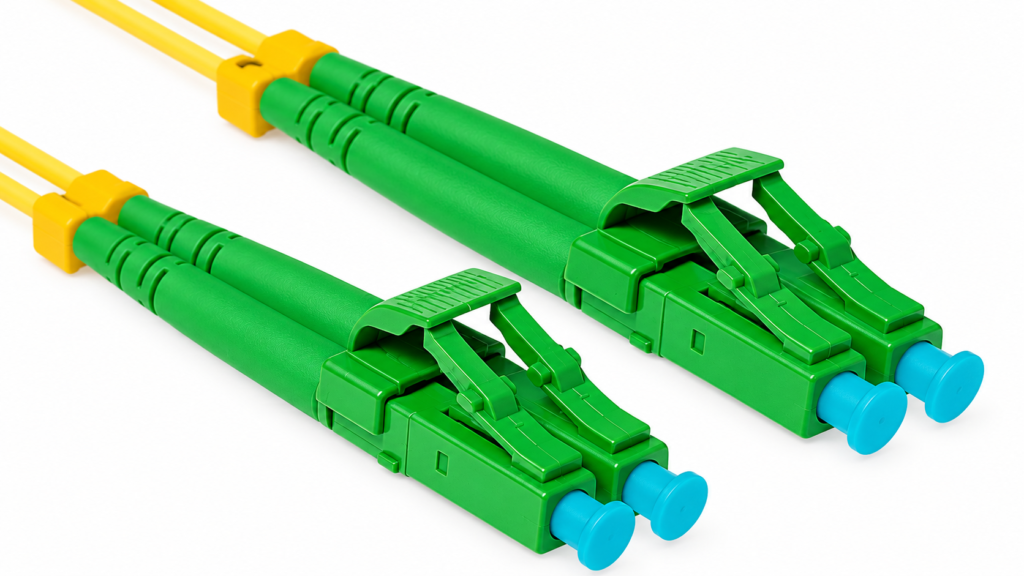
An accurate LC/APC to LC/APC quotation needs more than the connector name. Both ends, APC polish, fiber specification, fiber count, simplex or duplex configuration, connector arrangement, boot or clip requirements, and any equipment-related dimensional restrictions should be confirmed. Together, these details define the actual assembly the manufacturer is expected to quote and reproduce.
Are Both Ends LC/APC?
Writing LC/APC to LC/APC clearly is the first useful step because LC and APC describe different parts of the termination. LC identifies the connector interface, while APC describes the angled physical-contact polish. A request that says only “LC fiber cable” does not establish the polish on either end, and a request that says only “LC/APC cable” may still leave the opposite termination unclear. Even when both ends are identical, an RFQ is easier to review when it states them separately as End A: LC/APC and End B: LC/APC.
This becomes particularly important when a replacement assembly is being sourced from an existing machine, telecom device, optical module, panel, or customer sample. Purchasing may know that the connector body is green but not have the original manufacturer’s part number or drawing. In that situation, several close-up photographs are more useful than a vague description. A front view, side profile, boot area, duplex clip if present, and the point where the cable enters the connector can help engineering compare what the project actually uses with what is being proposed for the new assembly.
Mechanical details around the connector deserve attention as well. Boot length, boot style, duplex clips, protective caps, housing arrangement, and cable exit geometry can affect installation even when the optical interface itself is correct. A connector that works perfectly on an open bench may interfere with a neighboring port inside a dense panel or compact equipment chassis. That is why connector confirmation should cover both optical interface and physical fit rather than stopping at the words LC/APC.
Which Fiber Type Is Required?
LC/APC connectors are commonly associated with single-mode fiber applications, but the connector does not automatically define the fiber specification. The RFQ should identify the required fiber category or refer to the customer drawing, approved material specification, or existing product standard. OS2 is widely used in single-mode cable assemblies, while individual projects may further identify fiber specifications such as G.652.D, G.657.A1, or another approved construction.
The distinction becomes more important when routing conditions are tight. Cables inside compact optical devices, wall boxes, cabinets, dense telecom equipment, or other constrained spaces can experience smaller bend radii than cables routed through open trays. If a bend-insensitive fiber specification has already been selected, include it directly in the RFQ. If engineering has not yet frozen the fiber, describe the installation and routing conditions instead of selecting an arbitrary specification simply because it appears on a supplier’s standard product page.
A quotation is more useful when it distinguishes fixed specifications from items that are still open. For example, the project may require LC/APC connectors and a 2 m finished assembly but allow the manufacturer to review the specific fiber construction. Marking the fiber field as “engineering review required” is more accurate than pretending the issue is already settled. It also gives procurement a clear record of which decisions remain before the sample can become a production baseline.
Is It Simplex or Duplex?
Simplex and duplex determine the number and physical arrangement of optical paths, so they affect the cable structure, connector arrangement, material usage, assembly work, packaging, and ultimately quotation. A simplex assembly normally carries one fiber path, while a duplex assembly carries two. Duplex products may use paired cable structures, duplex clips, zipcord-style arrangements, or another project-defined configuration.
The phrase “two-core fiber cable” is not always enough. Two independent simplex assemblies and one duplex assembly can both involve two fibers but result in very different finished products. When the cable must match an existing device, the safest approach is to state the intended configuration and attach a photo or sample showing how the two LC connectors are paired. If transmit and receive channels or installation polarity are relevant to the system, that requirement should also be included instead of being left for the installation team to discover later.
For multi-SKU procurement, simplex and duplex information should be controlled at the SKU level. A sourcing sheet containing several lengths can easily become confusing if the configuration column is missing. What looks like a minor data-entry field is actually part of the product identity, especially when visually similar assemblies will be packed, stored, and installed together.
Are Connector Details Customized?
Many projects work perfectly well with a standard LC/APC connector configuration, but others have mechanical limitations that make connector details important. Boot shape, boot length, housing size, duplex clip arrangement, cable exit direction, protective cap, strain-relief geometry, and available installation space can all influence whether the finished cable fits the intended equipment.
The most practical RFQ identifies which dimensions are fixed and which may be optimized. If the equipment has a narrow channel where the cable exits, that limitation should be documented. If a specific connector or boot has already passed customer approval, provide a drawing, part reference, or sample. If no special restrictions exist, state that a standard configuration is acceptable. This prevents both overengineering and accidental changes to features that engineering considers important.
An existing sample can be particularly valuable when old project documentation is incomplete. A physical reference makes it possible to compare connector body, clip, boot, cable diameter, length, and general assembly arrangement before sampling. Cablivo’s documented fiber-optic project scope treats fiber type, connector type, cable length, jacket, cable protection, bend-radius requirements, application environment, transmission requirements, labeling, and testing as project variables that should be confirmed rather than assumed.
| Specification | Common RFQ Options | What Should Be Confirmed | Risk if Missing |
| End A | LC/APC | Exact connector and polish | Wrong termination |
| End B | LC/APC | Exact connector and polish | Wrong mating interface |
| Fiber category | OS2 / project-defined | Engineering requirement | Incorrect cable construction |
| Fiber specification | G.652.D / G.657.A1 / drawing-defined | Approved project standard | Routing or bend mismatch |
| Fiber count | 1F / 2F | Number of optical paths | Wrong cable structure |
| Configuration | Simplex / Duplex | Physical arrangement | Incorrect assembly cost |
| Boot / clip | Standard / customized | Equipment compatibility | Mechanical interference |
| Sample reference | Available / unavailable | Physical product match | Higher interpretation risk |
Which Cable Construction Details Matter?
Cable length, outer diameter, jacket, protection, color, and routing requirements determine how an LC/APC assembly behaves in the real installation. They can also change material usage, connector compatibility, production handling, packaging, and price. For an accurate quote, define the construction features that are fixed and clearly identify any areas where engineering review is still acceptable.
What Cable Length Is Needed?
Length sounds like the easiest line on an RFQ until two companies measure it from different reference points. A request for “3 m” should ideally state whether 3 m means finished connector-to-connector length, cable body length, or another drawing-defined dimension. On long assemblies, a small difference may not matter. On short assemblies installed inside equipment with very limited routing space, the same difference can prevent installation.
A dimensioned drawing is the cleanest way to control length because it gives both purchasing and manufacturing a common reference. If a drawing does not exist, measure the approved sample and explain where the measurement starts and ends. When the assembly may tolerate some variation, state an appropriate project tolerance rather than forcing production to guess. When the installation has almost no spare routing space, the tolerance deserves even more attention because length becomes a mechanical interface rather than merely a purchasing description.
Multi-length orders should be organized by SKU. If the project needs 1 m, 2 m, 3 m, and 5 m versions, show the quantity of each instead of writing only the overall quantity. This improves material calculation, packaging, labeling, warehouse identification, and later repeat-order control. A clear length matrix is particularly valuable when all versions look almost identical after they are coiled.
Which Cable Diameter Is Required?
Fiber patch-cord assemblies commonly appear in cable diameters around 2.0 mm and 3.0 mm, although actual projects can use smaller, larger, armored, breakout, or other application-specific constructions. Diameter affects flexibility, mechanical protection, boot compatibility, routing density, and how the cable feels during installation, so it should not be treated purely as an appearance choice.
A thinner cable can be convenient in dense cabinets or compact equipment because it occupies less routing space, but reduced diameter alone does not guarantee better bend performance or suitability for every application. A larger construction may provide more mechanical protection in some designs but can create interference in narrow channels or densely populated panels. The best choice therefore comes from the application and approved cable structure rather than from assuming that bigger is stronger or thinner is more advanced.
When a customer drawing specifies OD, the quotation should follow it. When only an existing sample is available, a measured diameter and several close-up photographs can provide a useful starting point. When diameter is flexible, tell the manufacturer the routing constraint and allow the construction to be reviewed before sampling. This separates what engineering truly needs from what can still be optimized.
Which Jacket Material Is Required?
The jacket protects the fiber structure and affects handling, flexibility, environmental suitability, installation acceptance, and discussions around flame-performance or building requirements. PVC and LSZH are common terms in fiber cable procurement, while particular installations may call for riser, plenum, outdoor, armored, or other specified cable constructions.
The important point is that jacket selection should follow the installation rather than a generic catalog description. A cable inside an equipment chassis does not automatically have the same requirements as one running through a building pathway, industrial environment, outdoor enclosure, or telecommunications infrastructure. If the end project already specifies a jacket or rating, include the exact wording in the RFQ. If no material has been frozen, describe the installation and target environment so the remaining decision is visible.
Material requirements and certification claims should also be kept separate. Specifying LSZH, for example, does not by itself prove that every finished product automatically satisfies every possible market or project standard. When a customer or target market has a specific compliance requirement, provide the actual requirement or controlled document rather than assuming the jacket name settles the entire question.
Are Color or Protection Requirements Custom?
Color is sometimes treated as cosmetic, but in large installations it can become part of cable management. Jacket colors, labels, heat-shrink markers, connector identifiers, and SKU information can help installers distinguish systems, lengths, network paths, equipment groups, or replacement parts. If exact color matching matters, provide a controlled reference instead of relying only on a simple description such as yellow, green, or black.
Connector protection matters even more because optical interfaces are sensitive to dust, contamination, scratching, and physical damage. Protective caps should remain in place through production handling and shipping. Long cables may require controlled coiling, protective bags, trays, or cartons that prevent tight bends and crushing. Some installations may require armored structures, protective sleeving, or additional mechanical reinforcement, but those features should be driven by application requirements rather than added automatically.
A useful way to think about cable construction is to follow the product beyond the factory. Consider how it will be packed, shipped, stored, unpacked, identified, routed, cleaned, connected, and potentially replaced. Many construction and packaging decisions become obvious when the entire journey is considered instead of looking only at the cable lying straight on a workbench.
| Construction Variable | Common Project Options | Selection Value | Important Check |
| Finished length | 0.5 m / 1 m / 2 m / 3 m / 5 m / custom | Equipment routing | Measurement method |
| Cable OD | Commonly around 2.0 or 3.0 mm; other structures vary | Flexibility and protection | Connector and routing fit |
| Jacket | PVC / LSZH / project-defined | Installation environment | Actual project requirement |
| Fiber construction | Standard / bend-insensitive / project-defined | Routing performance | Engineering specification |
| Color | Standard / customized | Identification | Controlled reference if critical |
| Protection | Caps / sleeving / armor / custom | Handling and mechanical protection | Real application need |
| Bend requirement | Cable-specific | Prevent excessive bend stress | Follow approved cable specification |
| Packing | Coil / bag / tray / custom | Shipment protection | Cable length and connector safety |

What Optical Performance Is Required?
Optical performance should be defined from the system design, drawing, engineering specification, or agreed quality standard rather than copied from a generic product listing. Confirm insertion-loss limits, return-loss requirements, test wavelength, end-face inspection expectations, and the form of test records required. If a limit has not yet been defined, identify it as an open technical item before final quotation.
What Insertion Loss Is Required?
Insertion loss measures how much optical power is lost through a connection or cable assembly. It is one of the most commonly discussed performance parameters for fiber assemblies, but there is a practical difference between a typical catalog value and a contractual production acceptance limit. Commercial LC single-mode connector specifications frequently show values in the approximate 0.2–0.5 dB range depending on connector grade, component quality, test method, and supplier specification, but these figures should not automatically become the acceptance criteria for every project.
The RFQ should instead state the value required by the equipment design, optical link budget, customer standard, or controlled engineering drawing. It should also explain what the value applies to. A maximum loss stated for an individual connector, a mated connector pair, or the complete finished assembly can mean different things during inspection. If the manufacturer’s proposed measurement method differs from the customer’s interpretation, that difference needs to be resolved before the sample becomes the approved reference.
Procurement comparisons become much more meaningful when all suppliers price against the same acceptance criteria. A lower unit price can be misleading when one quotation includes tighter optical limits or additional inspection while another assumes standard production performance. Optical performance should therefore appear beside price in the comparison sheet rather than being treated as an invisible technical detail.
What Return Loss Is Required?
Return loss describes how much optical energy is reflected back toward the source. APC terminations are specifically designed to reduce back reflection, which is one reason they are widely used in reflection-sensitive single-mode optical systems. Market specifications commonly associate good APC connector performance with return-loss figures around 60 dB or higher, but the project should still define the actual minimum requirement if return loss is a controlled acceptance parameter.
The distinction between a typical figure and a guaranteed minimum matters here as well. A supplier may publish an attractive typical performance figure while using a different production limit for pass/fail inspection. Engineering teams should therefore provide the required minimum value or reference the controlled specification instead of assuming that the label APC automatically defines every numerical performance requirement.
If the project has no explicit return-loss target, that uncertainty should be visible in the RFQ. Ask which production specification the manufacturer proposes and how the parameter will be verified. This is more reliable than copying a number from an unrelated patch-cord listing and accidentally making it part of a contractual requirement.
Which Test Wavelengths Are Needed?
1310 nm and 1550 nm are commonly used wavelengths when testing single-mode fiber assemblies, but the required wavelength should follow the actual system and validation plan. Telecom equipment, optical modules, test equipment, data transmission systems, and other applications may use project-specific test procedures. If both wavelengths are required, list them. If a different procedure applies, provide that procedure instead of asking the factory to “test normally.”
The RFQ should also separate production testing from customer validation. Some organizations perform their own optical qualification after receiving samples while requiring the manufacturer to complete a standard production test before shipment. Other projects expect individual measured data from the supplier. These workflows create different documentation and inspection requirements even when the physical cable is identical.
Structured test fields are easier to manage than informal email instructions. A line such as “Test wavelength: 1310 nm and 1550 nm; acceptance per Drawing Rev C” gives engineering, quality, purchasing, and production a common reference. It also makes future repeat orders easier because the requirement is attached to the specification rather than buried in an old email conversation.
Do You Need Test Records?
There is an important difference between performing a production check and producing formal test documentation. Some projects only need pass/fail inspection before packing. Others may require batch reports, individual cable data, serial-number-linked results, end-face inspection records, or files organized according to the customer’s quality system. These requirements consume different levels of inspection time and document control, so they should be included before final quotation.
The easiest way to decide is to identify who will use the information. A development engineer may need data to validate a new optical link. An incoming quality team may need evidence for acceptance. A distributor may only require batch documentation. A telecom equipment program may need traceability tied to each part number or production lot. Those are different deliverables and should not be bundled together under a vague request for a “test report.”
Cablivo’s documented fiber-optic scope states that transmission and testing requirements should be confirmed according to project information rather than supported by invented fixed performance claims. For a serious RFQ, that is the safer approach: establish the project’s acceptance conditions first, then confirm how the manufacturer will inspect and document them.
| Optical Item | Common Industry Reference | RFQ Decision | Stronger Acceptance Wording |
| Insertion loss | Connector specifications often around 0.2–0.5 dB depending on grade and method | Define maximum | Maximum IL per approved specification |
| Return loss | APC specifications often target approximately ≥60 dB | Define minimum | Minimum RL per approved specification |
| Test wavelength | 1310 nm / 1550 nm common for single mode | Confirm wavelength | Test at project-defined wavelengths |
| End-face condition | Clean and free of unacceptable defects | Define inspection plan | Inspect before final packing |
| Test scope | Sample / batch / individual | Select quality plan | Scope confirmed before production |
| Test records | None / batch / individual | Define documentation | Record format agreed before PO |
| Acceptance source | Drawing / customer standard / internal specification | Provide revision | Inspection per controlled document |

What Order Details Affect the Quote?
A technically correct cable specification is only part of an accurate quotation. Sample quantity, production volume, SKU mix, packaging, labeling, required documentation, target market, and project stage also affect sourcing and production planning. A five-piece engineering sample request, a first production order, and a multi-SKU repeat supply program can involve the same cable design but very different commercial preparation.
What Quantity Should Be Quoted?
Quantity affects material purchasing, connector sourcing, cable preparation, production planning, inspection workload, packaging, and commercial pricing. Asking only for the “best price” gives a manufacturer very little information about how the project should be evaluated. A more useful RFQ provides a realistic target quantity or several quantity levels that correspond to actual project stages.
For development projects, the RFQ might separate sample quantity, expected first production quantity, and forecast volume. Figures such as 5–10 pieces for engineering validation, 500 pieces for an initial order, 1,000 pieces for a normal production quantity, and 5,000 pieces as a forecast scenario can be useful examples, but they should not be interpreted as universal industry rules. Real commercial breakpoints depend on connector sourcing, fiber construction, packaging, project complexity, and the supplier’s production arrangement.
When several lengths are required, show quantity by SKU. A project containing 4,000 pieces may actually consist of four 1,000-piece length variants, which affects material consumption, labels, packing, work instructions, and warehouse handling. Forecast information can also be useful even when it is not a binding purchase commitment because it helps distinguish a one-time project from a product that may become part of a long-term supply program.
Is It for Sampling or Production?
Sampling and mass production answer different questions. A sample is usually intended to verify connector configuration, fiber construction, finished length, mechanical fit, appearance, optical performance, labeling, packaging, or another design requirement before the specification is frozen. Production pricing becomes much more reliable after the critical technical fields have stopped changing.
A common source of repeated quotation revisions is asking for “final mass production pricing” while fiber type, jacket, optical test requirements, or packaging are still open. A cleaner process allows the first quotation to identify expected cost and technical uncertainties. Engineering then validates the sample, approved changes are incorporated into the drawing or BOM, and the final production quotation is issued against the frozen specification.
Sample approval also reduces the gap between what engineering tested and what production is later expected to repeat. The approved sample, final drawing, BOM, test requirement, and packaging file together create a stronger production baseline than a purchase order containing only a product name and quantity.
What Packaging and Labeling Are Required?
Packaging is particularly relevant to fiber assemblies because connectors need to remain clean and protected while products may look almost identical across several lengths or SKUs. A useful RFQ can define individual bags, connector dust caps, cable coiling method, length identification, customer part numbers, barcodes, lot information, inner packaging, and export carton labeling when these items are required.
Longer cables may need a different coiling diameter or packaging arrangement from short patch cables to avoid excessive bending and make installation easier. Multi-SKU projects also benefit from obvious identification because a 2 m and 3 m LC/APC assembly may be difficult to distinguish quickly once both are coiled. Clear SKU labels reduce sorting errors during production, warehouse handling, incoming inspection, and final installation.
Packaging artwork does not need to be complete before an early technical review. If the project needs custom labels but the files are still being designed, the RFQ can state “custom SKU/barcode label required; artwork pending.” That is enough to show that label handling belongs in the quotation and prevents it from appearing as an unexpected requirement just before production.
Are Compliance Requirements Defined?
Compliance requirements should come from the target market, installation, customer specification, or product program rather than from a generic checklist of familiar acronyms. Telecom equipment, building infrastructure, industrial installations, medical-device-related projects, data-center environments, and other applications can have different expectations for materials, documentation, or testing.
If the end customer has a controlled requirement, attach it. If the project requires a particular material declaration, cable rating, environmental document, or customer-specific quality file, state it before quotation. If the destination is known but the exact compliance package is still under review, say so instead of asking the manufacturer to assume requirements for the entire market.
This approach also keeps claims realistic. A supplier should not imply that every LC/APC assembly automatically carries every common certificate simply because similar products sometimes do. The stronger approach is to review certification and testing requirements against the actual product, target market, material configuration, and project specification before finalizing the commercial offer.
| Order Factor | Example RFQ Entry | Main Planning Impact | Procurement Check |
| Sample quantity | 5 pcs | Prototype preparation | Is sample specification controlled? |
| Initial production | 500 pcs | Material and production planning | Is design frozen? |
| Repeat forecast | 1,000–5,000 pcs | Supply planning | Forecast or confirmed PO? |
| SKU mix | 1 m / 2 m / 3 m / 5 m | Material and labeling | Quantity listed per SKU |
| Packaging | Individual bag + caps | Materials and handling | Connector protection adequate? |
| Labels | Customer SKU / barcode | Artwork and data control | Final files available? |
| Test records | Batch / individual | Inspection and documentation | Included in quote? |
| Compliance | Project-defined | Materials and records | Controlled requirement attached? |
| Destination | US / EU / other | Documentation discussion | Final market confirmed? |

How Do You Send a Complete RFQ?
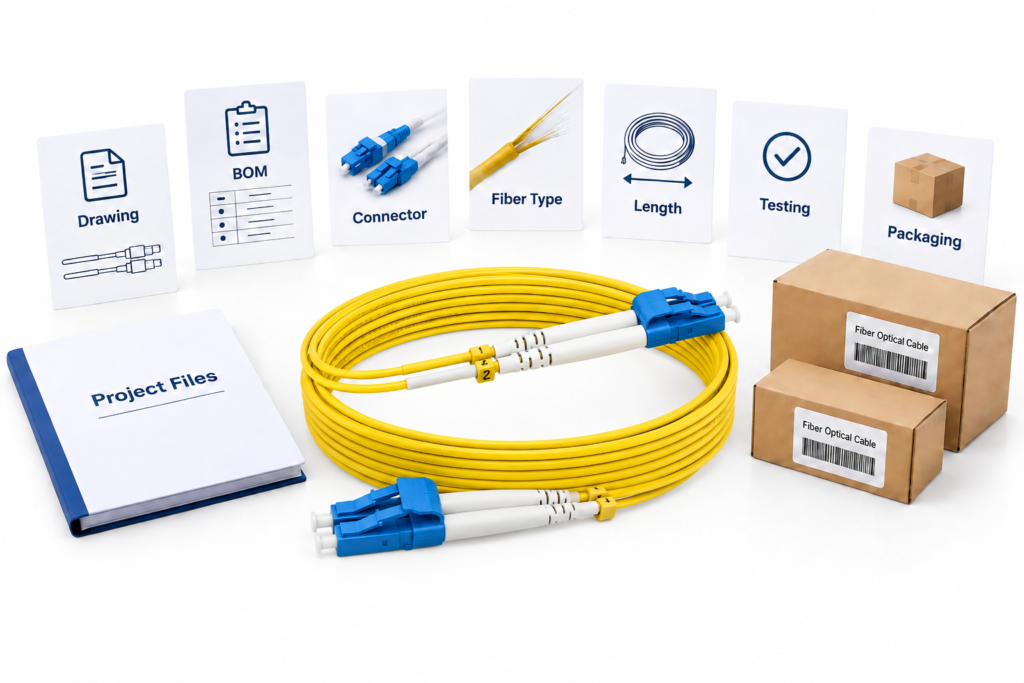
A strong RFQ combines structured specifications with evidence. Provide connector details, fiber specification, configuration, length, cable construction, optical requirements, quantity, application, test requirements, packaging, and available drawings, BOMs, part numbers, photographs, or reference samples. Unknown fields can remain open, but they should be visibly marked so the manufacturer knows exactly what still requires technical confirmation.
Which Files Should You Send?
Different project files answer different questions, so the strongest RFQ package often combines several sources instead of relying on one email paragraph. A dimensioned drawing controls length and important physical details. A BOM identifies approved fiber, connectors, boots, labels, and packaging components. Product photographs show physical appearance and connector arrangement. A reference part number can connect the project to an existing specification, while a physical sample can reveal details that were never recorded correctly in older documentation.
Do not delay an early review simply because the perfect drawing does not exist. Send the information that is available and separate verified facts from open points. An RFQ stating “LC/APC on both ends confirmed; finished length confirmed at 2 m; fiber specification requires verification; jacket may be recommended; optical acceptance pending engineering review” is considerably more useful than filling every blank field with an assumption.
This approach makes uncertainty manageable. Purchasing can see which requirements are fixed, engineering knows which questions remain, and the manufacturer can decide what information must be confirmed before the quotation or sample becomes final. Cablivo’s documented inquiry workflow includes collecting drawings, sample photos, BOMs, connector information, cable length, target quantity, and application details before project review and quotation.
What Application Details Should You Provide?
Application information gives technical specifications context. “LC/APC cable” defines the product family. “LC/APC duplex assembly connecting optical modules inside a compact telecom chassis” explains why cable diameter, bend performance, boot geometry, finished length, and connector handling may matter. A few sentences about the installation can expose engineering requirements that were invisible in the product name.
Useful information includes equipment type, installation location, available routing space, indoor or outdoor conditions, handling frequency, whether the cable moves during operation, how it is stored, and who performs final installation. Data-center projects may emphasize routing density and identification. Industrial communication equipment may put greater weight on protection and environmental conditions. Test equipment may experience more frequent connector handling, making cleanliness and connector protection particularly important.
Application details do not replace drawings or acceptance specifications. Their value is that they allow engineering to challenge an incomplete request. If a requested cable diameter, boot, bend condition, or packaging method appears inconsistent with the way the cable will actually be used, the question can be raised during review rather than after the first sample has already been produced.
What If Some Specs Are Missing?
Missing information is common in early product development. The risk comes from hiding those unknowns behind assumptions. A cleaner RFQ separates requirements into fixed items, open technical decisions, and optional features. Fixed requirements are items such as the equipment interface or maximum installed length that cannot change. Open items might include fiber construction, cable OD, jacket, or optical acceptance criteria. Optional items might include custom labeling, extra test documentation, or special packaging.
This structure allows different suppliers to quote against the same known information while clearly identifying where their recommendations differ. It also gives purchasing a better way to compare proposals. A supplier recommendation should not accidentally become a fixed customer requirement merely because it was written in the first quotation.
When drawings are incomplete, photographs, connector references, measured dimensions, existing samples, and application details can provide enough information for an initial review. The documented Cablivo engineering approach allows projects without complete drawings to begin with available sample photographs and basic confirmed information, with missing specifications identified before sampling.
How Do You Avoid Requoting?
Most repeated quotations are caused by specification movement rather than calculation mistakes. The simplest way to reduce requoting is to create a controlled quotation baseline. Give every supplier the same revision of the connector specification, fiber requirements, configuration, length, optical criteria, quantity, packaging, labeling, testing, and documentation expectations.
A revision number or date can prevent a surprising amount of confusion. If a requirement changes, record the change instead of sending another informal message into a long email thread. “Rev B: jacket changed to LSZH; all other specifications unchanged” is easier for engineering and purchasing to audit than an email saying, “Please use the new material we discussed yesterday.”
Before releasing the purchase order, compare the final quotation back to the final drawing or RFQ line by line. Confirm whether the supplier has made any exceptions or proposed alternatives. A lower price is not a saving when it was calculated against fewer tests, different packaging, another fiber construction, or an assumption that engineering never approved.
| RFQ Category | Minimum Useful Information | Better Supporting Evidence | Review Question |
| Product | LC/APC to LC/APC | Reference part number | Are both ends confirmed? |
| Fiber | Single mode / project-defined | Fiber specification | Is exact fiber approved? |
| Configuration | Simplex / Duplex | Existing sample photo | Does physical arrangement match? |
| Length | Finished length | Dimensioned drawing | How is length measured? |
| Cable OD | Fixed or open | Sample measurement | Is routing space limited? |
| Jacket | Required material | Customer specification | Is compliance connected to jacket? |
| Optical performance | IL / RL / wavelength | Engineering acceptance file | Are limits defined? |
| Quantity | Sample + production | Forecast by SKU | Is volume split correctly? |
| Packaging | Protection + label | Artwork / packaging file | Are connectors protected? |
| Application | Equipment + environment | Installation photo | Are routing conditions clear? |
| Quality | Testing and inspection | Customer checklist | Batch or individual records? |
| Revision | RFQ revision number | Controlled drawing/BOM | Is everyone quoting the same revision? |
A practical quotation package does not have to be complicated. One controlled sheet can contain the basic product specification, while drawings, BOMs, photographs, and quality requirements sit behind it as supporting files. What matters is that the manufacturer can identify exactly which information defines the product and which items are still waiting for a decision.
A concise RFQ might identify the product as an LC/APC to LC/APC duplex fiber assembly, specify OS2 fiber according to the attached drawing, give a 3.0 m finished length, state the required jacket and optical acceptance document, list sample and production quantities separately, define individual packaging with SKU identification, and attach the current drawing and BOM revision. If one item remains open, it should be marked as open rather than silently filled in.
That discipline has value beyond the first quotation. The same controlled specification becomes useful during sampling, sample revision, incoming inspection, mass-production preparation, packaging confirmation, repeat orders, and supplier changes. A well-built RFQ is therefore not only a purchasing tool. It becomes the beginning of the product’s manufacturing record.
Before You Request the Final Quote
The most useful quotation is not necessarily the one with the most detailed spreadsheet or the lowest first number. It is the quotation built against a clearly defined product. Before comparing suppliers, confirm that the connector configuration, fiber, simplex or duplex structure, cable length, OD, jacket, optical requirements, quantity, packaging, test documentation, and project revision are aligned. If one supplier is quoting a different construction or a different testing scope, the price comparison needs to show that difference.
An engineering team does not need every answer on the first day. Early projects often begin with an existing sample, several photographs, a connector requirement, and an approximate length. What matters is that the unknowns remain visible. Once they have been reviewed, the agreed sample and final documentation can become the reference for production rather than relying on assumptions carried forward from the first email.
For custom fiber-optic projects, Cablivo’s documented scope includes fiber optic cable supply together with connector confirmation, drawing review, sample development, quality inspection, packaging, labeling, and shipment coordination. If you are sourcing an LC/APC to LC/APC fiber cable assembly for telecom equipment, optical hardware, network systems, distribution programs, or another project-based application, the starting point can be the information you already have rather than a perfectly completed specification.
Send the available drawing, BOM, connector reference, sample photos, fiber requirement, cable length, expected quantity, application information, optical test requirements, labeling details, and packaging plan. Open specifications can then be identified during project review before the quotation and sample become the production reference.