Skip to content

“LC UPC to LC UPC, 2 meters, 1,000 pieces” looks like a reasonably complete purchasing request until several suppliers begin quoting it differently. The connector names and nominal length do not define the whole assembly. Fiber type, simplex or duplex construction, polarity, cable diameter, jacket requirement, optical acceptance criteria, labeling, packaging, and installation conditions can all change what is actually being manufactured. If those details remain open, a low quotation may simply reflect fewer requirements rather than a genuinely lower cost for the same product.
To quote an LC UPC to LC UPC fiber cable assembly accurately, the supplier normally needs the fiber type, simplex or duplex configuration, polarity where applicable, finished cable length, outer diameter, jacket requirement, optical performance criteria, test conditions, order quantity, application environment, labeling, packaging, documentation requirements, and any available drawings, BOMs, specifications, or approved samples. The purpose is not to create unnecessary paperwork; it is to remove assumptions that could change the finished cable or the commercial scope.
A typical quotation problem starts quietly. Three quotations arrive for what appears to be the same 2-meter duplex LC UPC assembly. One supplier assumed OS2 and LSZH, another priced an OM3 construction, while a third included individual optical test records and protective packaging. All three numbers may be reasonable, but they are not pricing the same specification. A strong RFQ avoids that problem by making the product definition clear before procurement begins comparing prices.
What LC UPC Configuration Is Required?
An accurate quotation begins by identifying the fiber type, simplex or duplex construction, polarity when duplex is used, and the intended application. “LC UPC to LC UPC” identifies the connector interface and polish but does not define the optical fiber inside the cable or the complete channel arrangement. Confirming these points first gives engineering and procurement teams a stable foundation for every specification that follows.
Which Fiber Type Is Required?
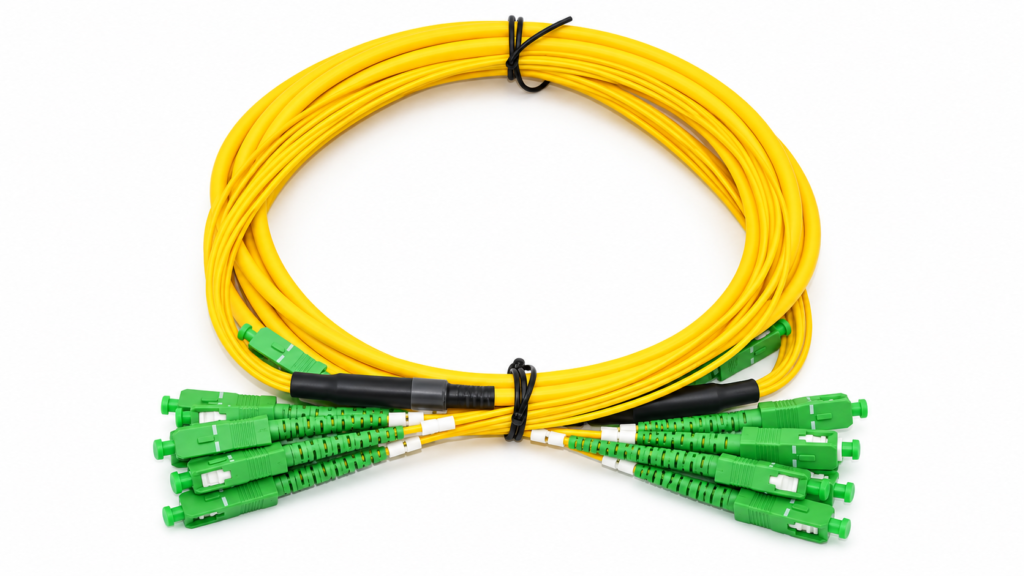
Fiber type is one of the first specifications that should be confirmed because LC UPC identifies the connector and polish rather than the optical fiber category. A project may use single-mode or multimode fiber even though the connectors look very similar from the outside. OS2 is commonly associated with 9/125 µm single-mode fiber, while OM3 and OM4 are commonly based on 50/125 µm multimode fiber. These categories support different optical systems, so the correct choice should come from the equipment platform, network design, BOM, approved drawing, or existing qualified assembly rather than appearance alone.
In practical sourcing work, the fastest route is often to look upstream at the equipment being connected. Transceiver specifications, optical module documentation, network drawings, or an existing part number can provide the fiber category that procurement needs to put into the RFQ. Jacket color may offer a useful visual clue because yellow is widely associated with single-mode cables and aqua is commonly seen with certain multimode assemblies, but color should never replace the actual fiber designation. A clear RFQ states something like “OS2 9/125 µm” or “OM4 50/125 µm” instead of leaving the supplier to interpret the word “fiber.”
Do You Need Simplex or Duplex?
Simplex and duplex describe how many optical paths are built into the cable assembly. A simplex LC assembly uses one fiber path, while a duplex assembly normally contains two fibers, commonly supporting separate transmit and receive channels. This choice changes more than the visible number of connectors. It influences fiber count, connector quantity, cable construction, duplex clips, channel identification, polarity control, inspection, packaging, and ultimately the quotation. A supplier pricing simplex construction is therefore not quoting an equivalent product if the equipment actually requires duplex.
When a replacement cable is being sourced, photographs can help identify whether the existing product is simplex or duplex, but the RFQ should still define it explicitly. For a duplex design, it is also useful to confirm whether the two LC connectors should remain clipped together and whether a particular orientation needs to be maintained at each end. These details become more important once a project moves from a single engineering sample into hundreds or thousands of assemblies where every piece needs to follow the same controlled configuration.
How Should Duplex Polarity Be Specified?
Duplex polarity controls the relationship between the two optical channels from one end of the assembly to the other. In most duplex links, the transmit path from one device needs to reach the correct receive path at the other device. If the relationship is reversed or interpreted differently during assembly, the cable can be physically compatible with the equipment while still failing to create the intended communication path. That is why phrases such as “standard polarity” or “normal wiring” can create unnecessary ambiguity in project documentation.
A stronger RFQ shows the A/B fiber relationship directly in a drawing or clearly defines connector orientation at both ends. Existing qualified samples can also be used as a reference, particularly for replacement programs, but the final orientation should still be documented before the sample becomes the production reference. If engineering has not yet finalized polarity, it is better to mark the field as “to be confirmed before sampling” than to let an undocumented assumption move into production. This simple discipline makes later sample approval and repeat-order control much easier.
What Application Will the Cable Serve?
Application information provides context for specifications that otherwise look like isolated numbers. An LC UPC assembly used for short equipment interconnection in a controlled data center may have different routing, jacket, labeling, and packaging priorities from a cable installed inside an industrial communication system or telecom cabinet. Procurement does not need to reveal confidential system architecture, but a simple description such as “data center equipment interconnection,” “telecom cabinet connection,” “industrial communication equipment,” or “test equipment interface” can significantly improve the technical review.
The application also helps engineering teams resolve fields that are still open. Dense routing may favor a smaller cable diameter, while a controlled building installation may require a specific jacket rating. Industrial or equipment programs may place more weight on cable protection, connector handling, labeling, and repeat-order consistency. Cablivo’s documented fiber optic product scope includes support for communication equipment, data center projects, network systems, optical communication equipment, industrial communication systems, test equipment, system integrators, engineering teams, and long-term supply programs.
| Configuration Item | Common Options | Typical Technical Reference | Selection Value |
| Fiber Type | OS2, OM3, OM4 | OS2 commonly 9/125 µm; OM3/OM4 commonly 50/125 µm | Matches network and optical equipment |
| Fiber Count | Simplex, Duplex | 1 fiber or 2 fibers | Defines basic assembly construction |
| Connector | LC UPC to LC UPC | UPC-polished LC interface | Defines the mating interface |
| Polarity | Project-defined A/B relationship | Drawing or approved sample | Prevents channel mismatch |
| Application | Data center, telecom, industrial, test equipment | Equipment or project documentation | Guides construction decisions |
| Reference Material | Drawing, BOM, sample, equipment specification | Project-controlled | Reduces quotation assumptions |
Which Cable Specifications Affect the Quote?
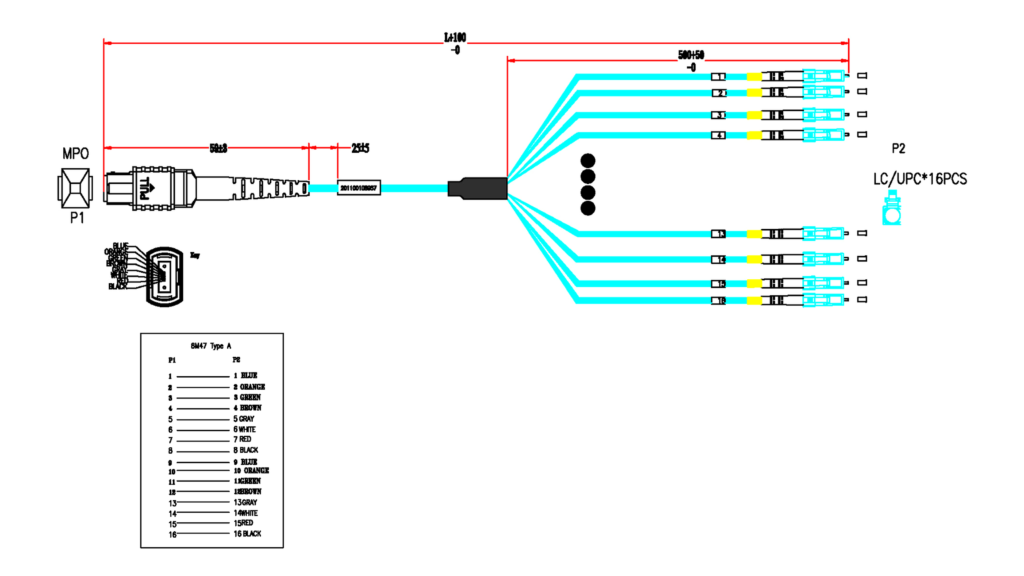
Finished length, length tolerance, cable outer diameter, jacket specification, color, and identification requirements can materially change the assembly being quoted. These specifications affect material usage, routing, mechanical behavior, production control, packaging, and SKU management. A cable can have the correct LC UPC connectors and correct fiber type yet still be unsuitable for installation because one of these physical requirements was left undefined.
What Length and Tolerance Are Required?
Length sounds simple until engineering and production use different measurement references. A request for “2 meters” should ideally identify whether the dimension means complete connector-to-connector length, cable length between defined reference points, or another measurement shown on the drawing. Two suppliers can manufacture slightly different finished assemblies from the same nominal number if both measure from different locations. This matters most when the cable is routed inside equipment, matched to an existing harness path, or installed where excess slack and insufficient reach both create problems.
Tolerance should come from the project requirement rather than being copied from an unrelated cable specification. If a drawing already defines allowable variation, include it directly in the RFQ. If no tolerance has been established, the supplier can provide its proposed production tolerance for engineering approval before sampling. Multi-length programs should also separate each length into an individual SKU. A project containing 1 m, 2 m, 3 m, and 5 m assemblies is much easier to quote, label, pack, receive, and reorder when every variant has its own controlled part number and quantity.
Which Cable Diameter Is Needed?
Cable outer diameter affects routing space, flexibility, bend behavior, connector boot compatibility, protection, and packaging. Common fiber patch cord constructions may use diameters around 2.0 mm or 3.0 mm, while smaller or larger constructions can also be used for specific designs. A smaller diameter can be useful in high-density equipment where routing space is limited, while a larger construction may be selected when greater mechanical protection is a priority. Neither choice is universally superior because the correct diameter depends on how the assembly will be installed and handled.
For an existing product, the approved sample, BOM, or drawing should be checked rather than estimating the diameter visually. For a new development, procurement can provide available routing space and application conditions while the supplier reviews suitable options with engineering. Diameter also needs to work with the LC connector boot and strain-relief transition. If these parts are considered independently, stress can become concentrated at the cable-to-connector transition, reducing the mechanical quality of the finished assembly even when the optical connection itself is correct.
Which Jacket Type Is Required?
Jacket requirements can have a meaningful influence on both suitability and quotation. Project documents may call for LSZH, OFNR or riser-rated construction, OFNP or plenum-rated construction, or another defined jacket specification. These categories are not interchangeable marketing terms. Their relevance depends on the installation environment, destination market, applicable project rules, and the cable design itself. A quotation based on a general-purpose jacket therefore should not be compared directly with one that includes a project-specific flame or installation requirement.
When the jacket requirement is not yet known, the RFQ should describe the installation environment and identify the target market or governing project document. Engineering can then review which requirement needs to be confirmed before production. Avoid selecting a jacket only because it is common on another fiber cable. A data center patching application, equipment-internal assembly, telecom cabinet connection, and building pathway can create different practical requirements. Compliance claims should remain tied to actual product materials, project specifications, and available documentation rather than assumed across all cable assemblies.
Are Cable Color and Identification Specified?
Color and identification may look secondary during prototype development, but they become important once a program contains multiple lengths, fiber types, or customer part numbers. A network team may use different jacket colors to distinguish connection paths, while an equipment manufacturer may rely on its own part number to control incoming materials. A distributor may require separate barcodes for visually similar 1 m, 2 m, and 3 m cables. In these situations, identification becomes part of production control rather than a cosmetic preference.
For repeat orders, label files, customer SKU numbers, barcode data, carton marks, and package identification should be controlled like other production documents. If these details are introduced only after the cable itself has been produced, additional handling and rework may be required. The quotation should therefore make clear whether identification is printed on the cable, applied as a separate label, placed on individual packaging, or used only on cartons. This improves warehouse accuracy and reduces the risk of receiving technically correct assemblies under the wrong SKU.
| Cable Specification | Common Reference | Typical Application Impact | RFQ Check |
| Finished Length | 0.5 m, 1 m, 2 m, 3 m, 5 m or custom | Routing and equipment fit | Confirm measurement reference |
| Length Tolerance | Project-defined | Important for controlled routing | Use drawing or agreed production tolerance |
| Cable OD | Commonly around 2.0 mm or 3.0 mm | Density, flexibility and protection | Check connector boot compatibility |
| Jacket | LSZH, riser, plenum or project-defined | Installation suitability | Confirm project requirement |
| Jacket Color | Yellow, aqua or customer-defined | Visual identification | Do not use color alone to identify fiber |
| Labeling | P/N, SKU, barcode, length, lot information | Warehouse and repeat-order control | Supply approved label data |
What Optical Performance Must Be Defined?
Optical acceptance criteria should be agreed before the sample becomes the production reference. Insertion loss, return loss, test wavelength, connector end-face condition, and reporting requirements can all affect inspection scope and project acceptance. Exact limits should come from the network design, equipment specification, customer drawing, or agreed project standard rather than being copied from a generic LC UPC product listing.

What Insertion Loss Is Required?
Insertion loss describes how much optical power is lost as light passes through the connectorized path. It is one of the most useful performance fields in an RFQ because excessive loss reduces the available system power margin. Industry specifications may use values such as 0.3 dB or 0.5 dB as connector-level reference limits in some projects, but those figures are not universal. Component grade, test method, network design, customer specification, and the way the finished assembly is evaluated can all affect the acceptance requirement.
The RFQ should therefore state the actual maximum insertion loss when engineering has already defined it. If the value remains open, write “insertion loss requirement: to be confirmed” and request the proposed specification for review rather than selecting a convenient number from another product page. The inspection scope also needs to be clear. A quotation that includes measured and recorded optical results is not necessarily equivalent to one based only on routine production inspection, even when both quotations use identical connectors and fiber.
What Return Loss Is Required?
Return loss relates to reflected optical power and is influenced by connector polish, mating quality, end-face condition, and cleanliness. Single-mode UPC applications often reference values around 50 dB or higher in commercial specifications, but the appropriate requirement still depends on the actual equipment and project standard. The important distinction is that “LC UPC” describes the connector interface and polish style; it does not automatically define every optical performance criterion that the finished assembly needs to meet.
When the customer specification contains a return-loss limit, that value should appear directly in the RFQ and, where relevant, in the inspection plan. If no project requirement exists yet, it is more reliable to keep the field open for technical review. This prevents an arbitrary value from becoming an unintended contract requirement. It also gives procurement a cleaner basis for comparing quotations because suppliers can be asked to price the same optical acceptance scope instead of embedding different assumptions behind otherwise similar product descriptions.
Which Wavelengths Should Be Tested?
Test wavelengths should follow the fiber type and the system requirement. OS2 single-mode testing commonly references 1310 nm and 1550 nm, while 850 nm is widely associated with multimode applications using OM3 or OM4. A 1300 nm wavelength may also appear in certain multimode characterization or project test requirements. These values are useful industry references, but an RFQ should include only the wavelengths that are actually relevant to the project instead of listing every possible option.
Where engineering already has a test specification, attach that document so the supplier can follow the defined wavelength, reference method, acceptance limit, and reporting format. This is safer than summarizing only part of the requirement inside an email. When no final test plan exists, the supplier can propose test conditions for approval during sample development. The approved test method can then become part of the production reference, making later quality checks and repeat orders more consistent.
Is End-Face Inspection Required?
Fiber connector end faces are sensitive to contamination and physical damage, and problems are not always visible without magnification. A connector can look clean during normal handling while still containing particles or defects in areas that affect optical performance. For projects with tighter quality requirements, microscopic end-face inspection may therefore be incorporated into incoming, in-process, or finished-product verification. The RFQ should identify whether inspection is required and whether the customer expects simple pass/fail confirmation, stored images, or another documentation format.
Packaging is closely connected to this requirement because a properly inspected connector still needs to reach the installation site in the same condition. Dust caps, controlled handling, suitable coiling, and connector protection help reduce contamination and mechanical damage during packing and transportation. When a project requires optical records or detailed inspection evidence, this should be discussed before quotation rather than added at the end of production. Cablivo’s documented fiber project scope requires optical parameters and test requirements to be confirmed according to actual project information instead of invented or generalized.
| Optical Item | Common Industry Reference | Practical RFQ Use | Key Caution |
| Insertion Loss | Some projects use ≤0.3 dB or ≤0.5 dB per connection | Defines loss acceptance | Use the actual project requirement |
| Return Loss | Single-mode UPC projects may specify ≥50 dB | Controls reflection performance | Do not assume one value fits every cable |
| OS2 Test Wavelength | Commonly 1310 nm / 1550 nm | Single-mode verification | Follow network or equipment specification |
| OM3/OM4 Wavelength | Commonly 850 nm; 1300 nm may also appear | Multimode verification | Confirm the approved test method |
| End-Face Inspection | Microscopic inspection | Finds contamination or surface defects | Define acceptance criteria |
| Test Records | Pass/fail or recorded measurements | Supports controlled projects | Confirm reporting scope before quote |
What Order and Packaging Details Are Needed?
Quantity, SKU count, packaging method, labels, documentation, and shipment requirements should be discussed before the final commercial offer. These fields may not change the optical path, but they affect material planning, production organization, inspection, packing labor, carton configuration, and order management. For distributors, equipment manufacturers, and repeat supply programs, packaging and identification can become as important operationally as the fiber assembly itself.

What Quantity Should Be Quoted?
Quantity gives the supplier enough commercial context to evaluate material preparation, connector sourcing, production planning, inspection, and packaging. A prototype quantity, first production run, and repeat supply program are different situations even when the cable specification is identical. Procurement teams should separate confirmed demand from forecasts so the quotation reflects a realistic order rather than an optimistic future volume. A statement such as “initial order: 1,000 pcs; future forecast under review” is usually more useful than presenting an unconfirmed annual number as firm purchasing demand.
For many custom cable projects, Cablivo’s current verified MOQ guidance starts from 500 pieces, while the final MOQ depends on the product type, connector, cable structure, materials, packaging plan, tooling needs, and quantity. Fiber projects should still be reviewed individually because connector sourcing, optical test scope, length mix, and packaging can change the commercial calculation. Multi-SKU orders should also show quantity per variant because 5,000 total pieces spread across ten lengths are operationally different from 5,000 identical assemblies.
Which Packaging Method Is Required?
Fiber cable packaging needs to protect the assembly from excessive bending, contamination, connector damage, tangling, abrasion, and transportation stress. Short patch cords may be packed individually in protective bags, while longer cables may require controlled coils or reel-based handling depending on length and construction. The packaging method should respect the cable’s mechanical limitations rather than forcing it into the smallest possible carton. Saving packaging volume has little value if the finished assemblies arrive with stressed fibers or damaged connectors.
Connector protection also deserves early attention because LC ferrules and end faces need to remain clean and physically protected. Dust caps, separation from heavy components, stable coiling, and internal carton organization help reduce handling risk. Multi-SKU projects benefit from clear physical separation so the receiving warehouse can identify each variant without opening every package. Packaging requirements should therefore enter the quotation before production begins, especially when longer lengths, individual retail-style packing, or special protective arrangements are required.
Are Labels or Barcodes Required?
Labels and barcodes become especially important when several LC UPC assemblies look almost identical but differ in fiber type, cable length, customer part number, or destination. A controlled product program may need a customer P/N, supplier P/N, SKU, barcode, length, quantity, lot information, carton number, or shipping mark. These fields can appear in different locations, including the cable itself, individual package, inner box, or export carton, so the RFQ should identify which information belongs at each level.
For distributors and long-term equipment programs, label accuracy is part of quality control rather than a purely administrative task. An assembly can pass optical tests and still cause a receiving problem if the wrong part number or barcode is applied. Approved label artwork, barcode files, SKU lists, and carton marks should therefore be revision-controlled before bulk production. Cablivo’s verified project capabilities include packaging, labeling, barcode and SKU coordination for project-based cable programs, helping support clearer receiving and repeat-order management.
Are Compliance Documents Required?
Compliance documentation should be defined according to the actual product, materials, destination market, and application rather than requested through a generic phrase such as “all certificates.” A project may require material declarations, supplier documentation, test reports, customer-specific forms, or third-party testing, while another project using the same connector may not require the same documents. Listing the actual documentation needs gives suppliers a clearer basis for quotation and prevents unnecessary assumptions about what is included.
This approach is particularly important when comparing quotations because one supplier may include testing or documentation that another excludes. Compliance requirements should therefore be reviewed before sampling or mass production, and any certificate or report should correspond to the actual cable, materials, and defined scope. Cablivo’s documented compliance approach is project-based: requirements are reviewed according to product type, target market, application, materials, testing needs, and real supporting documents rather than applying blanket certification claims to every cable product.
| Commercial Item | Example Project Data | Why It Matters | Procurement Check |
| MOQ | Often starts around 500 pcs for many custom projects | Material and production preparation | Confirm individually for fiber project |
| Order Quantity | 500 / 1,000 / 5,000 pcs | Sourcing and scheduling | Separate confirmed quantity from forecast |
| SKU Count | 1–10+ variants | Packaging and inventory complexity | List quantity for each SKU |
| Packaging | Individual bag, controlled coil, reel | Cable and connector protection | Confirm handling requirements |
| Product Label | P/N, SKU, barcode, length | Identification and traceability | Approve file before production |
| Carton Mark | PO, SKU, quantity, destination | Warehouse receiving | Supply final shipping information |
| Documentation | Material, testing or compliance files | Project acceptance | Define exact required documents |
How Do You Prepare a Complete RFQ?
A complete RFQ brings technical construction, optical requirements, quantity, packaging, and reference documents into one controlled project package. It does not need to be complicated or excessively long. The most useful RFQs clearly separate confirmed specifications from open points, include available drawings or samples, and identify which details must be resolved before the sample becomes the approved reference for production.
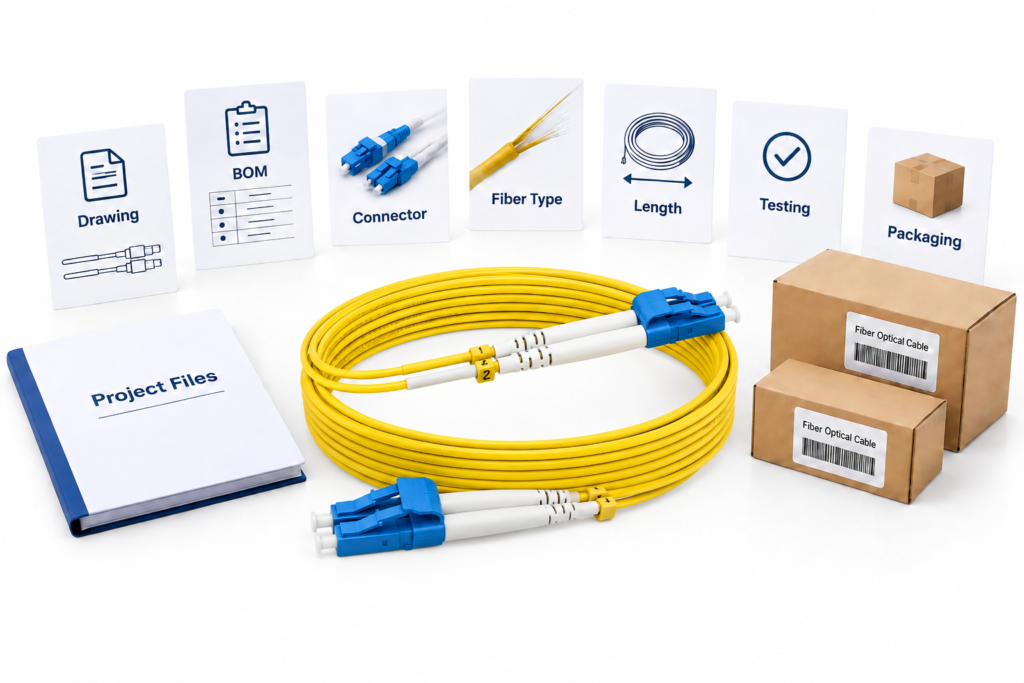
Do You Have a Drawing, BOM, or Sample?
A drawing is usually the clearest reference because it can define connector configuration, length, polarity, cable construction, dimensions, labeling, and technical notes in one controlled document. A BOM is valuable when approved connector models, fiber materials, packaging parts, or customer-specific components need to be checked during sourcing. When the project is based on an existing cable, a qualified physical sample can provide useful information about connector orientation, cable diameter, jacket feel, color, polarity, labels, and packaging that may not be obvious from a short written description.
Not every sourcing project begins with a complete production drawing. High-quality photographs can still help start an engineering review when they clearly show both connectors, the full cable, labels, packaging, and any distinctive structure. The customer can then add the information already known, such as fiber type, finished length, application, target quantity, and testing expectations. The goal is not to reject incomplete projects but to identify missing information before those gaps become assumptions inside the quotation or sample.
Which Details Must Be Confirmed Before Sampling?
Quotation can often begin while a few engineering fields remain open, but the sample should eventually represent a controlled specification that both sides understand. Before a sample becomes the production reference, the project should normally confirm fiber type, LC UPC connector configuration, simplex or duplex structure, polarity, length, cable diameter, jacket, color, optical performance requirements, test conditions, labeling, packaging, and any documentation that must accompany the product. Open issues should be visible rather than buried inside email conversations.
Revision control becomes important when sample feedback creates changes. If the first sample leads to a new length, jacket color, label position, polarity arrangement, or packaging format, those updates should be added to the drawing or final specification before the next stage. The approved sample, final drawing, and related project files can then support production preparation and repeat orders. Cablivo’s documented workflow includes requirement review, drawing review, BOM review, sample review, sample revision, sample approval, and production preparation according to confirmed project requirements.
How Do Missing Specifications Change the Quote?
Missing specifications create assumptions, and different suppliers may make different assumptions without clearly showing them in the quotation. Consider an RFQ that says only “LC UPC to LC UPC duplex, 2 m, 1,000 pcs.” One supplier may assume OS2 and LSZH, another may assume OM3 and a different jacket, and a third may include optical measurement records that the other two did not price. One quotation may use individual protective packaging while another assumes bulk packing. The spreadsheet may look comparable even though the products and inspection scopes are not.
A practical way to manage this uncertainty is to classify every RFQ field as “confirmed,” “supplier to propose,” or “to be confirmed before sampling.” Procurement can still collect commercial information without pretending that engineering has already finalized every detail. When a quotation changes later, the reason is easier to trace because everyone can identify which specification changed. This also reduces disputes around cost increases that are actually the result of a new material, test requirement, package format, or product configuration introduced after the original quotation.
What Should the Final RFQ Include?
The final RFQ should allow a supplier who has never seen the project to understand the requested assembly without relying on undocumented assumptions. Each SKU should identify the fiber type, LC UPC connector configuration, simplex or duplex construction, polarity, finished length, cable OD, jacket, color, application, optical requirements, test conditions, quantity, packaging, labels, destination, and relevant reference files. Open technical questions should be listed explicitly so engineering and procurement know which decisions are still pending.
This structure also improves supplier comparison because every quotation can be checked against the same product definition. Cablivo’s verified project scope supports review of drawings, sample photos, BOMs, connector information, cable length, testing requirements, packaging plans, sample development, production preparation, quality inspection, packaging, labeling, and shipment coordination. If some information is unavailable at the first inquiry, the available project materials can be reviewed first and the remaining points identified before sampling or bulk-production discussion.
| RFQ Field | Example Entry | Status Option | Project Value |
| Product | LC UPC to LC UPC Fiber Cable Assembly | Confirmed | Defines the assembly |
| Fiber Type | OS2 9/125 µm | Confirmed / Open | Defines optical platform |
| Construction | Duplex | Confirmed | Defines fiber count |
| Polarity | Per approved drawing | Confirmed / Open | Controls channel relationship |
| Length | 2.0 m | Confirmed | Controls installation fit |
| Cable OD | 2.0 mm | Confirmed / Supplier to propose | Affects routing |
| Jacket | LSZH | Confirmed / Open | Defines installation requirement |
| Optical Limit | Per project specification | Confirmed / Open | Defines acceptance criteria |
| Test Wavelength | 1310 / 1550 nm where specified | Confirmed / Open | Defines verification condition |
| Quantity | 1,000 pcs | Confirmed | Supports commercial planning |
| Packaging | Individual protective bag | Confirmed / Open | Protects cable and connectors |
| Label | Customer P/N + barcode | Confirmed / Open | Supports SKU management |
| Drawing | Current revision attached | Confirmed | Main technical reference |
| BOM | Attached if applicable | Available / N/A | Supports material review |
| Approved Sample | Available if applicable | Available / N/A | Supports physical comparison |
| Open Issues | Clearly listed | To be confirmed | Prevents hidden assumptions |
A precise LC UPC to LC UPC quotation is not created by adding more words to an inquiry. It comes from defining the few specifications that genuinely control the product, the inspection scope, and the way the order will be delivered. When engineering and procurement provide those fields consistently, quotations become easier to compare, sample approval becomes more meaningful, and the risk of discovering specification differences after the purchase order is reduced.
For a custom LC UPC to LC UPC fiber cable assembly project, send the information already available rather than waiting for every document to become perfect. Fiber type, connector configuration, simplex or duplex requirement, polarity, cable length, jacket, application, target quantity, optical test expectations, packaging requirements, drawings, BOMs, specifications, and reference sample photos can all provide a useful starting point. Cablivo can review the confirmed information and identify which remaining details should be clarified before quotation, sampling, or production preparation.