Skip to content


An HVAC wire harness can look simple when it is reduced to a few lines on a quotation sheet. In the equipment, however, it may connect a control board to a compressor, blower motor, pressure sensor, thermostat, contactor, solenoid valve, damper actuator, or communication module. Each circuit can carry a different electrical load while facing heat, condensation, vibration, sharp sheet-metal edges, limited routing space, or interference from nearby motors. A useful quotation therefore depends on much more than a product photo and an estimated cable length.
To quote a custom HVAC wire harness accurately, the manufacturer needs the latest drawing or sample, BOM, connector and terminal part numbers, pinout, wire gauge, branch dimensions, voltage and current, installation environment, testing requirements, prototype and production quantities, packaging details, delivery destination, and required schedule. Any missing information should be recorded as a quotation assumption rather than silently guessed.
The purpose of a detailed RFQ is not to create extra paperwork. It is to prevent uncertainty from turning into connector substitutions, undersized conductors, unsuitable seals, missing tests, installation problems, or unexpected charges after sample development. One additional page of technical information can save several rounds of emails and revisions. In many projects, the most expensive quotation is not the highest one; it is the lowest quotation based on a product that was never fully defined.
What Project Files Are Needed?
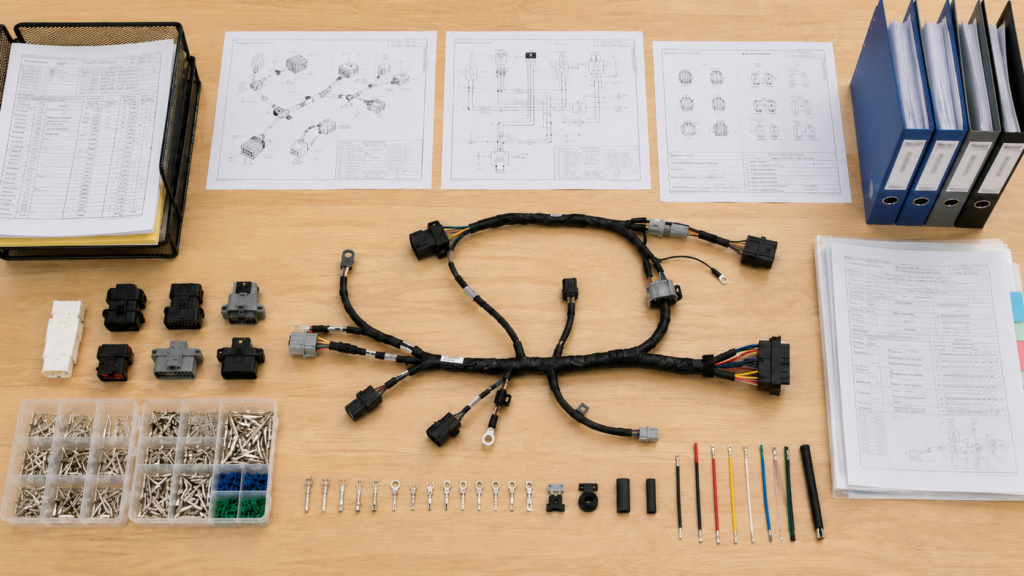
An accurate HVAC wire harness quotation normally begins with a controlled harness drawing, wiring diagram, BOM, connector references, sample evidence where necessary, and a confirmed revision level. These files define the product that must be manufactured. When one of them is incomplete, the manufacturer may still prepare a preliminary estimate, but the undefined items must remain visible assumptions until engineering review or sample inspection confirms them.
| Project input | Minimum useful information | Practical review standard | Quotation risk when missing |
| Harness drawing | Overall layout, branches, connectors, lengths and tolerances | Every critical dimension has a clear datum and unit | Material use and assembly labor must be estimated |
| Wiring diagram | Connector cavities, circuit names, polarity and destinations | Every active circuit can be traced from end to end | Pinout testing and fixture design remain undefined |
| BOM | Manufacturer, complete part number, quantity and approved alternative | Each component has one controlled reference | Connectors, seals or accessories may be excluded |
| Physical sample | Complete representative harness and mating information | Sample version matches the intended quotation baseline | Hidden structure may require inspection or reverse engineering |
| Photo set | Full layout, connectors, labels, branches and scale reference | Multiple clear views show all visible features | Suitable only for preliminary evaluation |
| Revision record | Drawing, BOM, sample and change status | One current package is shared by all teams | Different suppliers may quote different product versions |
Drawings and Wiring Data
A useful harness drawing should show more than overall cable length. It should identify branch locations, breakout distances, connector orientation, cable exit direction, free-wire ends, strip lengths, splice points, protective sleeves, conduit, clips, grommets, labels, heat-shrink positions, and any molded or overmolded areas. Dimensions must be measured from clearly defined reference points, such as the rear face of a connector housing, the center of a breakout, or a marked installation datum.
This level of detail prevents common interpretation errors. A branch described as 300 millimeters can produce different finished parts when one team measures from the connector contact and another measures from the rear of the housing. A small dimensional difference may stop a connector from reaching a control board or force excess wire into a narrow compartment. Dimensions that directly affect installation should therefore be marked as critical, while service loops and open routing areas can use practical manufacturing tolerances.
The wiring diagram should identify connector references, cavity numbers, circuit names, wire colors, wire gauge, polarity, grounding, sensor lines, communication pairs, shield termination, splices, and unused cavities. This information allows the manufacturer to prepare cutting instructions, assembly documentation, and an electrical test program. A physical harness can be assembled without complete wiring data, but continuity, short-circuit, polarity, and pinout testing cannot be defined reliably when the approved circuit map is missing.
BOM and Part Control
The BOM should list every material required for one finished harness, including wire, connector housings, terminals, secondary locks, seals, cavity plugs, sleeves, conduit, heat-shrink tubing, clips, cable ties, labels, grommets, fasteners, overmolding resin, protective caps, and packaging components. Each item should have a manufacturer name, complete part number, quantity per assembly, and approval status wherever that information is available.
Generic descriptions create avoidable uncertainty. A phrase such as “four-pin waterproof connector” may refer to many visually similar products with different keying, terminal ranges, seal diameters, current ratings, latch structures, plating systems, and mating interfaces. The quotation should be based on the exact housing, terminal, seal, secondary lock, and mating connector whenever possible. If a part number is not yet known, photographs and equipment-side information can support identification, but the quotation should clearly state that final component confirmation is still required.
Approved alternatives also need a defined process. Some projects permit equivalent connectors or wire materials when performance is maintained, while others require the exact nominated brand and part number. The BOM should state whether alternatives can be proposed, who approves them, and whether customer-supplied parts are included in the supplier’s scope. These details affect sourcing lead time, minimum component purchases, tooling compatibility, quotation validity, and the ability to maintain the same specification during repeat production.
Samples and Photos
A physical sample is valuable for replacement projects, legacy equipment, supplier changes, and products whose original drawings are unavailable. It allows the manufacturer to review connector fit, branch routing, wire colors, sleeve construction, attachment points, labels, cable flexibility, overall workmanship, and the relationship between the harness and the equipment. The customer should explain whether the sample is a current approved production part, an early prototype, a field-used unit, or a part containing temporary modifications.
A sample should not automatically be treated as the complete specification. Existing products can contain undocumented substitutions, worn components, field repairs, production deviations, or materials that are no longer available. Hidden splices, conductor size, terminal plating, crimp geometry, internal seals, shielding termination, and electrical ratings may require measurement, continuity mapping, component identification, or limited disassembly before a production quotation can be finalized.
When only photos are available, the set should include the complete harness laid flat, a ruler or scale reference, front and rear connector views, latch and keying details, terminal close-ups, branch transitions, label details, clips, protective coverings, and installation photos. Clear images can support a preliminary review, but they cannot reliably confirm internal wiring, conductor structure, AWG, terminal material, or sealed-cavity construction. Those items should remain open questions rather than being filled with convenient assumptions.
Revision Control
Every quotation should identify the exact technical baseline used for pricing. This normally includes the drawing number and revision, BOM revision, wiring-diagram revision, sample version, and the date of any approved engineering deviation. When engineering, procurement, quality, and an existing supplier hold different files, a controlled quotation package prevents each party from discussing a slightly different harness under the same product name.
A small engineering change can affect several areas at once. Changing one connector may require new terminals, seals, crimp tooling, mating test connectors, assembly instructions, and packaging protection. Increasing the wire gauge can change cable diameter, sleeve size, bend radius, terminal selection, connector sealing range, and routing space. Moving a breakout point may require a revised assembly board and different inspection references even when the total wire length remains similar.
Open items do not always prevent quotation, but they should be visible. A quotation may state that pricing assumes a specific connector, branch length, material, test method, or packaging format pending final confirmation. This gives all teams a traceable basis for comparison. Before mass production, the approved sample, final drawing, final BOM, test specification, and label or packaging files should refer to the same revision so that production is not released against a mixture of old and new information.

Which Electrical Specs Matter?
The manufacturer needs the operating voltage, continuous and peak current, circuit function, conductor size, insulation requirement, connector and terminal references, pinout, polarity, wire lengths, and acceptable voltage drop. These specifications determine the wire and terminal system, material cost, crimp tooling, heat performance, routing diameter, electrical test method, and whether the finished harness can operate reliably inside the intended HVAC equipment.
| Electrical factor | Information to provide | Common project discussion | Main quotation value |
| Voltage | Nominal, maximum and test voltage | Low-voltage control, sensor, communication or equipment power circuits | Defines insulation and test conditions |
| Current | Continuous, intermittent, peak and inrush current | Motors, relays, valves and actuators may have startup loads | Drives conductor, terminal and connector selection |
| Wire gauge | AWG or square millimeters for each circuit | Selected from current, length, temperature and voltage-drop needs | Controls copper cost, diameter and flexibility |
| Temperature rating | Required conductor and insulation class | May differ between general cabinet wiring and local hot zones | Affects insulation and jacket material |
| Pinout | Cavity-to-cavity map with circuit and polarity | Includes grounds, splices, shields and unused cavities | Defines assembly and electrical testing |
| Voltage drop | Maximum permitted drop at a stated load | Important for longer DC power and actuator circuits | May require a larger conductor than current alone suggests |
Load Definition
The RFQ should explain the function of each electrical circuit rather than describing the harness only as low voltage or high current. Power conductors, motor leads, relay circuits, sensor wires, communication pairs, grounds, heater circuits, and protective devices can have different material, shielding, routing, and test requirements. A circuit connected to a temperature sensor should not automatically be specified in the same way as a lead serving a contactor or blower motor.
For every circuit, provide nominal voltage, maximum operating voltage, continuous current, intermittent current, peak current, and startup or inrush current where applicable. Motors, solenoids, relays, valves, actuators, and compressor-related components can draw more current during startup than during normal operation. The duty cycle also matters because a conductor carrying a load for several seconds faces different thermal conditions from one carrying the same load continuously inside a warm enclosure.
Long DC circuits may require an explicit voltage-drop limit. A wire can remain below its thermal limit while still delivering insufficient voltage to an actuator, valve, control module, or motor. When the equipment design does not provide a voltage-drop target, the customer should confirm the wire size or allow the manufacturer to review it using the actual current, cable length, temperature, bundling, connector resistance, and installation conditions.
Wire and Insulation
Wire gauge affects far more than copper cost. It changes the outside diameter, flexibility, weight, bend radius, terminal range, connector rear-seal fit, sleeve size, routing space, and packaging volume. Increasing the conductor size may reduce voltage drop but can make the harness too stiff for a narrow control compartment or too large for the nominated terminal and seal. Reducing the size may improve flexibility while increasing heat, resistance, or mechanical risk.
The RFQ should state whether the conductor is bare copper or tinned copper, solid or stranded, and whether a particular strand structure or flexibility level is required. Tinned conductors may be discussed for applications involving soldering, moisture, or corrosion concerns, while bare copper is used in many standard internal harnesses. The correct selection depends on the complete system rather than on one isolated material preference.
Insulation should be reviewed against voltage, operating temperature, local hot spots, abrasion, moisture, oil, chemical exposure, flexibility, and applicable equipment requirements. PVC is common in many general-purpose wire constructions, while XLPE, TPE, TPU, silicone, and other materials may be considered for higher temperature, flexibility, abrasion resistance, weathering, or chemical exposure. Final material selection should remain tied to the actual application, test plan, target market, and connector limitations rather than being presented as one universal solution.
Connectors and Terminals
The connector specification should include the manufacturer, full housing part number, mating connector, gender, cavity count, keying, color, latch structure, secondary lock, terminal part number, wire-seal range, cavity plug, backshell, and plating requirement where applicable. The equipment-side connection should also be identified, especially when the harness mates directly with a PCB header, compressor, sensor, blower motor, valve, transformer, or controller.
Terminal selection must match both the connector housing and the conductor. One connector family may offer several terminal versions for different wire ranges, current levels, plating systems, and sealed or unsealed configurations. The selected terminal determines the required crimp applicator or die and affects crimp height, pull-force criteria, electrical resistance, and production method. A housing part number without the correct contact reference is therefore not a complete connector specification.
The RFQ should state whether original-brand components are mandatory or whether qualified alternatives may be proposed. A component that physically mates can still differ in contact resistance, retention force, temperature rating, sealing, resin, or long-term availability. Component packaging also changes production planning. Reel-fed contacts can support automated or semi-automated processing, while loose-piece terminals may require a different tool, more handling, and additional inspection.
Pinout and Dimensions
The pinout should map every circuit from its source connector and cavity to its destination connector and cavity. Each line should identify the circuit name, wire color, wire gauge, polarity, splice, shield, drain wire, ground point, twisted pair, and any unused cavity requiring a seal or plug. For smart HVAC equipment, communication lines, variable-speed controls, and sensor circuits may also require specific pairing, shielding, grounding, or separation from motor and power wiring.
Physical dimensions should include overall length, branch length, breakout position, free-wire length, strip length, sleeve position, label location, connector orientation, and cable exit direction. The drawing must show the datum used for each measurement. A stated length has limited value when it is not clear whether measurement begins from the terminal contact, front face, rear housing, or breakout center.
Tolerances should reflect installation risk rather than one standard value applied everywhere. A short branch entering a fixed control-board connector may need tighter control than a long service loop inside an open enclosure. Extremely tight tolerances increase setup, inspection, and rejection risk, while excessively loose tolerances can create routing or installation problems. The final pinout and dimensional specification becomes the basis for cutting programs, assembly boards, operator instructions, electrical test fixtures, and production inspection.

What HVAC Conditions Must Be Defined?
The RFQ should describe where the harness is installed and what it experiences during operation, servicing, storage, and transportation. Important conditions include equipment location, temperature, humidity, condensation, rain exposure, vibration, movement, abrasion, chemicals, electromagnetic interference, and available routing space. These factors influence insulation, jacket, connector sealing, shielding, sleeves, clips, grommets, overmolding, strain relief, and validation requirements.
| HVAC location or condition | Information to confirm | Possible protection or structure | Main risk to evaluate |
| Indoor control cabinet | Local temperature, routing space, service access | Standard insulation, organized sleeving, clips and labels | Wiring error, congestion and poor serviceability |
| Outdoor condenser | Temperature cycling, rain, UV, dust and corrosion | Weather-resistant jacket, sealed connector and conduit | Moisture entry, aging and corrosion |
| Near compressor | Local heat, vibration, oil and mounting distance | Higher-temperature insulation, secure clips and abrasion sleeve | Fatigue, heat damage and rubbing |
| Air-handler or drain area | Humidity, condensation, dripping and orientation | Sealed interface, drip-aware routing and moisture-resistant materials | Water accumulation and terminal corrosion |
| Near motor or VFD wiring | Signal sensitivity and circuit separation | Twisted pair, shielding and controlled grounding | Signal disturbance and false readings |
| Sheet-metal opening | Edge condition, movement and cable diameter | Grommet, edge guard, conduit or reinforced sleeve | Insulation cuts and short circuits |
Installation Location
The RFQ should identify the exact HVAC unit, connected components, and installation position. A harness inside a dry thermostat enclosure has different requirements from one routed through an outdoor condenser, near a compressor, across a furnace cabinet, or beside a drain pan. Installation photos, equipment drawings, and routing sketches help the manufacturer understand clearances, panel openings, bend points, hot surfaces, moving parts, and access during assembly or service.
The customer should also explain whether the harness is installed at the equipment factory, connected by a field technician, supplied as a replacement part, or used between separate modules. A factory-installed harness may prioritize fast connection, error-resistant keying, fixed clips, and repeatable routing. A service harness may need clearer labels, easier mating access, individual packaging, and protection that reduces damage during transportation and field handling.
Available space should be measured rather than described only as limited. Connector rear clearance, minimum bend radius, sleeve diameter, breakout direction, clip location, and overmold geometry can prevent installation even when the overall cable length is correct. For modular equipment, the RFQ should state whether one harness will serve several product models or whether optional branches, alternate connectors, and multiple labeled versions are required.
Temperature and Moisture
Temperature requirements should include minimum and maximum operating temperatures, storage conditions, local hot spots, and expected thermal cycling. The general ambient temperature of an HVAC unit may not represent the temperature experienced by every branch. Wiring near a compressor shell, heater, motor, heat exchanger, or discharge line can require a different insulation or jacket rating from wiring located inside a cooler control area.
Moisture conditions should be described with equal care. High humidity, condensation, dripping water, outdoor rain, contaminated drain water, and washdown are different exposures. Condensation can collect at low points or enter a connector when the cable orientation directs water toward the mating interface. A connector described as sealed can still perform poorly when the wrong wire-seal diameter is used, a cavity plug is missing, or the cable exit creates a path for water accumulation.
When environmental validation is needed, the RFQ should define temperature range, humidity, dwell time, number of cycles, sample quantity, and required post-test checks. Water-ingress requirements should identify the complete connector and sealing system, including terminals, wire diameter, rear seals, cavity plugs, mating condition, and cable orientation. This allows the test to represent the finished assembly rather than only the connector housing.
Vibration and EMI
Compressors, fans, pumps, dampers, transportation, and equipment servicing can expose a harness to vibration or repeated movement. The RFQ should identify the vibration source, mounting method, clip spacing, unsupported cable length, and whether movement occurs continuously, during startup, or only when a technician opens or removes a panel. Repeated stress often concentrates where a wire enters a connector, splice, overmold, or rigid sleeve.
Good routing and support can be more effective than simply increasing wire diameter. Controlled bend radius, clips, strain relief, abrasion protection, and suitable branch direction help prevent conductor fatigue, terminal movement, insulation wear, and contact with fans or sharp metal. Installation photographs are particularly helpful when the harness follows a complex route around a compressor, blower, or heat exchanger.
Electromagnetic interference should be reviewed when sensor or communication circuits run near motor leads, variable-frequency drives, relay coils, contactors, or switching power circuits. The RFQ should define whether wires require twisting, shielding, separation, or a specific grounding method. Shielding adds material and termination labor, but it may provide limited value when the drain wire and ground connection are not clearly specified. Signal type, frequency, communication protocol, and acceptable performance should therefore be discussed before selecting the cable structure.
Protection Materials
Protective materials should address a defined hazard rather than being added to every branch by habit. Braided sleeving can organize wires and resist abrasion. Corrugated conduit can protect a harness routed through equipment frames. Heat-resistant sleeves may protect local sections near hot components. Heat-shrink tubing can insulate splices, secure labels, reinforce branch transitions, and protect exposed terminal areas.
Grommets and edge guards are important where wiring passes through sheet metal. Clips and cable ties control movement and prevent contact with fans, sharp edges, hot surfaces, or drain areas. Connector caps and trays can protect delicate interfaces during shipping and equipment assembly. Overmolding may be considered when a connector or branch requires strain relief, controlled cable exit, sealing, impact protection, or a repeatable molded shape.
Additional protection introduces tradeoffs. Heavy conduit can reduce flexibility and make installation slower. Sealed connectors add seals, cavity plugs, special contacts, and assembly checks. Shielding adds diameter, termination steps, and test requirements. The most useful RFQ identifies the location and reason for each feature, such as an abrasion sleeve between a breakout and panel opening, rather than applying the same material to the complete harness without a clear risk assessment.

Which Quality Requirements Apply?
The RFQ should define the required electrical, mechanical, dimensional, environmental, labeling, and packaging checks, together with the acceptance limits, inspection frequency, record format, and governing specification. Continuity, pinout, polarity, insulation, hi-pot, connector fit, terminal pull force, dimensions, labels, and packaging are common items, but each test must be selected according to the harness function and actual HVAC environment.
| Quality item | Common inspection method | Acceptance basis | Key point to confirm |
| Continuity and pinout | Finished harness connected to a programmed fixture | Every circuit matches the approved wiring map | Whether every unit requires stored data |
| Short-circuit check | Combined open and short test | No unintended connection between circuits | Whether electronic components are included |
| Insulation or hi-pot | Project-defined voltage and duration | Agreed leakage or resistance limit | Circuits or components requiring exclusion |
| Terminal pull force | Destructive sampling from controlled production | Terminal- and wire-specific minimum | Standard, sample frequency and failure action |
| Critical dimensions | First-piece and in-process measurement | Drawing tolerance from a defined datum | Dimensions that directly affect installation |
| Environmental validation | Agreed development or qualification samples | Defined cycles and post-test performance | Internal, customer or third-party responsibility |
| Label and packaging | Visual or scan verification | Correct part number, revision, barcode and quantity | Final artwork approval and traceability level |
Electrical Testing
Continuity testing verifies that each required circuit is connected, but a useful test program should also detect open circuits, short circuits, crossed wires, and incorrect pinout. The manufacturer needs the approved cavity-to-cavity wiring map because an unused cavity may be intentional, while an open circuit in an active branch represents a failure. Polarity checks may also be required for DC power, sensors, diodes, LEDs, solenoids, and directional components.
Insulation resistance and hi-pot testing require more than a note stating that a high-voltage test is needed. The RFQ should define the test voltage, duration, leakage or resistance limit, circuit grouping, and any electronic components that must be excluded or protected. Applying an unsuitable test voltage to an integrated sensor, suppression component, or circuit board can damage the assembly even when the wire insulation is acceptable.
Testing coverage affects cost and production planning. A programmed fixture may support one hundred percent continuity and pinout testing, while a specialized functional test may require mating connectors, loads, simulators, customer equipment, or a custom control fixture. The RFQ should state whether records are needed for every serial number, each production batch, or only the first article. Data format, retention period, fixture ownership, maintenance, and reprogramming after an engineering change should be agreed before production.
Mechanical Checks
Crimp quality is one of the most important controls in a wire harness. Mechanical checks may include crimp-height measurement, conductor and insulation position, bellmouth condition, terminal deformation, wire pull force, terminal retention, secondary-lock engagement, and connector mating. Inspection requirements should reflect the terminal manufacturer’s process recommendations and the customer’s workmanship criteria.
Pull-force testing is destructive, so the RFQ should define the minimum acceptable force, sample frequency, production stage, and action taken after a failure. One universal pull-force value should not be used for every terminal because the correct limit depends on wire size, conductor construction, contact design, plating, and crimp geometry. First-piece checks, scheduled in-process sampling, and lot-based verification may all be used depending on the project.
Connector fit should be evaluated with the correct mating component or an approved gauge. Checks can include keying, latch engagement, secondary-lock position, terminal seating, seal placement, insertion force, withdrawal force, and resistance to terminal push-out. Repeated bending, vibration, or strain-relief tests may also be required for harnesses that move during operation or service. The RFQ must define the test angle, load, speed, cycle count, mounting condition, and failure criteria so that the quotation includes the correct fixtures and samples.
Environmental Validation
Environmental testing should represent the actual HVAC application rather than a generic severe test copied from another product. Temperature and humidity evaluation may be useful for outdoor units, high-humidity areas, local hot zones, or products exposed to frequent thermal cycling. The test plan should define minimum and maximum temperature, humidity, dwell time, transition conditions, cycle count, sample quantity, operating state, and required checks after exposure.
Water-ingress evaluation requires a confirmed connector, terminal, seal, wire diameter, cavity-plug arrangement, mating condition, and cable orientation. Testing a connector family name alone does not confirm the performance of the completed harness. Salt-spray or corrosion testing may be discussed for outdoor, coastal, or chemically exposed equipment, while material flammability may be relevant to the equipment design and destination market.
Vibration testing should reproduce the expected support and mounting arrangement whenever practical. A loose harness placed on a laboratory fixture may behave differently from a harness clipped to a compressor frame or routed through a cabinet. The RFQ should clarify whether tests will be completed by the manufacturer, the customer, or an independent laboratory, and whether the quotation includes samples, fixtures, reports, destructive inspection, transportation, and revised prototypes after a design change.
Traceability and Records
Traceability connects the finished harness to the approved specification, materials, production process, inspection results, and shipment batch. The RFQ should define whether identification is required by production lot, date code, batch, carton, kit, or individual serial number. Not every harness needs individual serialization, but projects involving multiple similar part numbers, field replacements, or controlled equipment programs may require more detailed records.
Label content may include the customer part number, revision, wire number, circuit name, batch, date code, barcode, QR code, serial number, and inspection status. The label material and printing method must suit the environment. A standard paper label may not be suitable near moisture, oil, heat, abrasion, or repeated handling. Heat-shrink markers, self-laminating labels, synthetic labels, direct wire printing, or molded markings can be evaluated according to the application.
The customer should supply or approve final label information before mass production. Barcode type, character count, human-readable text, scan quality, label position, and orientation should be checked during sample approval. Required records may include incoming inspection, first-article dimensions, crimp checks, pull-force results, continuity testing, environmental reports, packaging verification, and outgoing inspection. The quotation should distinguish routine production records from project-specific reports that require additional preparation or retention.

How Do Commercial Details Affect Pricing?
Accurate pricing requires more than a finished technical drawing. The manufacturer also needs prototype, pilot and production quantities, annual forecast, tooling requirements, nominated components, permitted alternatives, packaging, label data, delivery destination, shipping preference, and target dates. These factors influence material minimums, sourcing, production method, setup allocation, fixture cost, packaging labor, shipping volume, scheduling, and quotation validity.
| Commercial stage or factor | Typical project use | Main cost driver | Procurement value |
| Engineering prototype | Small quantity used to verify fit, pinout and routing | Engineering review, manual setup and material minimums | Identifies design issues before production tooling |
| Pilot production | Controlled batch used to validate repeatability | Fixture refinement, process checks and documentation | Confirms production readiness |
| Initial production | First commercial order after sample approval | Material purchasing, setup allocation and packaging | Establishes practical production pricing |
| Repeat production | Forecast- or release-based supply | Component planning, production scheduling and inventory | Supports stable replenishment |
| Tooling | Applicator, assembly board, test fixture, gauge or mold | One-time development, ownership and maintenance | Separates development cost from unit price |
| Custom packaging | Bulk, individual, tray, kit or service packaging | Materials, labor, label control and shipping volume | Reduces receiving and installation errors |
| Urgent delivery | Case-by-case acceleration | Premium sourcing, schedule adjustment or faster freight | Allows urgency to be compared with total landed cost |
Quantity Planning
The RFQ should separate engineering samples, validation units, pilot production, the first commercial order, normal release quantity, annual forecast, and spare-parts demand. A prototype may be built with manual cutting, temporary fixtures, loose-piece terminals, and small material purchases. Its unit price is normally higher because engineering, setup, and sourcing costs are divided across a small number of assemblies.
Pilot production serves a different purpose from a larger sample order. It can be used to confirm assembly instructions, test fixtures, label controls, packaging, operator training, line-side handling, and process repeatability before full production begins. The pilot quantity should reflect the customer’s validation plan rather than a generic number applied to every project.
Commercially practical production quantities depend on connector packaging, terminal reel size, wire minimums, custom colors, printed markings, overmolding, tooling, labels, and packaging. For many custom projects, MOQ may begin around 500 pieces, but the final quantity must be confirmed from the actual structure and material plan. Multi-part-number programs should list the quantity for each harness because ten designs at 500 pieces each have a different setup and sourcing profile from one design produced in a single 5,000-piece run.
Tooling and Sourcing
Tooling may include terminal applicators, crimp dies, wire-processing guides, assembly boards, routing fixtures, continuity-test fixtures, mating connector sets, dimensional gauges, grommet tools, overmold molds, or packaging fixtures. The quotation should identify which tools are required, whether the cost is charged separately or amortized, who owns the tooling, where it is stored, and how changes or maintenance will be handled.
Overmolding needs particular attention because mold cost and development time depend on connector geometry, cable diameter, exit angle, resin, cavity count, sealing concept, strain-relief profile, cosmetic requirements, and dimensional tolerance. A change to the connector or cable diameter after mold development can require modification or replacement of the tool. Assembly boards and test fixtures can also become obsolete when branch positions or pinout change.
Component sourcing should identify original-brand requirements, customer-nominated suppliers, approved alternatives, obsolete parts, imported components, customer-supplied materials, and special wire colors or printing. Connector availability can influence the project more than assembly time. A low-cost housing may require a large minimum purchase of terminals, seals, or cavity plugs. The quotation should distinguish confirmed component pricing from provisional pricing based on current availability, and any substitution should be submitted for approval rather than introduced after order placement.
Packaging and Delivery
Packaging should reflect how the customer receives, stores, installs, and services the harness. Bulk packing may be suitable for stable factory consumption, while individual bags, protective caps, trays, or compartment packaging may be needed for service parts, delicate connectors, mixed-SKU orders, or controlled line-side delivery. The RFQ should define coiling diameter, maximum bundle size, connector protection, quantity per bag, quantity per carton, tray orientation, moisture protection, carton marks, and pallet requirements.
Kitting can reduce handling when several harnesses, clips, fasteners, or accessories are installed together. The customer should specify whether kits are organized by equipment model, assembly station, installation stage, or service package. Similar-looking part numbers need especially clear label and packaging controls because a correctly manufactured harness with the wrong label can still stop an assembly line.
Delivery information should include destination, required date, preferred shipment method, delivery term, and whether the customer appoints a forwarder. Export cartons, commercial invoice information, packing lists, carton marks, and shipment coordination should be confirmed according to the order. Packaging changes material cost, labor, shipping volume, product protection, warehouse receiving, and the risk of mixing parts, so it should not be left until after the production price has been agreed.
Quote Assumptions
A useful quotation should identify exactly what has been included. The basis normally states the drawing and BOM revision, quantity tier, connector and terminal part numbers, wire specification, tooling, samples, testing, labels, packaging, delivery term, quotation validity, and any customer-supplied materials. It should also list exclusions and open questions, such as pending connector approval, unconfirmed voltage-drop limits, provisional packaging, or environmental tests that have not yet been defined.
Lead time should be linked to material availability, connector sourcing, tooling, sample approval, testing, packaging, order quantity, and production scheduling. A fixed promise made before technical review is less valuable than a realistic schedule connected to clear milestones. Engineering changes to connectors, wire gauge, pinout, branch dimensions, materials, testing, labels, or packaging may require requotation because they can affect materials, labor, tools, fixtures, inspection, and shipment volume.
The final supplier comparison should confirm that every quotation covers the same technical revision, components, test plan, packaging scope, tooling treatment, quantity tier, and delivery terms. A lower unit price based on missing seals, excluded testing, provisional connectors, or simplified packaging is not necessarily a lower project cost. A transparent quotation makes assumptions visible and gives engineering, procurement, quality, and production teams a common baseline for decision-making.
An accurate HVAC wire harness quotation is ultimately a shared project document rather than a number placed in an email. Complete information allows engineering teams to confirm function, procurement teams to compare equivalent scopes, quality teams to define acceptance, production teams to plan installation, and the manufacturer to identify component, tooling, process, and delivery risks before sample development.
When some information is still unavailable, the correct next step is a documented question, a visible quotation assumption, or a controlled prototype plan. Silent guessing may make an initial price appear faster, but it usually transfers uncertainty into sampling, production, or installation, where changes are slower and more expensive.
Cablivo supports custom cable, wire harness, and cable assembly projects from requirement review, drawing and BOM review, connector confirmation, material selection, and prototype development through production preparation, quality testing, labeling, packaging, and shipment coordination. Customers can begin by submitting a complete drawing package or, when formal documentation is unavailable, a representative sample, clear connector photos, application details, cable dimensions, target quantity, and testing requirements.
For an HVAC wire harness quotation, send the latest drawing or wiring diagram, BOM, connector and terminal references, pinout, wire gauge, voltage and current, branch dimensions, installation environment, test requirements, prototype and production quantities, packaging plan, required schedule, and shipping destination. A structured engineering review can then identify missing information, clarify quotation assumptions, and establish the next step toward sample approval and controlled mass production.