Skip to content


A custom cable assembly can look surprisingly simple on a purchasing sheet: two connectors, one cable, a finished length and a quantity. On the factory floor, those four items rarely define enough information to build a dependable quotation. Two cable assemblies that look almost identical can use different terminals, conductor sizes, shielding structures, jacket compounds, pin assignments, overmold geometry, testing methods or packaging requirements. Every difference can affect materials, sourcing, tooling, processing time and inspection cost, which is why a useful RFQ must describe much more than appearance alone.
For an accurate custom cable assembly quote, provide the latest drawing or sample reference, BOM, connector part numbers, cable construction, wire gauge, finished length and tolerance, pinout, application conditions, electrical requirements, testing requirements, target quantities, packaging specifications and delivery expectations. When some information is not yet available, identify those open items clearly so they can be reviewed before pricing or sampling.
The important word is not simply quote; it is accurately. Imagine receiving three attractive prices for the same project and choosing the lowest one, only to discover during sampling that one supplier assumed an unshielded cable, another priced an alternative connector, and the third excluded the electrical testing your equipment requires. The quotations looked comparable, but the products were never the same. A well-prepared RFQ prevents that problem before it becomes a costly engineering change.
What Files Are Needed for a Cable Quote?
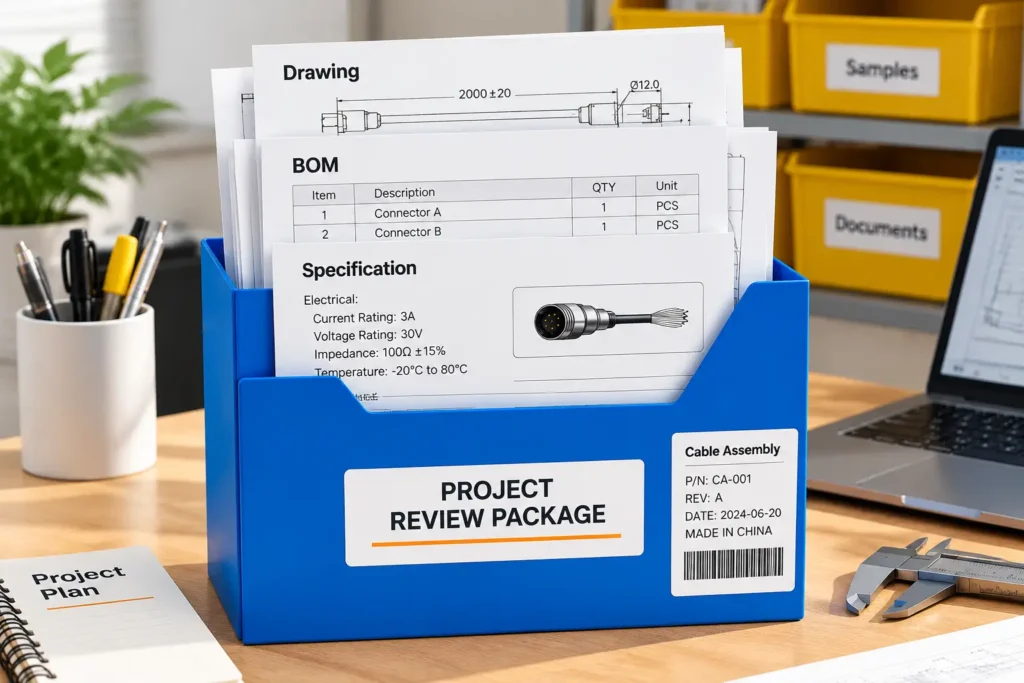
An accurate cable quotation normally begins with a controlled drawing, BOM, pinout or wiring information, and any available sample reference. If complete engineering documents do not yet exist, clear photographs, a dimensioned sketch, connector information, cable length, application details and target quantity can still support an initial review. The goal is to remove avoidable assumptions before material, tooling, labor and testing costs are finalized.
A good RFQ package behaves more like a manufacturing instruction set than a folder of unrelated attachments. A drawing explains how the assembly is physically built. A BOM identifies the components and materials that should be used. A pinout defines electrical relationships. Sample photographs or a physical reference can reveal details that were never captured in the original documentation. Revision information tells both engineering and purchasing teams which files currently control the project.
Problems often begin when documentation appears complete but contains contradictions. A drawing may show a finished length of 1,000 mm while an email asks for 1,200 mm. A BOM may list one connector revision while a sample photograph shows another. A pinout spreadsheet may have been updated after the drawing but carry no revision date. When information conflicts, a manufacturer must either stop the quotation and request clarification or continue by making assumptions, and both situations increase the chance of later price changes.
The most useful RFQ principle is simple: the supplier should never have to guess which file controls the build. A cable drawing, BOM, pinout, test requirement and packaging instruction should support one another rather than competing with one another. When the documents tell one consistent story, the quotation can move from a broad estimate toward a commercially meaningful production price.
| RFQ File or Reference | Minimum Useful Content | Stronger Version | Main Risk if Missing |
| Cable drawing | Overall structure and length | Dimensions, tolerances, orientation, breakouts, revision | Different suppliers price different interpretations |
| BOM | Basic component descriptions | Exact manufacturer P/N, quantity, revision | Wrong parts or uncontrolled substitutions |
| Pinout | Basic pin-to-pin map | Pin numbers, wire colors, circuits, shield and ground treatment | Wiring errors or incomplete labor estimate |
| Sample photos | Overall cable and connectors | Connector close-ups, labels, molded areas, packaging | Hidden construction remains unclear |
| Physical sample | Existing assembly | Sample plus dimensional and specification notes | Internal structure can still remain unknown |
| Test specification | Required functional checks | Test method, limits and acceptance criteria | Testing cost appears after quotation |
| Packaging file | General packing method | Label artwork, barcode, bag and carton specification | Packaging labor or materials are omitted |
Cable Drawing
A cable drawing should describe the finished assembly in a way that can be manufactured, measured and inspected. Overall cable length is important, but the measurement reference points are equally important. A specification such as “1,000 mm” remains ambiguous if one team measures from connector tip to connector tip while another measures only the exposed cable between connector bodies. Clear datum points eliminate that uncertainty.
For branched harnesses, each leg should have its own dimension and tolerance. Connector orientation also becomes important when the assembly must fit inside a restricted enclosure or leave the equipment through a specific direction. Overmolded cable assemblies may require molded-body dimensions, cable exit direction, strain-relief geometry or critical mating clearances to be shown. A drawing becomes especially valuable when several physical requirements interact and cannot be communicated reliably in an email.
Tolerance deserves careful treatment because tighter numbers do not automatically create a better product. A ±5 mm finished-length tolerance may be necessary for a cable routed through a fixed enclosure, while ±20 mm or more may be acceptable where additional routing freedom exists. Unnecessarily restrictive tolerances can add process control and inspection effort without creating practical value, so dimensions should be linked to how the assembly actually fits and functions.
Cable BOM
The bill of materials defines what the manufacturer is expected to purchase and assemble. Broad terms such as “4-pin connector,” “black cable” or “heat shrink” may be understandable in casual communication, but they are not sufficient for a controlled custom program. Several connector families may share the same number of pins while using different terminals, keying, plating, seals or locking structures.
Where a component is already controlled by the engineering team, the BOM should include the manufacturer name, manufacturer part number, description and quantity per assembly. Connector systems may need separate lines for housings, contacts, terminals, seals, backshells, locking wedges or protective caps. Wire specifications, sleeves, heat-shrink tubing, labels and packaging components may also need their own entries when they affect the finished product.
A complete BOM also reveals sourcing risk before the project becomes dependent on a component. A specified connector may have a long procurement cycle, a manufacturer-defined order multiple or uncertain lifecycle status. Finding those issues during quotation is far less disruptive than discovering them after a purchase order has been released or a sample schedule has already been promised internally.
Sample References
A physical sample is particularly useful when an existing assembly was developed years ago, documentation is incomplete, or important details cannot be explained easily through drawings. Photographs can show overall routing, connector appearance, overmold shape, strain relief, labels and packaging. A real reference sample can also help engineers evaluate connector fit, cable feel, flexibility and physical handling.
A sample should not replace the engineering specification. Two cable assemblies can look virtually identical from the outside while using different conductor gauges, shielding structures, insulation materials or pin assignments. An older sample may also contain obsolete components or materials that should no longer be copied directly. The sample should therefore be treated as physical evidence that complements drawings and specifications rather than becoming the only source of truth.
When complete drawings are unavailable, a useful starting package can include overall cable photographs, close-up images of both connectors, any readable component part numbers, measured cable length, application information and target quantity. An engineering review can then identify which details still need to be confirmed before the manufacturer commits to a production-ready sample or final quotation.
Quote Without Drawings
A custom cable project can often begin before a production drawing exists. This is common during new product development, supplier transfer, reverse-engineering work or replacement of an older assembly for which the original documents have been lost. A dimensioned sketch, clear connector photographs, an existing sample and a short description of the application may be enough to start a useful technical discussion.
The key distinction is between information that supports an initial evaluation and information that supports controlled production. A supplier may be able to judge basic feasibility or prepare preliminary pricing from sample photographs, but unresolved pinout, material, shielding, tooling or testing requirements should remain visible as open items. The quotation should never create the impression that unknown information has somehow already been confirmed.
A transparent project is easier to manage than an apparently complete project built on hidden assumptions. Marking unknown items clearly gives engineering and purchasing teams a checklist of what still needs to be confirmed, while allowing the project to move forward without pretending that every design decision has already been frozen.

Which Cable and Connector Specs Are Required?
A reliable quotation needs the connector system, cable construction, conductor count, AWG, finished length, tolerance and wiring configuration to be defined clearly. Depending on the application, shielding, insulation, jacket material, wire colors, terminals, seals, overmolding and approved substitutions may also affect cost. These details ensure that each supplier is pricing the same components and the same manufacturing work.
Describing a custom assembly only by its two visible ends is rarely enough. Terms such as “M12 to flying lead,” “USB-C to board connector” or “DC power cable” identify a product family but leave many engineering decisions unresolved. The manufacturer may still need to determine the exact connector, terminal, conductor size, shielding structure, jacket material, wire sequence and mechanical protection required.
Another important distinction is whether each specification is mandatory or flexible. A nominated connector part number creates a different sourcing condition from “equivalent connector acceptable.” The first requires the supplier to price the exact approved component, while the second allows alternatives to be reviewed against form, fit, function and project requirements. Without that distinction, two suppliers can submit very different prices while believing they have answered the same RFQ.
| Specification Item | Example Information | Why It Matters | Review Point |
| Connector | Manufacturer + exact P/N | Controls component cost and availability | Exact only or equivalent allowed |
| Terminal/contact | P/N, plating, compatible AWG | Affects crimping and connection quality | Match terminal to conductor size |
| Cable | 4C, 22 AWG, shielded | Defines materials and processing | Confirm conductor and jacket structure |
| Finished length | 1,500 mm ±20 mm | Controls material usage and cutting | Define reference points |
| Pinout | Pin 1 to red, Pin 2 to black | Defines assembly and testing | Confirm polarity, shield and ground |
| Jacket material | PVC, TPE, TPU, PUR or specified equivalent | Affects flexibility and environment fit | Match to application |
| Shielding | Foil, braid or combined shielding | Adds material and processing | Define termination method |
| Overmold | One or both connector ends | May require tooling and molding | Confirm shape, dimensions and material |
Connector Details
Connector definition should go beyond the appearance of the housing. In many industrial connector systems, the final interface depends on several separate components, including the housing, contacts, seals, locking wedges, backshells and strain-relief accessories. Quoting only the housing part number can therefore leave important cost and assembly information unresolved.
When the design has already been validated, the exact manufacturer and part number are the safest references. Similar-looking connectors are not necessarily interchangeable. Differences in keying, plating, terminal dimensions, sealing design or mating geometry can affect both function and manufacturing compatibility even when the housings look nearly identical in photographs.
When alternatives are acceptable, define the approval rule clearly. “Exact part required,” “approved equivalents only,” and “manufacturer may propose an equivalent for engineering approval” create three very different sourcing paths. That clarification allows purchasing teams to compare quotations more fairly and gives engineering teams control over which alternatives may actually enter the product.
Cable Specifications
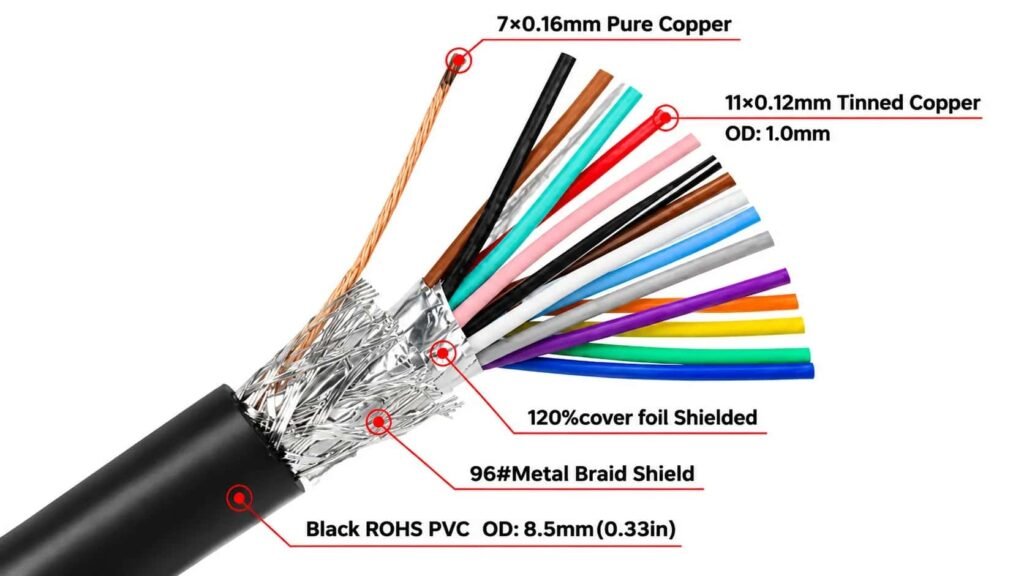
Cable specifications should describe the internal construction rather than only the color and outside diameter. Depending on the assembly, useful information can include conductor count, AWG or cross-sectional area, conductor material, insulation material, pair construction, shielding, drain wire, jacket material, nominal OD and color.
For flexible applications, conductor construction may matter because a finely stranded conductor behaves differently from a relatively rigid conductor of the same nominal gauge. For signal-related applications, pair geometry, shielding and termination can be more important than conductor count alone. A specification should therefore focus on the electrical and mechanical behavior required in the actual system.
Jacket material should also be tied to real use conditions. PVC can suit many general applications, while TPE, TPU, PUR, PE or other materials may become relevant when flexibility, abrasion, oil exposure, outdoor use or other environmental demands increase. Material selection should follow the application rather than a generic assumption that one jacket material is always superior.
Length and Tolerance
Finished length influences material cost, routing, packaging and process control. A good RFQ therefore defines both the nominal dimension and the point from which that dimension is measured. For a simple two-ended assembly, the measurement may be straightforward. For a Y-split cable or multi-branch harness, overall length alone is rarely sufficient.
Breakout positions, branch lengths, exposed conductor lengths, strip dimensions and connector orientations may all need their own dimensional controls. If several branches must reach fixed locations inside equipment, the tolerance on each branch may matter more than the overall cable length.
Purchasing teams should avoid making tolerances tighter than the application requires. A cable that hangs freely behind an enclosure may not need the same dimensional control as one installed between two fixed ports. Using realistic tolerances helps suppliers quote the process that the equipment actually needs rather than an unnecessarily restrictive manufacturing condition.
Pinout and Wire Sequence
Pinout information defines the electrical relationship between the two ends of the assembly. At minimum, it should show which pin or cavity on one connector connects to which pin, terminal or conductor at the other end. More complex assemblies may also include wire color, circuit function, conductor gauge, twisted-pair assignment, polarity, shielding and ground termination.
Shield treatment is particularly important. A shield connected at one end, at both ends or through a drain wire creates different electrical and manufacturing requirements. It should never be left for the supplier to interpret according to a preferred factory practice.
For wire harnesses, cavity numbers are more reliable than descriptions such as “red wire on the left,” because connector orientation can change how left and right are interpreted. A controlled pinout table provides a manufacturing reference and becomes the basis for continuity or wiring-sequence testing before shipment.
What Application and Performance Details Matter?
Application conditions can change the required cable construction even when two drawings look almost identical. Voltage, current, signal type, temperature, repeated movement, water exposure, chemicals, abrasion, vibration, shielding requirements and connector use may influence conductor size, jacket material, protection structure and validation. The manufacturer therefore needs to understand not only what the cable looks like, but what it must do and where it must work.
One of the easiest ways to obtain a technically incomplete quotation is to submit a detailed drawing without explaining the operating environment. The supplier may price exactly what appears on the drawing, while important performance requirements remain hidden. That problem becomes obvious only during prototyping or, worse, after the assembly has been installed in equipment.
Consider two one-meter cables using the same connector pair. One remains stationary inside clean indoor equipment. The other bends continuously around a moving mechanism and may be exposed to oil mist. Their visible geometry may be nearly identical, yet the conductor structure, jacket material, strain relief, routing limitations and test priorities can be very different.
| Application Condition | Information to Provide | Engineering Impact | Typical Verification Focus |
| Power transmission | Voltage, current and duty | AWG, terminal and insulation | Continuity, insulation and project-defined safety tests |
| Signal transmission | Signal type, frequency, impedance if controlled | Shielding, pair structure and termination | Electrical or functional testing |
| Repeated bending | Bend location, radius and movement pattern | Conductor structure, jacket and strain relief | Bend or swing testing |
| Outdoor use | Temperature, UV and moisture exposure | Jacket, sealing and connector protection | Environmental or sealing verification |
| Industrial use | Oil, abrasion, vibration or chemicals | Material and mechanical protection | Material and durability review |
| Tight enclosure | Routing space and exit direction | OD, flexibility and connector orientation | Dimensional or sample fit check |
| Frequent mating | Connector type and usage frequency | Connector and contact durability | Insertion and withdrawal testing |
| High humidity | Humidity range and condensation risk | Material, sealing and insulation | Environmental and insulation review |
Cable Application
The application explains why many specifications exist. A manufacturer benefits from knowing whether the assembly connects a motor, sensor, medical device, industrial controller, communication module, consumer product, charging system or another type of equipment. The product does not need to disclose confidential design details, but enough context should be provided to understand what the cable is expected to do.
Application information can explain requirements that otherwise seem arbitrary. A right-angle connector may be necessary because a straight connector would hit an enclosure wall. A soft jacket may be required because the cable moves through a narrow guide. Additional strain relief may be important because operators routinely pull the cable close to the connector.
It also helps to explain whether the cable is installed once and left in position, disconnected during scheduled servicing, or handled repeatedly by operators. These operating patterns can influence connector selection, strain-relief design and durability requirements long before the first prototype is built.
Electrical Requirements
Voltage and current are particularly important for power assemblies because they influence conductor size, insulation, terminal selection and the wider electrical design. Signal assemblies may require additional information such as shielding, controlled impedance, frequency, twisted pairs or grounding.
AWG should be considered together with the terminal system and connector. Selecting a larger conductor is not automatically safer or better because it may no longer fit the intended contact, change overall cable diameter or reduce flexibility. The electrical and mechanical requirements need to be evaluated as one system.
For assemblies carrying both power and signals, identify which conductors perform each function. Engineering teams may use different gauges, shielding arrangements or pair structures within the same cable. Where exact electrical limits are already defined, provide them directly. Where development is still open, distinguish known operating requirements from values that remain under review.
Environmental Conditions
Words such as “rugged,” “heavy duty” or “industrial grade” provide very little actionable engineering information. Specific environmental conditions are much more useful. Temperature range, humidity, water exposure, oil, chemicals, UV, abrasion, vibration and repeated flexing can all affect material and structure decisions.
Outdoor use may require attention to UV exposure, temperature changes and moisture, while factory automation may introduce oil mist, coolant, abrasion or mechanical movement. Medical or instrumentation applications can create different priorities involving flexibility, handling, cleaning or material restrictions. No single cable structure is ideal for every environment.
Waterproof requirements also deserve careful definition. Connector sealing, cable jacket, overmold geometry, interface condition and mating configuration can all contribute to performance. An overmold alone should not be treated as proof of a specific protection level unless the entire design and test requirement support that claim.
Testing Requirements
Testing belongs in the RFQ because it requires equipment, fixtures, labor and production time. Adding a new test after the commercial quotation is approved can change both price and process planning, especially when every finished assembly must be tested.
Depending on the project, relevant checks can include continuity, open and short detection, pinout verification, polarity, functional testing, dimensional inspection, pull-force testing, insulation resistance, Hi-Pot testing, repeated bending or connector mating evaluation. Not every product requires every test, and an effective quality plan should focus on the characteristics that matter for the application.
The strongest test requirement defines both the method and the acceptance criterion. “Pull test required” is less useful than identifying which connection is tested and what requirement determines pass or fail. Where limits come from an approved drawing, customer specification or applicable standard, the RFQ should reference that controlled source.

How Do Quantity and Delivery Affect the Quote?
Quantity affects much more than the final unit price. It influences material purchasing, component order multiples, production setup, tooling allocation, testing, packaging and scheduling. Instead of giving only one quantity, provide prototype demand, first production quantity, expected batch size and annual forecast when available. Delivery information should include the actual project milestone and destination so the quotation reflects a realistic manufacturing plan.
A quotation for ten engineering samples should not be interpreted in the same way as a quotation for several thousand production assemblies. Small prototype runs may contain engineering setup, special material purchases, manual processing or tooling costs that are spread across only a few units. Production quantities allow those fixed activities to be handled differently and may support alternative purchasing arrangements for connectors, cable and packaging.
Upstream suppliers also influence cable assembly economics. Contacts may be supplied on reels, connectors in cartons or trays, and certain cable constructions may have minimum extrusion quantities. Labels, molded parts and printed packaging can carry their own setup or purchase conditions. A finished-cable quantity therefore does not always match the quantities at which every component can be purchased.
| Commercial Input | Example | Why It Matters | Procurement Value |
| Prototype quantity | 5–20 pcs | Engineering setup and sample material | Confirms design before production |
| Initial production | 500–2,000 pcs | Material purchasing and line planning | Creates a realistic first-order cost |
| Batch quantity | 2,000 pcs per release | Production setup frequency | Clarifies repeat-order economics |
| Annual forecast | 10,000 pcs per year | Material and sourcing planning | Supports longer-term supply planning |
| Required sample date | Defined project milestone | Connector and tooling availability | Shows whether schedule is realistic |
| Production window | Required shipment or arrival period | Production scheduling | Improves delivery planning |
| Destination | USA, Germany, Australia or other market | Packing and export preparation | Reduces late logistics changes |
| Packaging | Bulk, individual bag or retail packaging | Material and labor content | Makes supplier quotes easier to compare |
The quantities above are examples of how an RFQ can separate project stages rather than universal order requirements. Actual quantities, minimums and production economics depend on connector sourcing, cable materials, tooling, packaging and the structure of the specific program.
Quote Quantity
A useful quantity request separates the different stages of the project. For example, a sourcing team might request ten samples for engineering evaluation, 500 pieces for the first production release, 2,000 pieces for later batch orders and provide an estimated annual requirement of 10,000 assemblies.
Those figures give the manufacturer a much clearer picture than a single request to “quote 500 pieces.” They help identify which costs belong to prototype development, which apply to the first production order and which may change when repeated production becomes established.
Forecast information should also be described honestly. An annual estimate can help with material planning, but it should not be treated as a guaranteed purchase commitment unless a formal agreement supports it. Keeping forecast and firm order quantities separate produces clearer commercial discussions and reduces the chance that a price is based on volume that never materializes.
Prototype vs. Production
Prototype manufacturing exists to remove uncertainty. A sample can confirm connector fit, pinout, cable length, routing, flexibility, overmold appearance, label position or equipment function before a larger quantity is produced.
The unit price of prototypes may be higher because several engineering and setup activities are spread across very few pieces. Certain operations may be performed manually, components may have to be purchased in quantities larger than the sample requirement, and tooling or special fixtures may need to be created before the product is proven.
Production pricing changes once the design is approved and the manufacturing process becomes repeatable. Material purchasing, cable cutting, stripping, crimping, soldering, overmolding, testing, labeling and packaging can then be planned around a defined production lot. Prototype price and production price should therefore be understood as two stages of the same program rather than directly comparable unit prices.
Packaging Information
Packaging can range from simple bulk packing to highly customized retail presentation, and those differences can materially affect the quotation. Industrial assemblies may only need orderly coiling and protective bulk cartons, while other programs can require individual bags, connector caps, dividers, barcode labels, inserts or customer-specific carton marks.
Labeling should be defined at the same time. Part numbers, revision information, barcodes, serial numbers or customer-supplied artwork can create additional material and control requirements. If final artwork is not yet available, the RFQ should at least state what type of label or printed packaging will be required.
Physical protection is also part of packaging design. Long cables can become tangled, exposed contacts can be damaged and molded surfaces can rub against one another during international transportation. Packing should protect the actual cable structure rather than follow one standard method for every product.
Delivery Information
“Fast delivery” is not a useful manufacturing specification. A better RFQ provides a sample evaluation milestone, production shipment window or required arrival period. That gives the manufacturer something concrete to evaluate against component availability, tooling preparation, testing and production scheduling.
Sample lead time depends on more than the time required to assemble several pieces. Connector sourcing, special cable preparation, mold development, material procurement and validation can all influence the schedule. A simple assembly built from available components is very different from a custom overmolded assembly requiring new tooling.
Production timing becomes more reliable after the sample, drawing, BOM, packaging requirements and quantity have been approved. Export projects should also provide the destination early because the required packing and shipment preparation can differ substantially between domestic samples and full production shipments moving internationally.
How Can You Avoid Quote Revisions?
Quote revisions are reduced by controlling specifications before the commercial price is treated as final. Use one current drawing, one current BOM, a defined pinout, confirmed connector information, known quantities, test requirements and packaging expectations. Open items should be marked clearly instead of allowing suppliers to make silent assumptions, because comparable quotations require comparable technical and commercial conditions.
Not every revised quotation indicates a poor supplier. If the connector changes, a new electrical test is added, the packaging becomes more complex or the quantity changes substantially, the commercial price may reasonably need to be updated. The real problem is avoidable revision caused by information that should have been clarified before the initial quote.
This becomes particularly important when several manufacturers are being compared. Supplier A may quote the exact nominated connector. Supplier B may assume an equivalent. Supplier C may leave out the requested test procedure. All three prices can look professional while representing different materials and production processes.
| Revision Risk | Weak RFQ Example | Better Control Method | Likely Commercial Effect |
| Connector unclear | “4-pin connector” | Exact P/N or approved substitute rule | Material price changes |
| Pinout incomplete | “Same as sample” | Controlled pin-to-pin table | Rework or sample revision |
| Length unclear | “About 1 meter” | Defined dimension and tolerance | Material or process change |
| Test undefined | “Test before shipment” | Named test and acceptance criteria | Additional test cost |
| Packaging missing | “Standard packing” | Bag, label, coil and carton requirements | Packing cost added later |
| Revision unclear | Several different PDFs | One controlled drawing revision | Wrong version quoted |
| Quantity unclear | “Large volume later” | Prototype, batch and annual forecast | Unit-price misunderstanding |
| Environment omitted | “Industrial use” | Temperature, movement, oil, water and other conditions | Material redesign |
| Tooling unknown | Overmold visible only in sample | Confirm molded structure and tooling need | Unexpected tooling charge |
| Label file pending | “Custom label required” | Define size, content and file status | Artwork or setup revision |
Missing Information
The most dangerous RFQ is not always the shortest one. Sometimes a polished package looks complete while leaving one critical decision unresolved. A drawing may omit shield termination, a BOM may list the connector housing but not the terminals, or a specification may define the cable material while saying nothing about required electrical testing.
A useful review question is whether two competent manufacturers could read the same requirement and reasonably build two different products. If the answer is yes, the specification probably needs more clarification before the quotations can be compared confidently.
Missing information does not mean the project has to stop. Development projects naturally contain open items. The better approach is to identify them explicitly. A connector substitute may be waiting for approval, jacket material may still be under evaluation, or final label artwork may arrive after sample validation. Visible uncertainty can be managed; hidden uncertainty usually becomes a later revision.
Revision Control
Every controlled drawing and BOM should carry a revision identifier, release date or another clear version-control method. When an engineering change occurs, both purchasing and manufacturing teams should be able to see what changed and which revision is currently approved.
File names such as “final,” “final-new,” and “final-new-latest” create avoidable risk once a project has passed through several internal reviews. A cleaner approach is to maintain one active RFQ package containing the current drawing, BOM, pinout, test requirement and packaging information while older versions are clearly identified as obsolete.
Revision control becomes especially important after sample modification. If the sample has been changed successfully, the approved change should be transferred into the drawing, BOM or relevant specification before the project enters mass production. Relying on a physical sample and employee memory is not a dependable way to reproduce a cable over repeated orders.
Quote Assumptions
An assumption is not automatically a problem; an invisible assumption is. When an RFQ still contains open information, the supplier can state the commercial basis clearly. Examples include pricing based on the specified connector, packaging based on an individual bag and bulk carton, tooling excluded until mold review, or jacket material pending final engineering approval.
These statements help procurement teams compare suppliers on equal terms. If one manufacturer includes custom tooling and another excludes it, that difference should be visible before the purchasing decision is made. The same applies to alternate components, testing, packaging and labeling.
Engineering review is useful because it can reveal connector availability, material questions, overmold feasibility, DFM issues, testing scope and packaging details before the quotation is treated as fixed. The goal is not to eliminate every variable instantly, but to make every material variable visible.
Production Freeze
Mass production should begin from a controlled baseline rather than a collection of emails and memories from sample development. The final release may include the drawing, BOM, approved sample, connector part numbers, cable construction, pinout, material requirements, testing criteria, label files and packaging specification.
An approved sample remains valuable because it gives production and quality teams a physical reference, but important changes discovered during sampling should also be captured in documentation. That makes the project reproducible when future orders are built by different operators or at a later date.
Once the specification has been frozen, material preparation, cutting, stripping, crimping, soldering, connector assembly, overmolding or heat-shrink processing where required, testing, labeling, packaging and outgoing inspection can all follow the same released definition. The real value of a good RFQ becomes visible here: it creates a clean path from quotation to sample approval, repeatable production, quality verification and export delivery.
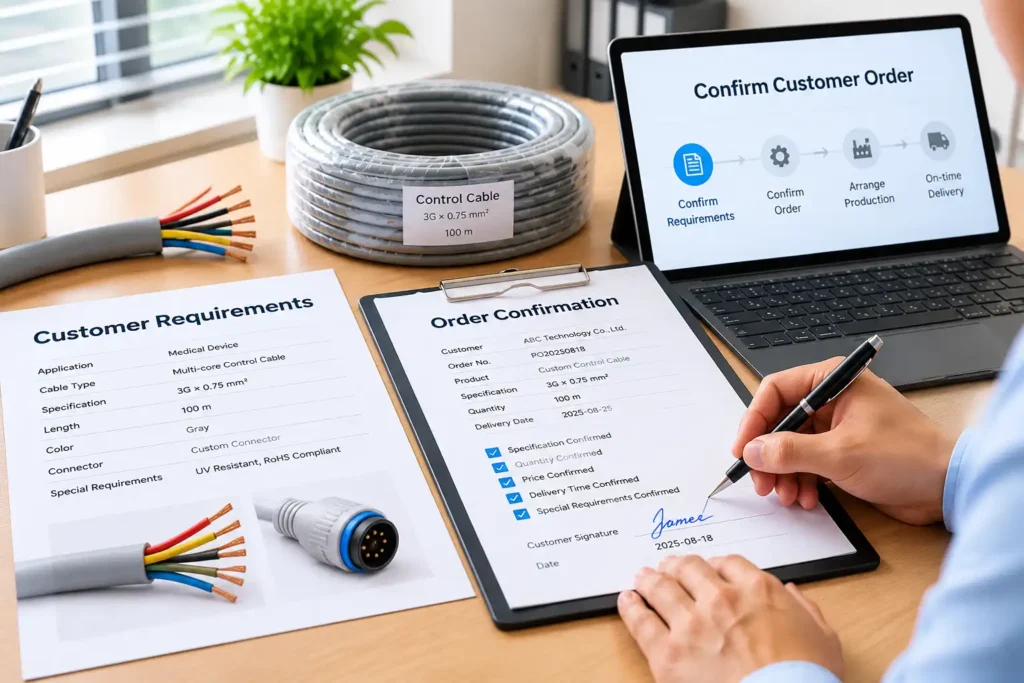
Ready to Request a Custom Cable Assembly Quote?
A useful custom cable quotation begins with clarity rather than volume of paperwork. If the project is already well defined, prepare the latest drawing, BOM, connector part numbers, pinout, cable specification, length and tolerance, target quantity, application information, testing requirements and packaging plan. Those details allow the engineering and manufacturing teams to evaluate the same product before material sourcing and production assumptions begin to influence price.
If the design is still developing, the project can still begin with the information that already exists. Sample photographs, close-up connector images, an existing physical assembly, a dimensioned sketch, cable length, application description and expected quantity can provide enough context for an initial engineering review. The remaining questions can then be identified and resolved before a sample or production specification is finalized.
Cablivo supports custom cable, wire harness and cable assembly projects from requirement review, drawing and BOM review, connector confirmation and sample development through mass production preparation, testing, labeling, packaging and shipment coordination. For projects involving molded or overmolded connectors, tooling and strain-relief structures can also be reviewed as part of the development process.
An accurate quotation should do more than tell you what one cable costs. It should create a technically controlled path from the first RFQ to an approved sample, repeatable production and reliable delivery. If you are preparing a new custom cable assembly, wire harness, molded cable or overmolded cable project, send the available drawing, BOM or sample information to Cablivo for engineering review and quotation discussion.