Skip to content


A battery connection wire harness may look straightforward on a purchasing sheet: several wires, a battery-side terminal, an equipment-side connector, heat shrink, perhaps a sleeve, and a specified finished length. In practice, two harnesses that look almost identical in a photograph can require very different conductor sizes, terminals, connector contacts, materials, crimping processes, testing methods, tooling, packaging, and inspection controls. This is why a request such as “Please quote the battery cable shown in the attached photo” often produces a series of technical questions before a manufacturer can return a dependable price.
An accurate battery connection wire harness quote normally requires a drawing or reference sample, BOM, connector and terminal specifications, cable length, wire gauge, voltage and current requirements, polarity or pinout, material requirements, operating environment, testing criteria, target quantity, packaging requirements, and target market. When a complete drawing is unavailable, clear sample photos and application information can provide a useful starting point for engineering review.
The real issue is not how quickly a supplier can type a number into a quotation sheet. The issue is whether that number is tied to the same product your engineering team expects to receive. A small missing detail can change the commercial result considerably. A ring terminal may need a different stud hole, a connector housing may require another contact series, the conductor may need to increase in size because of current and cable length, or a test that was not mentioned during the RFQ may later become mandatory. A quotation that survives these clarifications is far more useful than one that looks attractive for a day and has to be rebuilt before sampling.
For project teams preparing a custom harness, the most efficient approach is to treat the RFQ as a controlled technical package rather than a casual price inquiry. Drawings, BOMs, electrical requirements, component information, application conditions, testing criteria, quantity, and packaging all work together. Once these inputs are reasonably clear, the manufacturer can review not only material cost, but also manufacturability, component sourcing, crimping, assembly, inspection, prototype planning, production consistency, and shipment preparation.
What Documents Are Needed for a Battery Harness Quote?
An accurate battery harness quote normally starts with an assembly drawing, wiring diagram or pinout, BOM, wire list, connector and terminal information, dimensions, quantity, and test requirements. If formal drawings are not ready, clear sample photos, connector close-ups, sketches, application details, cable length, wire gauge, and target quantity can still support an initial engineering review.
Drawing and Wiring Diagram
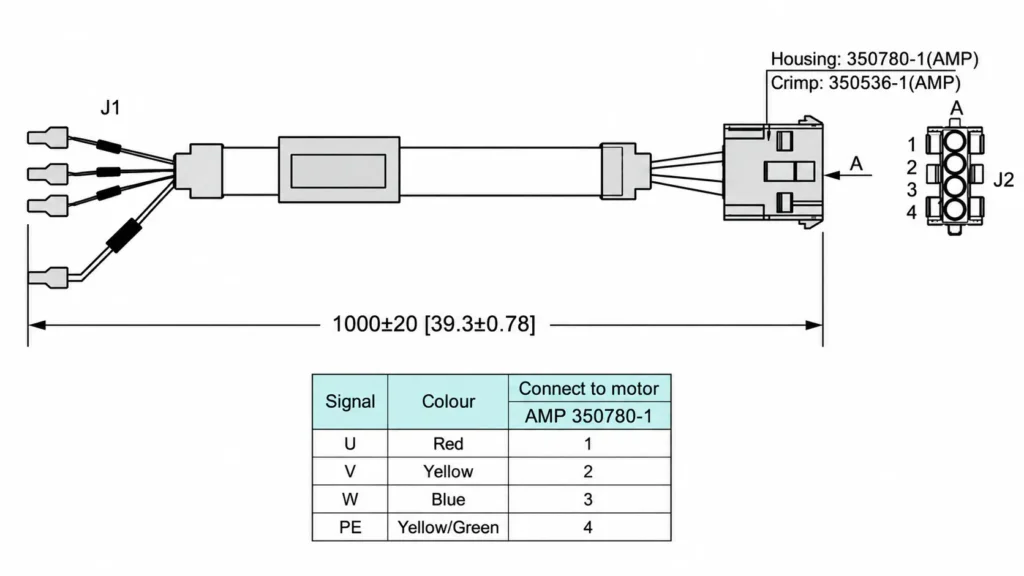
A drawing does much more than show how a finished battery harness looks. It defines the physical relationships that determine wire consumption, assembly sequence, routing, terminal orientation, connector positioning, inspection points, and installation fit. A useful drawing normally identifies overall cable length, individual branch lengths, breakout locations, connector positions, terminal orientation, wire colors, protective sleeves, heat-shrink locations, label positions, critical dimensions, and any tolerances that matter during installation or assembly.
For a simple two-wire harness, one overall length may appear sufficient until the equipment interface is considered. The measurement may need to run from the mating face of the connector to the center of the ring terminal, from the cable exit to the lug, or between two other controlled datum points. A multi-branch harness adds another layer of complexity because each branch location, branch length, connector assignment, and identification point may affect installation. Clear dimensional references reduce the chance that a mechanically correct-looking sample becomes unusable inside the equipment.
The wiring diagram or pinout should identify the electrical relationship between every conductor and termination. Positive and negative circuits should be defined explicitly rather than assumed from color alone. When the harness contains additional sensing, grounding, control, or communication wires, each cavity should be identified by function, wire color, conductor size, and destination. For quotation and subsequent production, the drawing also needs revision control so engineering, procurement, manufacturing, and quality teams are reviewing the same version.
BOM and Wire List
The BOM converts a visual cable assembly into a material definition. It should identify the items that have already been selected, including wire specifications, connector housings, terminals, seals, heat shrink, sleeves, labels, molded parts, fasteners, and packaging components. Exact manufacturer part numbers are especially useful for connectors and terminals because small differences within one connector family can affect contact type, sealing, plating, wire range, mating compatibility, component availability, and purchasing cost.
A wire list becomes particularly valuable when the assembly includes conductors with different sizes, colors, lengths, or functions. Instead of stating that a harness contains “four wires,” the list can identify one conductor as a specified AWG from the positive battery terminal to a particular connector cavity, another as a smaller sensing wire, and another as a grounding lead. This level of definition helps prevent different suppliers from interpreting the same drawing differently.
A BOM can also expose sourcing problems before they become production problems. An exact terminal may only fit a limited conductor range, a connector may require a separate secondary lock or seal, or a specified component may have a purchasing minimum that matters at prototype quantity. Reviewing these conditions during quotation allows the commercial offer to reflect the actual component package instead of a generic substitute that may not be acceptable later.
Sample-Based RFQ
A complete engineering drawing is the strongest quotation reference, but many battery harness projects begin from an existing physical assembly. An older machine may need a replacement harness, an imported product may need localization, or an engineering team may have a working prototype without complete production documentation. In these situations, a physical sample can help the manufacturer examine connector construction, terminal style, cable routing, protective parts, branch layout, assembly method, and approximate dimensions.
When a sample cannot be sent immediately, provide more than one photograph. Useful images include the complete harness laid straight, the mating face of each connector, the rear of the connector, terminal close-ups, labels, branch points, heat-shrink areas, molded structures, protective sleeves, and packaging. A connector photographed only from the side is often difficult to identify because many connector families share a similar external shape but differ in keying, cavity layout, seal structure, or terminal system.
Photos are still a starting point rather than a substitute for hidden specifications. They cannot reliably confirm conductor construction, terminal plating, exact wire gauge, contact material, electrical rating, internal pinout, or acceptance criteria. The best sample-based RFQ therefore combines photographs with cable length, voltage, current, polarity, target quantity, application, and any known component information so the manufacturer can identify which details still need confirmation before pricing or sampling.
RFQ Document Control
A professional RFQ package should make clear which specifications are fixed and which remain open for engineering discussion. If an equipment connector has already been approved, state its exact part number and mark substitution restrictions clearly. If the jacket material is still undecided, define the operating environment and performance expectations rather than guessing a material. If the test plan is under development, separate mandatory tests from reliability evaluations that are still being discussed.
This distinction makes quotations easier to compare. When information is missing, suppliers may fill the gaps differently. One may assume a generic terminal while another quotes the exact branded component. One may include only continuity testing while another includes polarity and pull-force checks. These are not necessarily differences in supplier competitiveness; they are differences in product definition. A controlled RFQ reduces this uncertainty and gives procurement teams a more reliable technical basis for evaluating commercial proposals.
| RFQ Document | Recommended Content | Example Entry | Quote Risk if Missing |
| Assembly drawing | Lengths, branches, connector orientation, labels | Overall 850 mm; Branch A 220 mm | Material and labor estimate may change |
| Wiring diagram | Polarity, pinout, circuit paths | Pin 1 positive; Pin 2 negative | Functional mismatch |
| BOM | Wire, terminals, connectors, sleeves, labels | Connector and terminal part numbers | Component cost may be inaccurate |
| Wire list | Gauge, color, length, start/end points | 12 AWG red, BAT+ to J1-1 | Conductor specification unclear |
| Sample photos | Overall and detailed views | Connector front and rear photos | Component identification remains uncertain |
| Revision record | Drawing revision and date | DWG-102 Rev B | Obsolete specification may be quoted |
| Test specification | Required acceptance checks | Continuity, polarity, pull force | Inspection scope may change |
| Packaging specification | Packing and labeling method | 20 pcs per bag with SKU label | Packed cost cannot be finalized |
Which Electrical Specs Define the Battery Harness?
The core electrical inputs are system voltage, continuous current, peak current where applicable, conductor size, cable length, conductor material, polarity, pinout, and any defined voltage-drop or insulation requirements. These values should be considered together because changing current, length, connector type, or operating conditions can change the appropriate conductor construction and the resulting quotation.

Voltage and Current
“Battery harness” describes the connection function, but it does not define the electrical load. A low-current monitoring lead and a high-current power connection can both operate in the same nominal voltage system while requiring completely different conductors, terminals, connector contacts, insulation structures, and production controls. A useful RFQ therefore states the nominal system voltage and, where relevant, the maximum operating condition rather than relying only on a general description such as “12 V battery cable.”
Current should also be described properly. Continuous current and peak current are not interchangeable. A conductor carrying a moderate load continuously may face a different thermal condition from one carrying a higher value for only a brief duty cycle. When peak current matters, providing both the magnitude and the operating context helps engineering teams understand whether the peak is an occasional transient or a regular part of machine operation.
The current path includes more than the copper conductor. Connector contacts, terminals, splices, and other interfaces can become limiting points. Increasing wire gauge alone cannot compensate for a connector contact that is not appropriate for the electrical requirement. For this reason, voltage, current, conductor size, terminal system, connector system, cable length, and application need to be reviewed as one connected specification rather than independent line items.
Wire Gauge Selection
Wire gauge affects resistance, voltage drop, temperature behavior, finished cable diameter, flexibility, terminal compatibility, stripping process, crimp tooling, connector fit, installation space, material consumption, and cost. Common project specifications may call for sizes such as 8 AWG, 10 AWG, 12 AWG, 14 AWG, or 16 AWG, but those values should never be treated as universal recommendations without knowing the actual current, cable length, environment, and connector limitations.
If engineering has already selected the conductor size, provide that size explicitly in the RFQ. If the gauge remains open, share the electrical and mechanical conditions that drive the decision. Current, voltage, cable length, installation temperature, routing space, bundling condition, connector contact range, and any allowable voltage-drop requirement give the manufacturer a much stronger basis for review than a request for “a thick battery wire.”
Larger conductors are not automatically better. Increasing conductor size may reduce resistance, but it can also increase cable diameter, reduce flexibility, require larger terminals, create connector compatibility issues, and make routing more difficult inside compact equipment. Good design balances electrical performance with mechanical installation and component compatibility, which is why the RFQ should reflect the actual system rather than focusing on one isolated specification.
Polarity and Pinout
Battery and DC power harnesses should define polarity explicitly on the controlled drawing or pinout. Red and black are commonly associated with positive and negative circuits, but production should follow approved documentation rather than color convention. A two-wire harness may appear simple, yet connector cavity numbering, terminal orientation, wire exit direction, mating direction, and labeling may still create opportunities for error if they are not clearly specified.
For multi-pin connectors, each cavity should identify wire color, conductor gauge, circuit function, and destination. If the assembly combines main power lines with smaller sensing or control conductors, a complete pinout becomes essential. The same applies to harnesses that include several connectors or branches because a cable can be dimensionally correct and still fail completely if two circuits are reversed.
Polarity identification may also extend beyond the conductor color. Some projects require printed wire numbers, heat-shrink identification, labels, colored sleeves, or branch tags to help equipment assembly and servicing. These requirements should be included during quotation because they affect materials, assembly operations, and inspection rather than being treated as a cosmetic detail added after pricing.
Voltage Drop and Cable Length
Cable length affects electrical resistance, so a conductor that performs adequately in a short battery connection may not provide the same result over a much longer run. As current increases, the effect becomes more important because the voltage lost in the electrical path increases with current and resistance. This is one reason a manufacturer cannot select wire gauge accurately from system voltage alone.
For RFQ preparation, engineering teams do not need to provide a lengthy calculation unless their internal specification requires one. What matters is sharing the parameters that define the condition: conductor material, conductor size, finished length, operating current, system voltage, and any project-defined voltage-drop limit. When the electrical path also includes several terminals, splices, connectors, or removable interfaces, those connections should be considered because contact resistance can contribute to overall performance.
A 300 mm harness and a 3 m harness may use the same connector family and appear similar in photographs, but their electrical requirements may differ substantially. Quotation accuracy improves when cable length is treated as an electrical input as well as a dimensional and material-cost input.
| Electrical Parameter | Useful RFQ Format | Example Specification | Engineering Significance |
| Nominal voltage | Numeric + DC/AC | 24 VDC | Defines system context |
| Continuous current | Numeric amperes | 18 A continuous | Influences conductor and contacts |
| Peak current | Value + duration | 35 A short-duration peak | Helps assess transient load |
| Wire gauge | AWG or mm² | 12 AWG | Affects resistance and terminals |
| Cable length | Finished or conductor length | 1,200 mm | Affects resistance and material |
| Polarity | Circuit assignment | Red positive / Black negative | Prevents reverse connection |
| Pinout | Cavity assignment | J1-1 positive, J1-2 negative | Controls connector wiring |
| Conductor material | Material requirement | Tinned copper | Affects material and processing |
| Voltage-drop limit | Project-defined value | Per equipment specification | May influence conductor size |
| Operating temperature | Required range | Application-defined | Affects material review |
The example values above show a useful RFQ format and should not be treated as universal design recommendations.
What Wire, Terminal, and Connector Details Matter?
A reliable quote requires exact or reviewable information for the conductor, insulation, jacket, terminals or battery lugs, connector housing, mating interface, seals, orientation, strain relief, and critical mechanical dimensions. Similar-looking components can differ in wire range, terminal system, stud size, plating, sealing, keying, electrical capability, and sourcing conditions, so visual similarity alone is not enough.
Terminals and Battery Lugs
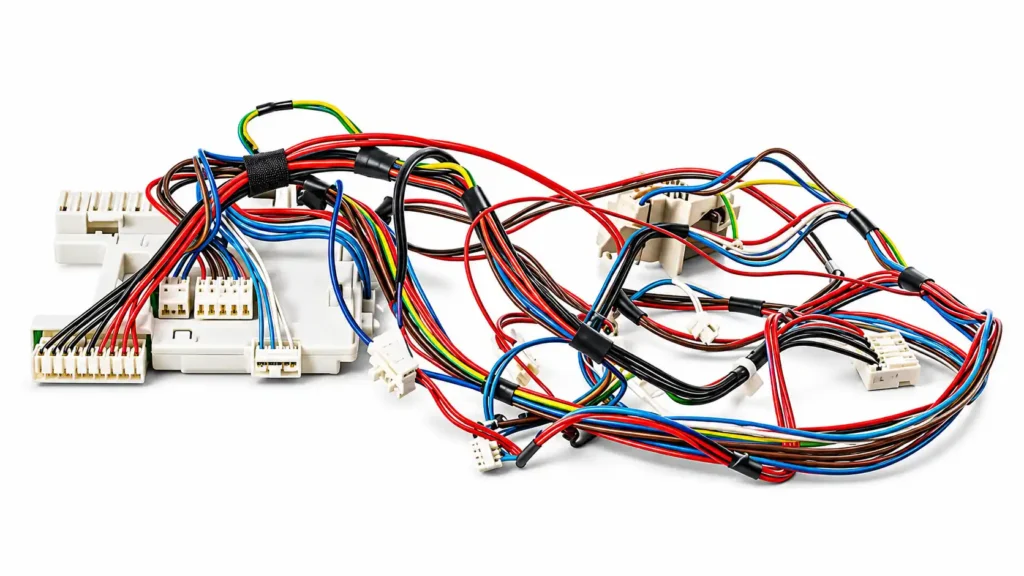
The terminal is the transition between the conductor and the electrical equipment, so it deserves more attention than a generic description such as “ring lug.” Where available, provide the exact terminal part number together with compatible conductor size, ring or stud dimensions, material, plating, orientation, insulation, and any protective boot or heat-shrink requirement. Small dimensional differences can determine whether the finished harness can actually be installed.
Stud size is particularly important for battery connections. Two ring terminals may have nearly identical overall shapes while using different hole diameters. If the equipment requires a specific stud or bolt size, that requirement should be identified on the drawing rather than left for visual interpretation. Terminal barrel design and wire-size range also need to match the selected conductor so the crimp can be produced using an appropriate process.
Where the project controls crimp quality through measurable criteria, provide those criteria early. Depending on the application, engineering may specify pull-force requirements, crimp height, cross-sectional analysis, approved tooling, or visual acceptance standards. These details can influence process preparation and inspection, so they belong in the quotation package rather than appearing only after the sample has been produced.
Connector and Mating Parts
Connector information should be precise enough to eliminate family-level ambiguity. A strong RFQ includes the connector manufacturer, complete housing part number, gender, number of positions, keying or coding, terminal part number, seals, secondary locks, mating connector, orientation, and any restrictions on approved alternatives. A photograph is useful for confirmation, but it should not replace exact component identification where the project already has an approved part.
The mating connector is often one of the most useful details because it confirms the actual equipment interface. Several connector variants may share the same general appearance while using different keys, cavities, contact systems, sealing methods, or secondary locking arrangements. Providing the mating-side part number allows the manufacturer to review whether the proposed harness connector truly matches the equipment.
Availability is another practical consideration. A technically suitable connector can still affect quotation if it has a high purchasing minimum, limited regional availability, a long sourcing path, or special terminals that require particular tooling. If equivalent alternatives are permitted, identify the approval conditions. If the original component must be used without substitution, state that clearly so the quotation does not rely on a generic replacement.
Wire and Protective Materials
The wire specification may cover conductor material, conductor construction, wire gauge, insulation, outer jacket, color, flexibility, temperature requirements, and environmental performance. Bare copper and tinned copper are both common options, but material selection should follow the application rather than a general assumption that one option is always superior. The correct choice depends on electrical requirements, manufacturing process, environmental exposure, connection method, and customer specifications.
Protection may also extend beyond the base wire. Heat shrink can protect a crimp transition or label. Braided sleeving can help with abrasion protection and routing organization. Protective tubing may be required where the harness passes through equipment. Overmolding or molded strain relief can be useful when the connector transition needs additional mechanical support, repeatable geometry, or sealing-related design features.
When a material has not yet been selected, describe the engineering problem instead of choosing a material at random. “The harness passes beside moving machinery and may rub against a metal edge” is more useful than “use premium jacket material.” The first statement allows a manufacturer to discuss abrasion protection, routing, sleeving, or jacket options in the context of the real application.
Mechanical Dimensions
Electrical compatibility does not guarantee successful installation. A harness can pass continuity and polarity checks yet still fail during equipment assembly if its branches are too short, connectors face the wrong direction, lugs cannot reach the mounting points, or the protective sleeve begins in the wrong location. This is why physical dimensions should be tied to actual installation references.
Useful dimensions include overall finished length, individual branch length, breakout position, strip length where controlled, connector exit direction, terminal orientation, protective sleeve location, heat-shrink length, and label position. Multi-branch harnesses should define the measurement reference for every critical branch instead of assuming the manufacturer will interpret all lengths from the same starting point.
Tolerance deserves equal attention. Where equipment fit is sensitive, state the appropriate project tolerance. Tight requirements may involve additional inspection and process control, while unnecessarily tight tolerances can increase manufacturing difficulty without improving function. Molded or overmolded components add another consideration because changes in cable exit angle, strain-relief geometry, or connector protection may affect tooling and sample approval.
| Component | Information to Confirm | Example RFQ Detail | Risk if Incorrect |
| Wire | AWG, conductor, color, insulation | 12 AWG red and black | Electrical or fit mismatch |
| Ring lug | Stud hole and wire range | M8-compatible lug | Cannot mount to equipment |
| Crimp terminal | Exact part number | Approved terminal P/N | Poor wire-terminal compatibility |
| Connector | Full housing part number | Manufacturer + P/N | Wrong connector family |
| Mating connector | Equipment-side part number | J2 mating P/N | Physical mismatch |
| Seal | Type and position | Individual wire seals | Environmental protection issue |
| Sleeve | Material and dimensions | Braided sleeve, specified length | Routing or protection mismatch |
| Heat shrink | Size, length and position | 30 mm over terminal barrel | Coverage inconsistency |
| Strain relief | Geometry and cable exit | Straight cable exit | Local stress or installation issue |
| Label | Content and location | SKU and polarity identification | Assembly identification problem |
How Do Application and Testing Affect the Quote?
Application and testing requirements can materially change a battery harness quotation because they influence material selection, connector protection, terminal treatment, process controls, inspection time, validation equipment, and acceptance criteria. Tell the manufacturer where the harness operates, whether it moves, which environmental stresses it sees, and which electrical or mechanical tests are required before acceptance.

Application Conditions
A battery harness should be specified in the context of the equipment it serves. “24 V battery cable” defines only a small part of the requirement. “24 V battery connection inside an industrial monitoring unit with restricted routing space, fixed installation, and periodic maintenance access” gives the engineering team a much clearer picture of the mechanical and electrical environment.
Useful application information includes equipment type, installation location, cable routing, available space, whether the harness is fixed or repeatedly moved, connection and maintenance frequency, proximity to heat sources, possible abrasion points, and whether the product is installed inside a protected enclosure or exposed to a harsher environment. These details help explain the reasoning behind material, sleeve, strain-relief, terminal, and connector requirements.
Application review also helps control unnecessary cost. Adding the most extreme jacket, sealing method, sleeve, plating, and reliability test to every harness does not automatically create a better product. A more effective approach is to understand the actual operating condition and select a construction that addresses the relevant risks. Accurate application information therefore improves both technical suitability and quotation accuracy.
Environmental Requirements
Temperature is often the first environmental parameter mentioned, but it is rarely the only one. Humidity, vibration, repeated flexing, oil, chemicals, water exposure, dust, abrasion, salt-containing environments, and installation stress can all affect a battery harness. The RFQ should describe the relevant conditions as specifically as possible instead of relying on vague terms such as “industrial grade,” “heavy duty,” or “outdoor quality.”
If the harness needs to operate within a defined temperature range, provide that range. If a connector may be exposed to moisture, describe the expected condition and the required sealing target. If corrosion is a concern, identify the metal parts or connector interfaces involved. Where the cable repeatedly bends or moves with equipment, identify the bend area and operating pattern so flexibility and durability can be reviewed meaningfully.
These conditions may influence conductor treatment, jacket selection, protective sleeving, connector sealing, terminal plating, heat shrink, overmolding, and test planning. Environmental information should therefore be supplied before quotation whenever it is important to the project rather than being added after materials have already been selected.
Electrical and Mechanical Testing
A battery harness test plan usually begins with confirming electrical correctness. Continuity, polarity, wire sequence, and pinout checks help verify that every conductor reaches the intended terminal and connector cavity. Depending on the project, connector-fit inspection, pull-force testing, insulation testing, hi-pot testing, dimensional inspection, temperature and humidity evaluation, salt-spray testing, bending evaluation, or other customer-defined checks may also be required.
Testing should be linked to a real requirement rather than included as a generic list. A simple stationary internal harness may not need the same reliability program as an assembly exposed to movement, corrosion, or demanding electrical conditions. Conversely, a high-risk connection should not rely only on a visual inspection when the project requires measurable mechanical or electrical acceptance criteria.
Where possible, define not only the test name but also the part being tested, the test condition, sampling method, and pass/fail requirement. “Pull-force test required” is a useful start, but a controlled acceptance requirement gives manufacturing and quality teams a much clearer basis for planning inspection and determining whether the finished product meets the intended specification.
Compliance and Acceptance Criteria
Compliance requirements should be handled as engineering inputs rather than broad marketing claims. Depending on the product and target market, a project may involve customer internal standards, restricted-material requirements, approved component lists, required documentation, specific electrical safety considerations, or third-party testing conditions. These can influence conductor, insulation, connector, terminal, labeling, packaging, and quality planning.
For power-related harnesses, voltage, current, wire size, insulation, jacket, connector type, target market, and customer-specified tests should be reviewed together. It is risky to assume that every battery harness automatically needs the same certification or test set. The appropriate requirement depends on the product category, destination, application, equipment integration, and customer specification.
Acceptance criteria are equally important. If the customer needs dimensional inspection, polarity confirmation, specific connector mating checks, pull-force verification, environmental testing, or documentation, those expectations should be included before the commercial quotation is finalized. Treating compliance and acceptance as part of the RFQ reduces the chance that additional cost and validation work appears unexpectedly after the prototype stage.
| Project Condition | Information to Provide | Potential Specification Impact | Possible Verification |
| Static indoor use | Installation and temperature | Standard routing may be sufficient | Continuity and polarity |
| Repeated movement | Bend location and operating pattern | Flexible construction review | Bending or swing evaluation |
| High temperature | Required temperature range | Insulation and jacket review | Environmental testing |
| Moisture exposure | Exposure and sealing requirement | Sealed connector or overmold review | Project-defined waterproof test |
| Vibration | Equipment operating conditions | Terminal and strain-relief review | Mechanical validation |
| Corrosive environment | Exposure details | Plating and material review | Salt-spray test if specified |
| Higher electrical stress | Voltage/current and insulation requirements | Insulation structure review | Hi-pot or insulation testing |
| Critical crimp | Terminal and acceptance criteria | Crimp process control | Pull-force test |
| Target market | Country and required standards | Material and documentation review | Required compliance evaluation |
| Customer standard | Controlled test document | Process and inspection scope | Customer-defined acceptance |
How Do Quantity and Missing Information Affect Pricing?
Order quantity, forecast volume, tooling, material purchasing, connector sourcing, testing, packaging, and specification completeness all affect the commercial quotation. Missing information does not remove cost; it simply creates assumptions. Those assumptions may cause the quotation to change after the actual AWG, connector, terminal, test requirement, packaging method, or production volume is confirmed.

Prototype and Production Quantity
Quantity should be stated according to project stage instead of appearing as one isolated number. A prototype order may contain only enough harnesses to evaluate fit, function, polarity, connector mating, cable routing, and assembly. A pilot batch may support equipment validation or a limited production run. A mature program may have a confirmed initial purchase quantity together with a realistic forecast for subsequent orders.
These stages create different manufacturing economics. Material purchasing minimums are more visible at prototype quantity. Setup, crimp tooling preparation, inspection planning, and special packaging are distributed across fewer pieces. At larger volume, repeatability, production organization, quality control, label accuracy, packaging efficiency, and supply continuity become more important. The same harness can therefore have different commercial conditions at different stages of the program.
Forecast information is useful when it is realistic. Inflating expected annual volume solely to obtain a lower unit price produces a quotation that may not apply when the actual purchase order is issued. Procurement teams should distinguish confirmed quantity from forecast demand and explain whether the project is a one-time requirement, initial validation order, recurring production program, or expected long-term supply project.
Packaging and Labeling
Packaging can make a meaningful difference to final cost and production handling, particularly when several similar harness SKUs are involved. A simple assembly-line cable may be suitable for bulk packing, while another program may require individual bags, cable winding, connector protection, barcode labels, customer SKU labels, wire-number labels, carton marks, inserts, or defined quantities per bag and carton.
Connector protection during transport deserves attention. Heavy ring terminals, exposed contacts, or delicate connector housings can be damaged if harnesses move freely inside a carton. Protective caps, organized winding, partitioning, bagging, or other packaging methods may reduce this risk, but they add materials and handling. The correct approach depends on the product structure, shipment method, customer warehouse process, and final use.
Labeling also supports operational accuracy rather than merely appearance. Two battery harnesses may look nearly identical but have different lengths, connectors, polarity arrangements, or branch layouts. Clear SKU, wire, branch, barcode, and carton identification can help reduce confusion during receiving, warehousing, equipment assembly, and repeat ordering. These requirements are best included during quotation rather than left until the shipment stage.
Pricing Risk From Missing Data
Consider an RFQ that says only: “Need 1,000 battery harnesses, 500 mm, red and black wire.” The quantity and overall length are useful, but the manufacturer still does not know the wire gauge, conductor construction, terminal part number, stud size, connector, pinout, voltage, current, insulation, protective sleeve, heat shrink, label, test plan, packaging method, or operating environment.
Several manufacturers could quote this request and return very different prices while each believes its quotation is reasonable. One may assume 16 AWG while another assumes 10 AWG. One may use a generic ring terminal while another prices an exact approved component. One may include only continuity testing while another includes polarity and pull-force checks. One may use bulk packing while another assumes individual packing.
The resulting prices do not represent the same finished product, so comparing them directly can be misleading. A technically sound quotation should therefore identify confirmed specifications, assumptions, exclusions, alternatives, and unresolved points. Procurement teams can then understand the reason behind cost differences rather than assuming every supplier quoted an identical construction.
Requote Prevention
The simplest way to reduce unnecessary requotes is to organize the RFQ around four decisions: what must be built, how it must perform, how it will be verified, and how many units are required. Under the first question, define drawing, wire, terminals, connectors, dimensions, protective components, labels, and packaging. Under the second, define voltage, current, polarity, pinout, mechanical conditions, and operating environment.
The third question covers acceptance. State the required continuity, polarity, connector fit, pull force, insulation, dimensional, environmental, or customer-specific tests. The fourth covers prototype quantity, first production quantity, realistic forecast, and expected repeat-order structure. When one of these points remains open, identify it clearly instead of allowing it to become an unstated assumption inside the quotation.
This approach does not mean every project needs a perfect drawing package before a manufacturer can become involved. Early-stage projects can begin with samples, photos, partial BOM information, connector references, electrical requirements, and an application description. The important point is to make known and unknown information visible. Engineering review can then move logically into connector confirmation, material discussion, prototype development, sample testing, approved specifications, production preparation, quality inspection, labeling, packaging, and shipment coordination.
| RFQ Status | Quote Confidence | Main Uncertainty | Recommended Action |
| Drawing + BOM + electrical specs complete | High | Minor commercial details | Proceed to detailed review |
| Drawing complete, BOM partly open | Medium-high | Component sourcing | Confirm components or approved alternatives |
| Physical sample available | Medium | Hidden materials and specifications | Measure and verify components |
| Photos + dimensions only | Preliminary | Electrical and material details | Confirm AWG, current and terminals |
| Connector P/N missing | Low-medium | Cost and compatibility | Identify housing and mating part |
| Current/AWG missing | Low | Conductor construction | Confirm electrical load |
| Test plan missing | Medium | Inspection cost and scope | Define required tests |
| Packaging open | Medium-high ex-factory | Final packed cost | Confirm packaging and labels |
| Quantity not confirmed | Low commercial accuracy | Purchasing and setup basis | Define prototype and production volume |
| Several core items remain open | Budgetary only | Product definition | Complete engineering clarification |
A useful battery connection wire harness quotation is more than a unit price. It is a commercial result attached to an agreed technical definition. When the drawing, BOM, conductor, terminals, connectors, voltage, current, polarity, application, tests, quantity, and packaging are clear, the quotation can become a practical basis for prototype development and later production rather than a temporary estimate that changes every time another specification appears.
For projects that are still being defined, the starting package does not need to be perfect. Existing drawings, sample photos, connector information, cable length, wire gauge, voltage and current requirements, polarity or pinout, target quantity, application environment, testing requirements, and packaging expectations can already support a meaningful engineering review. Missing items can then be identified and confirmed before the prototype is treated as the production reference.
Cablivo is the overseas-facing brand of Shenzhen Tianxiaowei Electronics Co., Ltd., supporting custom cable, wire harness, and cable assembly projects from requirement review and drawing or sample evaluation through material and connector confirmation, prototype development, production preparation, testing, labeling, packaging, and shipment coordination. The manufacturing background includes 18 years of industry experience, more than 20,000 square meters of factory space, a team of more than 1,500 people, and three manufacturing bases.
If you are preparing a custom battery connection wire harness RFQ, send the information already available rather than waiting until every detail is perfect. A drawing, BOM, existing sample, connector model, cable length, AWG, voltage and current requirement, polarity, target quantity, application, testing plan, and packaging requirement provide a strong starting point. The project can then be reviewed for remaining specification gaps before quotation, sampling, and production discussions move forward.