Skip to content


A request that says only “SC/UPC to SC/UPC, three meters, please quote” sounds complete until two suppliers return different prices for products that are not technically equivalent. One may assume single-mode OS2, another may use multimode fiber; one may quote simplex construction while another assumes duplex; one may include a standard indoor jacket while another prices a different environmental rating, testing scope or packaging method. The connector names define the two interfaces, but they do not define the entire assembly.
To quote an SC/UPC-to-SC/UPC fiber cable assembly accurately, the supplier needs the connector and fiber configuration, simplex or duplex construction, fiber type, cable length and diameter, jacket and protection requirements, installation environment, optical performance criteria, testing scope, quantity, labeling, packaging, sample requirements and delivery information. Drawings, BOMs, approved samples and customer specifications should be supplied whenever they control the project.
That additional information does more than improve price accuracy. It creates a common technical baseline that engineering, procurement, quality and the manufacturer can use from quotation through sample approval and mass production. A cable that looks like a simple patch cord on a desk may be part of telecom equipment, a data-center connection, a test system, an industrial communication installation or a long-term supply program. Each environment can change the specification in ways that are easy to miss when an RFQ focuses only on connectors and length. Cablivo’s documented fiber-optic project scope identifies fiber type, connector type, cable length, jacket material, cable protection, bend-radius requirements, application environment, transmission requirements, packaging, labeling and testing as items that may need confirmation rather than assumption.
A useful quotation process therefore starts by separating confirmed requirements from open questions. If the drawing already defines the fiber standard, loss criteria and jacket, those values should be quoted exactly. If the project is based on an existing sample with incomplete documentation, the supplier should identify what the sample proves and what still needs engineering confirmation. That discipline keeps an early budget estimate from quietly becoming a production specification and makes supplier comparisons more meaningful.
What Fiber and Connector Details Must Be Confirmed?
An accurate RFQ should confirm SC/UPC on both ends, simplex or duplex construction, single-mode or multimode operation, the required fiber category and any project-controlled fiber standard. SC/UPC-to-SC/UPC identifies the connector interfaces and polish, but it does not tell the supplier what fiber, fiber count or cable construction must sit between those connectors.
Commercial fiber portfolios show why this distinction matters. Assemblies using SC/UPC interfaces can be supplied in different fiber modes, fiber categories, fiber counts and cable constructions. Procurement teams that compare quotations before these variables are fixed may unintentionally compare technically different products. The lowest price can then appear attractive simply because a supplier has assumed an easier specification rather than because its manufacturing offer is genuinely more competitive.
For new projects, the fiber identity should come from the network architecture, optical equipment specification, engineering drawing or approved product requirement. For replacement projects, existing cable markings, transceiver information, equipment documentation, connector photos and an approved physical sample can help establish the intended configuration. Cablivo’s project-support framework includes connector confirmation, drawing review, sample review, material selection and project information review, which makes these checks appropriate before sampling or production release.
| Specification Item | Common Project Options | What Should Be Confirmed | Selection Value |
| Connector A | SC/UPC | Connector family and UPC polish | Prevents wrong first interface |
| Connector B | SC/UPC | Connector family and UPC polish | Confirms both ends |
| Fiber count | 1 fiber / 2 fibers | Simplex or duplex | Defines basic cable construction |
| Fiber mode | Single-mode / multimode | Match optical system | Prevents system incompatibility |
| Fiber category | OS2, OM1, OM2, OM3, OM4, project-defined | Drawing or network requirement | Aligns supplier quotations |
| Fiber standard | G.652, G.657 or other project-defined standard | Exact requirement if specified | Controls substitution |
| Reference | Drawing, BOM, sample, specification | Document number and revision | Establishes one controlled baseline |
Is SC/UPC Required on Both Ends?
Write both ends separately even when the connector is identical: End A: SC/UPC; End B: SC/UPC. This may look repetitive, but it reduces errors when RFQs move between engineering, sourcing, sales, purchasing and production systems. It also prevents a legacy product description or copied BOM line from accidentally introducing an APC interface or another connector family into one end of the assembly.
The distinction between UPC and APC matters because the end-face geometries are different. FOA notes that APC connections should not be mated with ordinary PC or UPC interfaces. For a replacement project, connector color can help identify the product visually, but it should not replace a controlled drawing or approved specification. When the existing cable is the main reference, provide close connector photographs, cable markings, equipment-port information and the old part number so the supplier can confirm what is visible and flag anything the sample cannot prove.
Is the Assembly Simplex or Duplex?
Simplex and duplex should be stated explicitly because they change the number of fibers, cable geometry, connector arrangement, routing, packaging and ultimately the quotation. A simplex assembly normally provides one optical path, while a duplex assembly provides two fibers and may be used for paired transmit-and-receive connections depending on the system architecture.
In practice, “SC to SC” is not enough to distinguish these constructions. For a duplex requirement, the RFQ should also state whether the two SC connectors need to be paired mechanically, supplied as separate legs or arranged to match an existing equipment interface. Photographs of the installed cable can be valuable when a project is duplicating an existing layout. If the two fibers require controlled identification, polarity or labeling, those requirements should be included before sample development rather than added after the physical cable has already been approved.
Which Fiber Type Is Required?
Fiber type should be selected from the optical system requirement rather than from supplier convenience. Single-mode projects may reference OS2 and particular ITU-T fiber families, while multimode projects may use OM1, OM2, OM3, OM4 or another category defined by the installed network. The exact requirement should come from the drawing, equipment specification or customer-controlled standard whenever one exists.
If the fiber specification is unknown, the RFQ should not simply state “standard single-mode” or ask the supplier to use whatever is common. Instead, provide the transceiver type, equipment model, transmission environment and existing network information. That gives engineering enough context to identify what still needs confirmation. Cablivo’s own fiber-optic fact base specifically requires fiber type and transmission requirements to be confirmed from actual project information rather than invented.
Is Single-Mode or Multimode Needed?
Single-mode versus multimode is fundamentally a system decision. The presence of an SC/UPC connector does not determine the fiber mode, because SC interfaces can appear across different fiber systems. Procurement teams should therefore obtain this requirement from engineering, the network standard, optical-module specification or approved sample documentation before treating a quotation as production-ready.
For replacement work, cable jacket color may provide a clue, but color alone is not a sufficiently controlled engineering reference. Transceiver data, existing BOM information, cable printing and network drawings provide stronger evidence. When several sources disagree, the discrepancy should be resolved before samples are ordered. That approach is more reliable than allowing each supplier to make a different assumption and discovering the mismatch only after comparing prices or receiving prototypes.
Which Cable Construction Details Affect the Quote?
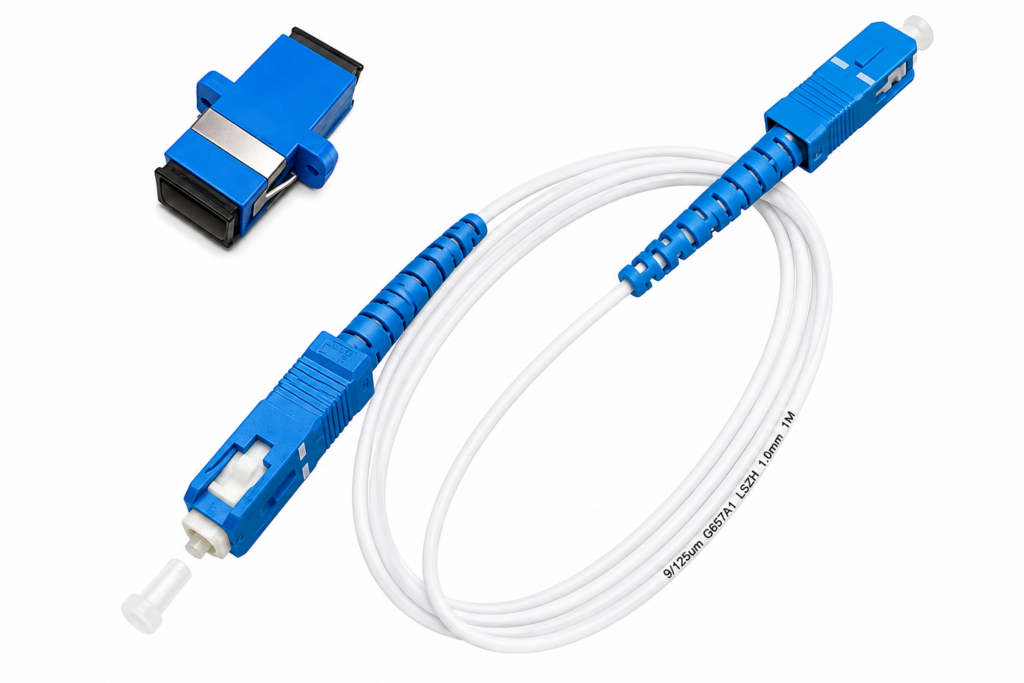
Length, cable diameter, jacket, protection structure and bend requirements all influence the actual cable being manufactured. Two SC/UPC-to-SC/UPC assemblies can use identical connectors but require different materials, routing behavior, mechanical protection and packaging because they are installed in different racks, devices, buildings or industrial environments.
Length is normally the first physical detail purchasing teams provide, but it should not become the only construction detail. A short rack jumper and a long assembly routed through equipment can have completely different handling and protection requirements even when both use SC/UPC connectors. Cable diameter also affects routing space, flexibility, boot compatibility and physical protection. Rather than assuming one universal outside diameter, the RFQ should state the required size where it is controlled by the equipment design or approved sample.
Jacket requirements should be treated with the same care. Fiber products may be supplied with different indoor, riser, plenum, LSZH or indoor/outdoor constructions depending on the installation and applicable project requirements. The correct question is not which jacket sounds more advanced, but which one the application actually requires. Cablivo’s fiber-optic project scope explicitly identifies cable length, jacket material, cable protection, bend-radius requirements and application environment as variables that may need confirmation.
| Construction Variable | Common Reference Range or Option | Main Selection Trigger | Quotation Relevance |
| Length | 0.5 m, 1 m, 2 m, 3 m, 5 m, 10 m, custom | Equipment spacing and routing | Material quantity and handling |
| Cable diameter | Common designs around 1.6 mm, 2.0 mm, 3.0 mm or project-defined | Space, flexibility, protection | Cable structure and boot selection |
| Jacket | Indoor, LSZH, riser, plenum, indoor/outdoor | Installation and market requirement | Material and compliance scope |
| Mechanical protection | Standard or reinforced/armored where required | Crushing and handling risk | Structure and unit cost |
| Bend requirement | Standard routing or project-defined minimum | Rack density and enclosure geometry | Fiber/cable selection |
| Color | Standard family color or customer-defined | Identification and SKU management | Material preparation and labeling |
What Cable Length Is Required?
State the finished length and the measurement method clearly. A description such as “three meters” can still be ambiguous if one supplier measures the cable body and another measures between connector reference points. When tolerances or measurement reference points matter, the drawing should define them rather than leaving the production team to infer the intended finished dimension.
For multi-SKU projects, separate each length into its own item and quantity. A request for “2,000 pieces mixed lengths” is not a complete production RFQ if the order actually contains four different specifications. Clear SKU separation supports more accurate material planning, labels, carton identification and receiving inspection. It also keeps volume pricing from being applied incorrectly when one configuration represents only a small share of the total order.
Which Cable Diameter Is Needed?
Cable diameter affects how the assembly fits into cable managers, equipment channels, conduits, glands, housings and dense racks. Common commercial patch-cord designs may use outside diameters in the range of roughly 1.6 mm, 2.0 mm or 3.0 mm, but these are only useful reference points. The correct diameter depends on the actual structure and installation rather than the connector family alone.
If an existing assembly must be duplicated, provide a measured outside diameter or send the approved sample. If the cable passes through a narrow housing opening or a constrained internal route, include that dimension in the drawing. Choosing a smaller diameter purely for flexibility or a larger diameter purely for perceived durability can create unnecessary trade-offs if the application does not support the decision.
Which Jacket Material Is Required?
Jacket material and rating should follow the installation, target market and customer specification. LSZH, riser and plenum descriptions refer to different material or installation requirements and should not be treated as interchangeable marketing upgrades. If engineering has already selected a particular jacket or flame rating, write it into the RFQ exactly and include the relevant controlled document.
When the requirement has not yet been fixed, describe the application environment instead of asking for the “best” jacket. A supplier can review whether the assembly is installed in a rack, building pathway, telecom cabinet, industrial system or another environment and identify the questions that must be resolved. Cablivo’s documentation requires compliance and material requirements to be handled project by project rather than assumed across every product.
Are Bend Radius Requirements Important?
Bend behavior matters in dense racks, internal equipment routes, cabinets and other installations where the cable must change direction within limited space. Excessive bending can increase optical loss or create long-term stress on the fiber, so routing constraints should be considered before the cable structure is finalized rather than discovered only during installation.
When engineering has specified a minimum bend radius, include the value on the drawing. If no formal value is available, provide equipment drawings, enclosure dimensions or photographs of the real route. This gives the supplier a physical constraint to review instead of an imprecise statement such as “very flexible cable needed.” Bend-radius requirements are also explicitly listed in Cablivo’s fiber-optic customization scope, making this a legitimate project-review item before sampling.

What Optical Performance and Testing Are Required?
Optical requirements should state the acceptance criteria that actually matter to the project, including insertion loss, return loss or reflectance where relevant, test wavelength, inspection method and required documentation. If the customer drawing or technical specification already defines these conditions, the quotation should reference that document rather than substitute generic performance numbers.
This is one of the easiest areas for quotations to become difficult to compare. One supplier may price only routine production verification, another may include individual insertion-loss measurements, while a third may include customer-specific reports or additional return-loss verification. Those are different scopes of supply even if all three quotations describe the same SC/UPC-to-SC/UPC assembly. Procurement teams should therefore separate the required performance from the evidence required to demonstrate that performance.
Industry references can help when engineering is building a loss budget, but reference values should not be confused with customer acceptance criteria. FOA commonly uses approximately 0.3 dB per connector as a practical planning value in link-loss calculations. Published connector products can show typical insertion loss below this level, but a typical value is not the same as a guaranteed maximum. Cablivo’s fact base is intentionally conservative on fiber-specific performance: transmission and testing requirements should be confirmed from real project specifications, and unsupported optical values should not be invented as universal manufacturing claims.
| Optical / Quality Item | Common Industry Reference | RFQ Requirement | Procurement Check |
| Connector insertion loss | ~0.3 dB often used as a planning value | Maximum permitted value | Compare guaranteed limits, not only typical values |
| Typical connector IL | Some commercial products publish ~0.15 dB typical | Clarify typical vs maximum | Avoid misleading comparisons |
| Return loss | Product and polish dependent | Minimum project value if required | Confirm test scope |
| Test wavelength | Project/system dependent | Exact wavelength(s) | Use customer test plan |
| End-face condition | Clean and undamaged | Inspection criteria | Define acceptance standard |
| Test reporting | None, sample, batch or individual | Required report format | Include documentation scope in quote |
| Traceability | Lot, SKU or serial where required | Identification level | Align testing with labels |
What Insertion Loss Limit Is Required?
When the project has a defined insertion-loss requirement, state it as a measurable maximum together with the relevant test conditions. Using a phrase such as “low loss” does not create a useful acceptance criterion because two suppliers can interpret it differently. FOA’s roughly 0.3 dB-per-connector planning value is useful when estimating a link budget, but a production limit should still come from the customer’s controlled requirement.
The distinction between “typical” and “maximum” deserves careful attention. A typical 0.15 dB result and a guaranteed maximum of 0.30 dB describe different things. Purchasing teams comparing quotations should therefore look at the contractual acceptance value rather than the most attractive typical number in a data sheet. If engineering has not yet defined the limit, the quotation should identify it as an open point rather than silently applying one supplier’s internal standard.
Is Return Loss Verification Required?
Return loss or reflectance verification should be included when it is required by the optical system, equipment manufacturer or customer acceptance plan. It should not automatically be added to every SC/UPC assembly simply because the connector uses a UPC polish. The application and performance specification determine whether the parameter must be controlled and documented.
When return loss is required, the RFQ should state the minimum acceptance value, test condition and whether recorded data must accompany samples, batches or individual assemblies. That final point matters commercially because routine process verification and serialized reporting involve different levels of data handling. The supplier should therefore understand whether the customer needs a performance requirement only or a performance requirement plus formal evidence.
Which Test Wavelengths Are Needed?
Test wavelengths should come from the network design, equipment specification or customer test procedure. A generic instruction such as “test the fiber before shipment” does not define the condition under which the optical performance will be measured. Two suppliers can produce valid-looking reports at different wavelengths and still create results that are not directly comparable.
When the project specifies one or more wavelengths, copy them directly into the RFQ and reference the relevant document revision. If the test plan is still under development, keep the quotation provisional on that point. This is more transparent than issuing a final quote before the test condition has been released and then adding new testing requirements after sample approval.
Is an Optical Test Report Required?
Testing and reporting are separate commercial requirements. A supplier can perform production optical checks without issuing an individual report for every assembly, while another project may require sample reports, batch records, serialized data or customer-specific documentation. The RFQ should therefore define both the test and the required evidence.
If reports are needed, state the information they must contain, such as part number, lot number, serial number where applicable, test wavelength, insertion loss, return loss where required, result and date. Cablivo’s fact base treats testing and documentation as project-specific requirements and avoids claiming that every cable automatically includes the same certificate or test record.

How Do Application Requirements Change the Specification?
The same SC/UPC connector pair can serve very different environments, so application information can change fiber selection, jacket, protection, routing, compliance documents and testing. A useful RFQ identifies where the assembly will be installed, how it will be routed and which environmental or equipment conditions can realistically affect its performance or service life.
Fiber assemblies may appear in telecommunications equipment, data centers, enterprise networks, optical modules, test systems and industrial communication equipment. Cablivo’s documented fiber-optic product scope specifically includes telecom equipment, data centers, network systems, fiber communication devices, industrial communication systems, test equipment, optical modules and enterprise network projects. These applications can share the same connector family while creating very different requirements for space, protection, cable handling and documentation.
Application information becomes particularly useful when the customer does not yet have a complete drawing. A description such as “SC/UPC cable for telecom equipment” is still broad, but “two-meter duplex assembly connecting an optical module to a panel inside a compact cabinet with limited routing space” immediately gives engineering more useful context. The supplier can then ask focused questions about bend radius, cable diameter, jacket, port arrangement and sample validation instead of guessing which version of a standard patch cord might work.
| Application | Primary Specification Focus | Common Project Risk | Useful RFQ Evidence |
| Data center rack | Length, routing, fiber mode, density, jacket | Excess cable and tight bending | Rack layout and port map |
| Telecom equipment | Connector accuracy, loss, routing | Interface mismatch | Equipment model and drawing |
| Industrial communication | Protection, bend, environment | Mechanical damage | Installation photos and conditions |
| Test equipment | Repeatability and identification | Inconsistent test setup | Test method and port layout |
| Enterprise network | Fiber type, route, jacket rating | Incorrect building classification | Building environment and standard |
| Optical module connection | Fiber mode and loss budget | Transmission mismatch | Module specification |
| Replacement project | Physical and optical match | Hidden differences from original | Existing sample and cable marking |
Where Will the Cable Be Installed?
State the real installation rather than only the industry name. A cable inside a telecom cabinet, a jumper between rack panels, an internal equipment harness and a connection inside a test system can all require different routing and physical characteristics. Drawings or photographs that show the route can reveal requirements that are not obvious from the BOM.
The supplier should understand whether the cable passes through cable managers, narrow openings, moving service areas or other constrained locations. That information helps engineering evaluate length, outside diameter, bend behavior and protection before the first sample is built. Cablivo’s fiber definition also emphasizes that optical cable projects involve not only length and appearance but connector matching, protection, transmission stability, installation environment and packaging protection.
Is the Application Indoor or Outdoor?
Indoor and outdoor use should be stated explicitly because the environment can influence jacket, protection and validation requirements. A cable does not become an outdoor product simply because it is long, and an assembly should not be treated as indoor merely because it uses a familiar SC connector. The route and exposure conditions are what matter.
If only part of the cable route is exposed, describe the complete installation. A cable can begin inside equipment, pass through an enclosure and continue into another environment. When waterproofing or weather protection is provided by another component, such as a cabinet or sealed feedthrough, explain that boundary clearly so the cable itself is not unnecessarily over-specified or under-protected.
Which Jacket Rating Is Required?
The jacket or environmental rating should come from the building specification, target market, customer engineering requirement or other controlled document. Plenum, riser and LSZH constructions are not simply good-better-best choices; they address different material or installation needs and may affect sourcing, documentation and cost.
If the exact rating is already known, name it in the RFQ. If it is still being reviewed, provide the installation environment and destination market so the supplier can identify the relevant open questions. Cablivo’s compliance fact base specifically avoids claiming that all products carry universal CE, RoHS, REACH, UL or other approvals and requires certification requirements to be confirmed according to the actual product and project.
Are Environmental Conditions Important?
Environmental conditions matter whenever temperature, humidity, vibration, abrasion, maintenance activity, movement or mechanical handling can influence the assembly. Not every fiber cable needs an extensive environmental test program, but neither should a cable used in demanding equipment automatically be treated as a basic protected indoor patch cord.
The most useful RFQ describes the conditions the product will actually encounter and separates mandatory requirements from desirable extras. This allows engineering to focus on risks that matter to the real installation rather than adding expensive features simply because they sound more industrial. During sample development, the installation information can also help evaluate routing, connector fit, cable handling and packaging before production is released.

What Commercial Details Are Needed for a Final Quote?
Once the technical configuration is understood, quantity, reference files, sample status, labels, packaging and delivery information are needed to turn the specification into a commercially usable quotation. These details affect material planning, production preparation, inspection, documentation, packing and shipment, and they determine whether a price is only preliminary or ready for an actual production decision.
Quantity should be provided by configuration, not only as one combined number. If a program contains several cable lengths, fiber types or customer part numbers, each SKU should have its own quantity. A total order of 2,000 pieces can have very different manufacturing economics from four variants of 500 pieces each. Clear SKU breakdown also helps control labels, cartons, inventory and receiving inspection after production.
Reference files reduce interpretation risk. A drawing establishes dimensions and controlled notes, a BOM can identify required components, an approved sample shows the physical construction, and packaging artwork defines the finished delivery format. Cablivo’s project-information guidance asks customers to provide drawings, sample photos, BOMs, connector models, cable length, application, target quantity, testing requirements, packaging requirements and shipping destination because fuller project information supports more accurate quotations and smoother evaluation.
| Commercial Detail | Weak RFQ | Better RFQ | Practical Value |
| Quantity | “Need bulk” | 500 pcs initial, forecast stated separately | Better material and production planning |
| SKU mix | “2,000 pcs total” | 500 × 1 m, 500 × 3 m, 1,000 × 5 m | Accurate cost by variant |
| Drawing | None | Drawing FC-102 Rev. B | Revision control |
| Sample | “Same as photo” | Approved physical sample available | Reduces structural ambiguity |
| Testing | “Test before shipping” | Test per attached acceptance plan | Defines quality scope |
| Label | “Custom label” | Artwork, barcode and placement attached | Prevents labeling mismatch |
| Packaging | “Export packing” | Individual protection and carton requirements defined | Aligns delivered product |
| Destination | Country only | Delivery location and requested trade basis | Clarifies freight scope |
| Project stage | Unclear | Prototype, pilot or production | Establishes quotation certainty |
How Many Assemblies Are Required?
State the initial quantity by exact configuration and include a realistic forecast only when it is genuinely useful. The first quantity determines the immediate material and production requirements, while a forecast can help the supplier understand whether the project is a pilot, a recurring program or a long-term supply opportunity. Forecasts should not be presented as guaranteed orders unless procurement has actually committed them.
Cablivo’s current fact base states that MOQ starts from 500 pieces for many custom cable projects, while the final MOQ depends on connector type, cable structure, material, overmolding requirements, tooling, packaging and order quantity. An SC/UPC fiber project should therefore have its exact MOQ and commercial terms confirmed after the actual specification and purchasing plan are reviewed.
Is a Drawing or Sample Available?
A controlled drawing provides the strongest starting point when the cable has already been engineered because it can combine connector information, dimensions, tolerances, fiber notes, labels and revision control. When a drawing is unavailable, an existing sample, clear connector photographs, cable markings and equipment information can still support an initial project review.
The important principle is to understand the limits of each reference. A sample can show the physical cable and connector structure but may not reveal the exact internal fiber standard or optical acceptance criterion. Cablivo’s engineering framework allows initial review from sample photos, connector photos, cable length, application details and target quantity when complete drawings do not yet exist, while open items are confirmed before sampling.
Are Custom Labels Required?
Custom labeling should define part number, barcode or QR code where required, dimensions, material, printed content, placement, serialization rules and artwork revision. These details become important when several fiber assemblies look almost identical but differ in length, fiber type, customer SKU or application.
Providing final or provisional artwork before quotation makes the production scope clearer. If a label is not yet approved, identify the open items and avoid assuming that standard factory identification will satisfy the final program. Packaging and labeling are part of Cablivo’s documented project-support scope together with quality inspection and shipment coordination.
Is Special Packaging Required?
Fiber packaging should protect connector ferrules, avoid unnecessary cable bending and keep each SKU easy to identify through storage and shipment. Depending on the project, requirements can include dust caps, individual bags, defined coil dimensions, customer labels, inner boxes, carton labels and multi-SKU separation. These details affect the delivered product even though they do not change the optical path.
Cablivo’s fiber-specific fact base lists packaging method, labeling requirement and cable protection among the customization points and identifies packaging protection as an important part of the fiber project discussion. Sending packaging artwork and packing instructions before the final quotation makes it easier to compare suppliers on the same finished-delivery basis instead of comparing bare-cable pricing with a complete packaged program.

A complete SC/UPC-to-SC/UPC fiber cable quotation does not need to become a complicated engineering exercise, but it should be detailed enough that every supplier understands the same product. The most useful RFQs connect product identity, cable structure, optical acceptance criteria, application conditions and commercial requirements in one controlled information set. Unknown fields can remain marked as “to be confirmed,” provided they are visible rather than hidden inside assumptions.
For projects that already have released documentation, send the latest drawing, BOM, fiber specification, testing requirement, quantity breakdown, label artwork and packaging plan. For projects based on an existing cable or incomplete information, clear sample photographs, connector details, cable markings, application information and target quantity can be used to begin the review. Cablivo’s documented role covers custom cable and cable-assembly project support from requirement review and sample development through mass production, quality inspection, packaging, labeling and shipment coordination, with fiber optic cables included in its supported product scope.
If you are preparing an SC/UPC-to-SC/UPC fiber cable assembly RFQ, send the available specification, sample information, required lengths, target quantity, application environment, optical test requirements and packaging details. The project can then be reviewed against the information that actually controls the product, open specifications can be identified before sampling, and the final quotation can be based on a clearly defined assembly rather than a collection of assumptions.