Skip to content

A wire harness quotation can look deceptively simple. A purchasing team sends a photo, a target quantity and perhaps one overall length, then asks several factories for a unit price. The numbers come back quickly, but they may represent different connector assumptions, different wire constructions, different test scopes and different packaging methods. The cheapest quotation may therefore describe a different product rather than a more efficient manufacturing solution.
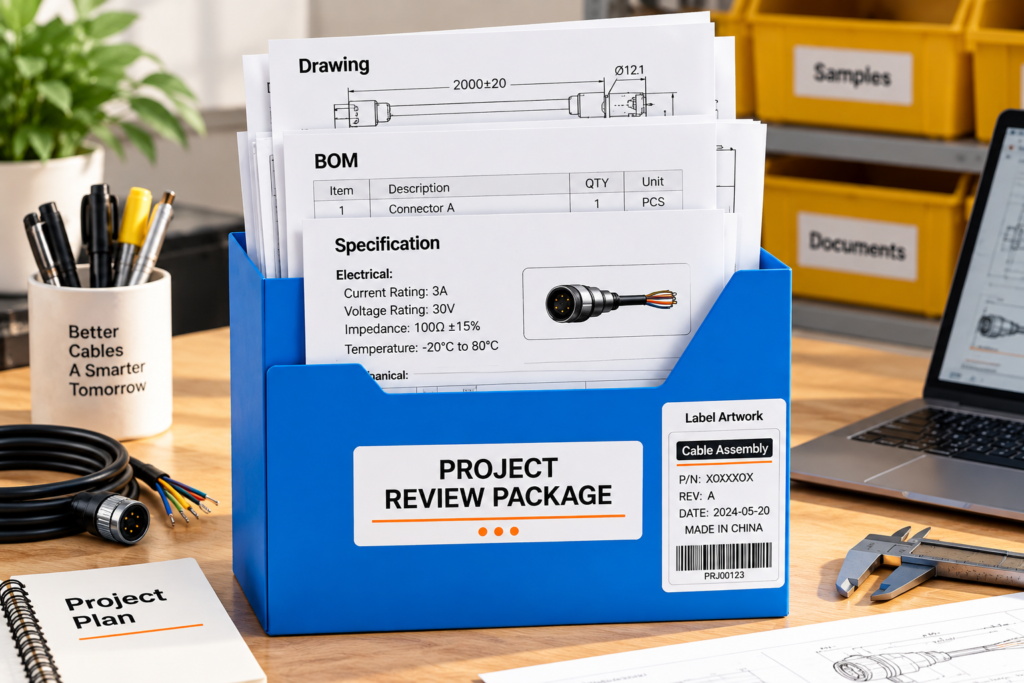
An accurate industrial wire harness quote normally requires a drawing or usable reference, BOM or component information, connector and terminal details, wire gauge and length, pinout and wire sequence, branch dimensions, material and protection requirements, application conditions, target quantity, testing requirements, labeling, packaging and delivery information. Any missing specifications should be identified and clarified before the quotation becomes the production reference.
A common sourcing problem begins when three suppliers quote what appears to be the same harness. One assumes a standard connector equivalent, one prices the specified branded connector, and another includes continuity testing, individual labels and protective packaging. Three prices arrive, but they are not comparable. The practical goal of a strong RFQ is therefore not simply to obtain a lower number. It is to make sure engineering, procurement and manufacturing are discussing exactly the same harness before samples, tooling or production begin.
What Documents Are Needed for a Wire Harness Quote?
An accurate quotation normally begins with an assembly drawing, BOM, pinout or wiring table, connector and terminal references, target quantity, testing requirements and packaging information. When controlled drawings are unavailable, clear sample photos, connector details, measurements, application information and a documented list of unresolved items can still provide enough information for an initial engineering review.
Documentation quality directly affects quotation quality. A supplier can always produce a preliminary number from limited information, but a commercial quotation becomes useful only when the product definition is stable enough to calculate material usage, component sourcing, processing steps, assembly time, testing work and packaging requirements. Missing details force the manufacturer either to stop and ask questions or to make assumptions that may later become price changes.
A practical RFQ package should separate confirmed specifications from open questions. Industrial equipment projects often reach the sourcing stage while routing, protective sleeving, label positions, connector availability or final branch dimensions are still being reviewed. Recording those points openly is much safer than allowing each factory to interpret them independently.
| RFQ Input | Minimum Useful Information | Main Quote Impact | Risk if Missing |
| Assembly drawing | Overall length, branches, connectors, labels, critical dimensions | Material usage and assembly work | Different physical constructions may be quoted |
| BOM | Connector, terminal, wire and protection references | Component pricing and sourcing | Different materials may be substituted |
| Pinout / wire list | Pin-to-pin relationship and wire identification | Assembly and electrical verification | Wrong wiring assumptions |
| Application data | Equipment type and operating environment | Material and protection selection | Product may not suit actual use |
| Target quantity | Sample, first production and expected volume | Unit cost and planning | Pricing based on the wrong production scenario |
| Test requirements | Required electrical or mechanical checks | Inspection labor and equipment | Required tests may be omitted |
| Packaging specification | Labels, bagging, coiling and protection | Final processing and shipment | Packaging cost may appear later |
Is a Drawing Required?
A controlled drawing is usually the strongest starting point because it places dimensions, connector locations, branches, protection, labels and revision information in one reference. For a simple point-to-point cable, overall length and connector data may cover much of the structure. A multi-branch industrial harness needs more detail because breakout locations, individual branch lengths, connector orientation and protective sleeve positions can directly affect installation.
Measurement reference points matter as much as the values themselves. A branch marked as 300 mm is still ambiguous if one engineer measures from the center of the breakout while another measures from the end of the sleeve. The same problem appears at connector ends, where length might be measured to the mating face, rear housing, strain-relief exit or another physical reference. Clear dimension origins prevent small drafting differences from becoming large installation problems.
A useful drawing also shows which requirements are fixed and which remain under review. Connector selection may already be approved while sleeve material, label position or overmold geometry is still being evaluated. Keeping those open items visible allows the manufacturer to assess cost and feasibility without turning an assumption into an unofficial specification.
What Should a BOM Include?
The BOM should identify components that can materially affect function, procurement, manufacturing or price. Depending on the harness, relevant items may include wire, cable, connectors, terminals, seals, housings, heat-shrink tubing, braided sleeve, protective tubing, shielding materials, cable ties, labels, overmold materials and packaging components. Generic descriptions are useful for early discussion, but exact manufacturer and part references provide much stronger quotation control.
Connector and terminal part numbers deserve particular attention. A description such as “4-pin industrial connector” can correspond to many families with different keying, contact sizes, terminal systems, sealing structures and purchasing conditions. When the original part is mandatory, the BOM should state it clearly. When alternatives are acceptable, the approval process should be identified instead of allowing suppliers to substitute components without discussion.
Revision control is another practical detail that prevents costly confusion. The drawing, BOM, pinout and packaging specification should all describe the same revision. If the drawing references a new connector while the BOM still lists the previous terminal system, the quotation may be accurate against the wrong document set. For repeat orders, controlled revisions also protect production from drifting back toward an older configuration.
What If the Drawing Is Incomplete?
Incomplete engineering documentation is common in real sourcing projects. A machine builder may have a functional prototype assembled internally, a procurement team may be replacing a previous supplier without owning the original CAD package, or a product team may still be finalizing cable routing inside equipment. None of these situations automatically prevents quotation work, but the missing information must be identified.
Connector photos, equipment-side interface photos, cable length, AWG, pinout, wire sequence, application conditions, sample images, testing requirements, packaging expectations and target quantity can create a useful starting point. A manufacturer can review what is visible, identify uncertainties and determine which specifications must be confirmed before a production-oriented quotation is released.
The commercial difference between an estimate and a final quotation should remain clear. A preliminary price may be reasonable when several items are still open, but high-impact unknowns such as connector identity, conductor size, pinout, branch dimensions or required tests should not remain hidden. Making those gaps visible protects both sides from treating an early assumption as an approved production requirement.
Which Harness Specifications Must Be Defined?
The quotation should define the specifications that determine what the manufacturer must source, cut, strip, crimp, solder, assemble, protect and test. Connector and terminal identity, conductor size, cable and branch lengths, pinout, wire sequence, insulation, shielding, sleeving, heat shrink, labels, strain relief and overmolding are among the details that can materially change construction and cost.
A wire harness should be reviewed as a connected assembly rather than a collection of isolated parts. A change in conductor size can require another terminal. A terminal change can affect the housing. Additional shielding increases bundle diameter. A larger bundle may need a different sleeve. Overmolding introduces another material, process, tooling consideration and inspection step. Small specification changes can therefore move through several parts of the manufacturing process.
Clear specifications also improve supplier comparison. When every factory receives the same connector references, conductor sizes, branch dimensions and protection requirements, price differences become more meaningful. When those inputs are incomplete, lower quotations often reflect different assumptions rather than manufacturing efficiency.
| Specification | What Should Be Confirmed | Typical Quote Impact | Main Engineering Value |
| Connector | Series, gender, pin count, keying, mating interface | High | Prevents equipment mismatch |
| Terminal | Part number, conductor range, housing match | High | Supports reliable crimping |
| Wire gauge | AWG or conductor size per circuit | High | Affects material and terminal selection |
| Branch length | Defined reference points and tolerances | Medium–High | Controls routing and installation |
| Pinout | Pin-to-pin connection map | High | Defines electrical function |
| Shielding | Foil, braid or specified structure | Medium–High | Supports interference-control requirements |
| Protective sleeve | Type, coverage and location | Medium | Supports abrasion and routing protection |
| Overmolding | Shape, material, exit direction and tooling | High | Adds molding and validation work |
| Labels | Content, position and identification method | Low–Medium | Supports installation and SKU control |
Which Connectors and Terminals Are Required?
Connector identification should be detailed enough to define the actual mating interface. Manufacturer, family, part number, gender, pin count, keying, orientation, mating connector, seal arrangement and required accessories may all matter. A connector family can contain versions that look nearly identical while using different coding, terminals or mechanical interfaces, so a photograph alone may not always be sufficient.
Equipment-interface photographs are still valuable because they reveal installation conditions that part numbers do not. Available space, connector direction, nearby components, locking access and cable exit orientation can affect the finished harness. Including a photo of the actual mating device alongside the connector reference gives the manufacturer another way to catch an error before samples are built.
Terminals should be treated with the same care. The terminal must match the housing and conductor construction. Crimp geometry, conductor preparation and retention performance are related to both wire and terminal choice. If the project requires a specified connector brand, the RFQ should state that clearly. If compatible alternatives may be reviewed, the technical approval process should be defined before cost comparisons are made.
How Are Length, AWG, Pinout, and Branches Specified?
Multi-branch harness drawings should define the physical structure more precisely than a single overall length. Each branch needs a measurement reference, and breakout locations need their own dimensional control. If one branch must reach a sensor mounted beside a machine frame, moving the breakout point even when total conductor length remains unchanged can create tension, rubbing or installation difficulty.
Wire gauge should be identified by circuit when different conductor sizes are used. Power, ground, control and signal circuits may have different electrical requirements, so describing an entire harness with a single AWG value can be misleading. Color coding should also be specified when it supports assembly inspection, equipment installation or field servicing.
Pinout provides the electrical map connecting one interface to another. The exact values depend on the project, but a structured table makes the relationship easier to review than a paragraph of instructions.
| Circuit | Connector A | Connector B | Wire Definition | Function |
| Example 1 | Pin 1 | Pin 3 | Project-defined AWG | Power |
| Example 2 | Pin 2 | Pin 1 | Project-defined AWG | Return |
| Example 3 | Pin 3 | Pin 2 | Project-defined AWG | Signal |
The example above illustrates documentation structure rather than a universal wiring specification. Production should always follow the approved project drawing and pinout.
Do Shielding, Sleeving, or Overmolding Requirements Apply?
Protective structures should solve a defined problem. Terms such as “industrial-grade protection” sound reassuring but do not explain whether the concern is abrasion, electrical interference, repeated motion, connector strain, moisture or crowded routing. A manufacturer can select and quote materials more accurately when the application risk is described first.
Foil or braided shielding may be relevant where signal protection or interference control is required. Braided sleeve or protective tubing can support routing, abrasion protection and bundle organization. Heat-shrink tubing may protect joints, labels, terminals or transition areas. Each additional structure changes material content and processing work, so it should be included deliberately rather than added as a generic quality feature.
Overmolding can have an even larger influence on cost because it changes both the design and the manufacturing route. Shape, hardness, material, cable exit direction, connector geometry, strain relief and tooling all require review. A well-designed molded transition can improve connector protection and repeatability, but it needs to be treated as an engineered part of the assembly rather than decorative plastic around a connector.

How Do Operating Conditions Affect the Quote?
Operating conditions explain what the harness must survive after installation. Voltage, current, signal requirements, temperature, humidity, oil, abrasion, vibration, repeated movement, moisture, routing space and connector usage can influence conductor size, jacket material, shielding, protective structures, strain relief, connector selection and the testing required before shipment.
A harness installed inside a stationary control cabinet and a harness moving beside an automated machine may use similar connectors but require different construction. The same applies to a sensor cable exposed to oil compared with a cable routed inside a clean electronic enclosure. Application information therefore belongs in the RFQ even when the drawing appears mechanically complete.
Environmental requirements should be described in practical terms. Instead of simply asking for a “high-temperature industrial harness,” provide the expected operating condition if known. Instead of writing “oil resistant,” explain where exposure occurs and whether it is continuous, occasional or limited to maintenance. Better context helps the engineering team distinguish necessary design features from specifications that add cost without solving the actual problem.
| Operating Condition | Information to Provide | Possible Design Impact | Possible Verification |
| Electrical load | Voltage, current and circuit function | Conductor and terminal selection | Electrical checks |
| Repeated movement | Motion location and bending behavior | Flexible construction and strain relief | Bending evaluation |
| Oil / coolant | Type and location of exposure | Jacket and protective material review | Material review |
| Abrasion | Contact points and routing | Sleeve or protective jacket | Durability inspection |
| Temperature | Expected operating range | Insulation and jacket selection | Temperature evaluation if required |
| Moisture | Exposure condition and connector location | Sealing and connector structure | Project-specific verification |
| Vibration | Equipment location and mechanical load | Retention and strain relief | Mechanical evaluation |
| Corrosive environment | Exposure around metallic components | Terminal and connector material review | Salt-spray discussion if applicable |
What Electrical Requirements Should Be Provided?
Electrical information should cover parameters that affect material selection, termination or acceptance. Operating voltage, current per circuit, circuit function, grounding, shielding and any defined electrical verification requirements should be provided when relevant. A harness containing power, control and signal circuits should not be described only by total current if individual conductors operate under different conditions.
Current can influence conductor size, terminal selection and connector suitability. Signal circuits may introduce shielding or grounding considerations that do not apply to simple power conductors. When signal performance has specific requirements, those should be taken from the equipment specification rather than replaced with broad descriptions such as “data wire” or “signal cable.”
Not every project will have every electrical value finalized at the first RFQ stage. When a parameter is still under engineering review, marking it as pending is safer than allowing a preliminary value to become an accidental production specification. The quotation can then show which items remain subject to technical confirmation.
Which Environmental Conditions Apply?
“Industrial use” can describe a very wide range of applications. A harness may operate inside automation equipment, a factory control system, machinery, robotics, test equipment, outdoor monitoring equipment or a sensor installation. Each environment introduces a different mix of mechanical, electrical and material risks, so the RFQ should describe the actual installation rather than relying on a broad market label.
Relevant variables can include jacket material, shielding, oil exposure, abrasion, temperature, bending, moisture, strain relief, overmolding and test requirements. The manufacturer does not need a long environmental report for every project, but it does need enough information to understand whether the cable is stationary, frequently moved, exposed to liquids, routed across hard edges or installed where connectors experience mechanical load.
Testing should follow those application risks. A project concerned about terminal retention may need pull-force evaluation. A moving assembly may call for bending evaluation. Metallic connector parts exposed to a corrosive environment may require a corrosion-related test plan. Temperature and humidity work may be relevant when the operating specification requires environmental reliability verification. Test methods and acceptance criteria should be agreed according to the actual project rather than added automatically.
How Will the Harness Be Installed and Used?
Installation conditions often reveal problems that are invisible in an electrical schematic. A harness can be electrically correct yet still fail to fit comfortably because a branch exits in the wrong direction, a connector cannot be reached after assembly or the main trunk rubs against a machine frame. Routing information therefore has direct engineering and commercial value.
Useful installation information can include equipment layout, cable path, bend locations, fixing points, available space, connector orientation, service access, moving areas and the sequence in which the harness is installed. Equipment photographs are especially useful for replacement projects because they allow the manufacturer to understand physical constraints that may not appear on the original documentation.
When the project replaces an existing harness, describe the reason for the change. Repeated failure near a connector may indicate a strain-relief issue. Tangling during installation may suggest different branch restraint or packaging. Confusing branches may require clearer labels. A good RFQ describes these real operating problems because solving them during sample development is usually easier than repeating them during mass production.

What Quantity, Testing, and Packaging Details Matter?
Quantity defines the production scenario, while testing, labeling, packaging and delivery define work that continues after physical assembly. A useful RFQ should separate sample or validation demand from expected production volume, identify required inspections or tests, describe labeling and packaging expectations and provide the delivery information needed for realistic production and shipment planning.
Prototype quantities and recurring production volumes should not be treated as identical commercial situations. Material purchasing, connector sourcing, setup, tooling, testing, line organization and packaging work can be distributed differently across production quantities. Asking for several realistic volume levels can therefore provide more useful information than asking only for the lowest possible unit price.
Testing and packaging also influence price in ways that are easy to miss. “100% tested” does not explain whether every harness receives continuity verification, wire-sequence checks, insulation-related testing or another acceptance process. Likewise, “standard packaging” does not define whether branches need restraint, connectors need protection or individual labels are required.
| Commercial or Quality Item | Useful RFQ Information | Main Value | Common Risk if Missing |
| Sample quantity | Number needed for engineering validation | Defines prototype workload | Sample cost misunderstood |
| Production quantity | Expected first order | Supports realistic unit pricing | Quote based on wrong volume |
| Forecast | Expected recurring demand or SKU mix | Supports sourcing and capacity planning | Supply assumptions remain unclear |
| Testing | Required verification and acceptance criteria | Defines quality workload | Testing scope differs between suppliers |
| Labels | Content, position and identification logic | Supports installation and traceability | Similar harnesses may be confused |
| Packaging | Coiling, bagging, branch and connector protection | Supports safe handling | Damage or tangling during shipment |
| Destination | Receiving country or facility | Supports export planning | Logistics assumptions appear late |
How Many Units Are Needed?
The RFQ should reflect the real purchasing path. Development may begin with a limited number of samples, followed by a first production run and then recurring demand. When the project has a predictable ramp, procurement can request several realistic quantity levels rather than forcing every supplier to price against one number.
Artificially large quantity requests often produce numbers that cannot be used when the actual order arrives. A quotation for 50,000 pieces is not especially helpful if the first production order will be 2,000 pieces and the project has no confirmed annual volume. Better comparisons come from giving each supplier the same practical purchasing scenario.
Order frequency and SKU mix can also matter. Five thousand pieces ordered once may be planned differently from the same annual quantity released quarterly. Several harnesses sharing connectors or materials may create another production scenario. Sharing the expected program structure gives the manufacturer a better basis for connector sourcing, material planning and production organization.
Which Tests and Compliance Requirements Apply?
A useful test specification describes what needs to be verified rather than relying on the phrase “tested before shipment.” Continuity and wire-sequence checks are common concerns for harness assemblies because they confirm whether circuits have been connected correctly. Depending on the application, additional review may involve connector fit, pull force, insulation performance, bending durability, dimensions, appearance or environmental reliability.
The correct test plan depends on project requirements. A stationary internal harness may not need the same reliability verification as an assembly exposed to movement, moisture or temperature changes. Tests should therefore follow engineering risk and acceptance criteria rather than being added simply to make a specification look more demanding.
Compliance requirements should also be stated precisely. Target market, equipment requirements, material documentation, customer specifications and any required certifications should be identified where applicable. A factory should not assume that every industrial wire harness requires the same certification package, and procurement should not assume that a generic compliance statement covers every component, material and target market.
What Labeling, Packaging, and Delivery Details Are Required?
Labeling becomes increasingly important when several harnesses use similar connectors, colors or branch structures. The RFQ should define label content, location and identification logic when those details matter to installation, quality control or SKU management. Part-number labels, branch identifiers or packaging labels can reduce errors at both the manufacturing site and the receiving assembly line.
Packaging should reflect both transportation and factory handling. A short harness may only require controlled coiling and bagging, while a long multi-branch assembly may need individual branch restraint, connector protection or a larger package to prevent tangling. Heavy connectors or delicate locking features may require additional protection during shipment.
The receiving process should also be considered. Packaging that survives transport can still create unnecessary labor if operators must untangle every harness before installation. For long-term production programs, packaging efficiency influences handling on every shipment. Defining the destination, identification needs and handling expectations during quotation allows those requirements to become part of the approved product rather than an extra task discovered before shipment.

How Can an Incomplete RFQ Still Be Quoted?
An incomplete RFQ can still move forward when available information is clearly separated from unresolved specifications. Existing samples, photographs, connector references, measurements, application details, estimated quantities and partial wiring information can support an initial assessment. High-impact unknowns should then be identified and confirmed before a production-oriented quotation or approved sample becomes the manufacturing reference.
Many genuine projects begin without a perfect documentation package. A previous supplier may own the old drawings, an engineer may have assembled the prototype manually, an original connector may be obsolete or the equipment designer may still be finalizing branch routing. The important question is not whether every document exists immediately. The important question is whether the missing information is visible enough to manage.
An open-item list is one of the simplest ways to control uncertainty. Each unknown can be assigned a priority, an owner and a stage by which it must be resolved. Connector identity, pinout, conductor size and critical dimensions normally deserve earlier attention than final carton markings because they can fundamentally change the product itself.
| Missing Information | Useful Temporary Reference | Initial Review Possible? | Confirmation Needed Before Production? |
| Full drawing | Sample photos and measurements | Often yes | Yes |
| Connector part number | Close-up photos and mating interface | Preliminary only | Yes |
| Pinout | Existing sample and equipment data | Limited | Yes |
| Material grade | Application and performance requirement | Yes | Yes |
| Final label artwork | Required content and label location | Yes | Yes before labeling |
| Final packaging | Product dimensions and handling needs | Yes | Yes before shipment |
| Annual forecast | Initial order quantity | Yes | Helpful for long-term planning |
| Environmental test method | Application condition | Yes | Yes if required for acceptance |
Can Photos or Samples Be Used?
Photos are useful when they show more than one general view. A practical image set includes the complete harness, connector faces, connector sides, branch points, labels, protective sleeve, overmolded areas, visible cable markings, packaging and the equipment mating interface. Including a scale reference or measured length can make the images even more useful during preliminary review.
Pictures cannot reliably reveal everything. Internal conductor size, shielding, terminal part numbers, internal splices, material grade and pin assignments may remain uncertain. For those items, a physical sample, additional measurement or engineering documentation may still be necessary. A photograph should therefore support the investigation rather than being treated as automatic proof of every hidden specification.
A physical sample can provide much more information about dimensions, construction, connector fit, branch layout, protection and processing details. When a sample is sent, the project team should state whether it represents the approved product, an old field-used assembly or only a general reference. That distinction prevents normal wear or an obsolete detail from being copied unintentionally.
What Information Must Be Confirmed First?
Open items should be prioritized by the consequences of getting them wrong. Connector identity, pinout, wire sequence, AWG, critical dimensions, application requirements and mandatory tests usually belong near the top because they can affect function, fit, material selection and price. Label artwork or final carton markings may be resolved later if they do not affect earlier production steps.
A simple issue register prevents important questions from disappearing into long email threads. The exact priority depends on the project, but the structure below illustrates a useful approach.
| Open Item | Priority | Main Risk | Recommended Confirmation Stage |
| Connector model | High | Equipment will not mate correctly | Before sample |
| Pinout | High | Electrical function will be wrong | Before sample |
| AWG | High | Wire and terminal selection may change | Before final quotation |
| Branch dimensions | High | Harness may not fit equipment | Before sample |
| Protective sleeve | Medium | Protection and cost may change | During engineering review |
| Label artwork | Medium | Identification may be incorrect | Before mass production |
| Carton marking | Lower early in project | Shipment identification issue | Before packaging |
The principle is straightforward: resolve uncertainties that can make the harness electrically wrong, mechanically incompatible or commercially mispriced before spending time on details that can be safely confirmed later.
How Does Engineering Review Reduce Requotes?
Engineering review reduces quotation changes by turning drawings, photos, BOM files, connector references and application notes into one controlled product definition. The review checks whether the connector matches the mating equipment, the terminal suits the conductor, pinout is complete, branch dimensions are measurable, materials fit the application and testing requirements reflect the actual risks.
More questions at the beginning can feel slower, but they usually cost less than questions raised after samples or production have started. Confirming a connector before purchasing is easier than replacing it after assembly. Checking a breakout location before sample approval is easier than discovering that hundreds of harnesses cannot reach a sensor during machine installation.
For projects handled by Cablivo, the practical starting point can be a complete drawing package, an existing sample, a BOM, connector photographs or a combination of available project information. Engineering review can then cover connector confirmation, wire sequence, pinout, materials, sample development, testing, production preparation, labeling, packaging and shipment requirements according to the project stage.
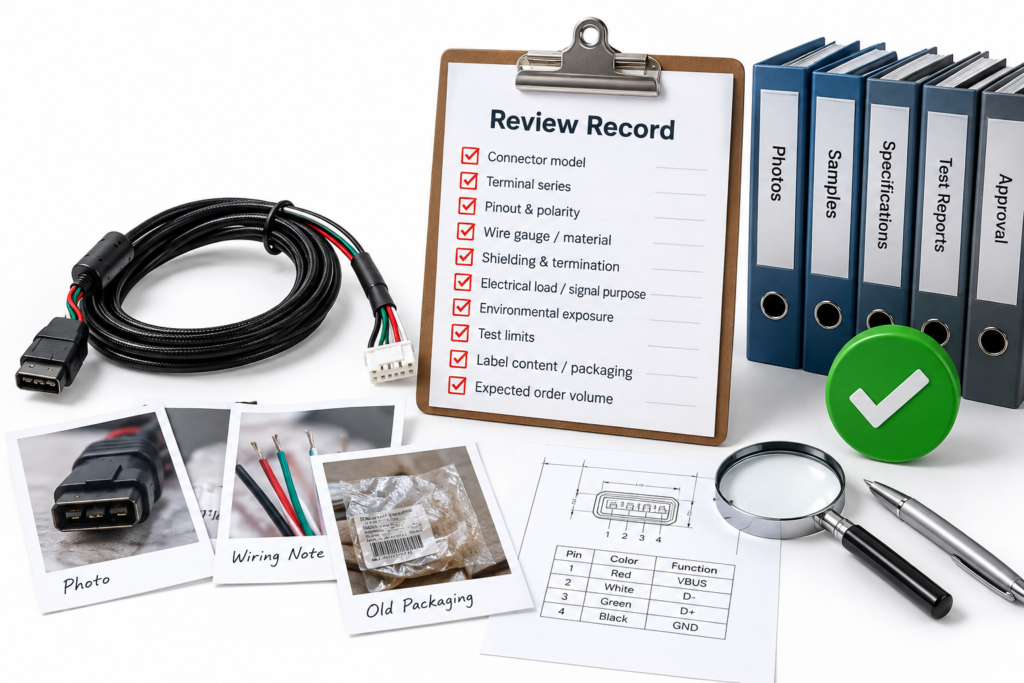
Start an Industrial Wire Harness Quotation
A useful industrial wire harness quotation begins with enough information to make the product comparable from one manufacturing proposal to another. Drawing, BOM, connector and terminal references, AWG, branch dimensions, pinout, materials, environmental conditions, quantity, testing, labels and packaging create the strongest starting point, but projects do not need to arrive in a perfect document package before technical discussion can begin.
If your engineering team already has complete drawings and a BOM, send them together with target quantities and application requirements for review. If the project is earlier and you only have an existing harness, sample photographs, connector information or partial specifications, those references can still be used to identify missing items and establish the next engineering steps before sampling and mass-production discussion.
Cablivo supports custom wire harness and cable assembly projects from specification review and sample development through production, testing, labeling, packaging and export-delivery coordination. Share the available project information, including drawings, BOM, connector references, cable length, AWG, pinout, application conditions, target quantity, testing requirements and packaging needs, to begin a more accurate industrial wire harness quotation.