Skip to content


A Dual RJ45 cable assembly can look straightforward on a purchasing list: two RJ45 interfaces, a cable length, and an order quantity. In manufacturing, however, those few words can describe very different products. The connectors may be plugs, jacks, shielded panel-mount interfaces, molded ends, or components from a specific approved source. The cable itself may differ in category, conductor size, shielding, jacket, flexibility, diameter, wiring, and test requirements. Two assemblies that look almost identical in a photograph can therefore require different components, tooling, processes, inspection methods, and packaging.
For an accurate Dual RJ45 cable assembly quote, provide the connector configuration, cable category, finished length, conductor or AWG specification, shielding, jacket requirement, pinout or wire sequence, intended application, network performance requirement, testing scope, target quantity, labeling, packaging, and any available drawing, BOM, sample, or connector part number. These details allow the manufacturer to calculate the product around the actual specification rather than assumptions.
This matters because a fast quotation built on missing information can create more work later. A project may initially be described as a one-meter Cat6 Dual RJ45 cable, but sampling can reveal that one interface must be panel mounted, the pinout is custom, the cable must pass through a restricted enclosure opening, and every finished assembly requires additional inspection. At that point, the original price no longer represents the product. A well-prepared RFQ helps prevent that disconnect before tooling, samples, approvals, and production schedules begin.
What Does “Dual RJ45” Mean in Your Assembly?
“Dual RJ45” is a useful product description, but it is not a complete manufacturing definition. The quotation should first establish what the two RJ45 interfaces actually are, how they are arranged, where the assembly will be installed, and whether the project is based on a drawing, an existing sample, or a new equipment design. Clarifying the structure early prevents the wrong connector or cable arrangement from being priced.
Are Both RJ45 Interfaces the Same?
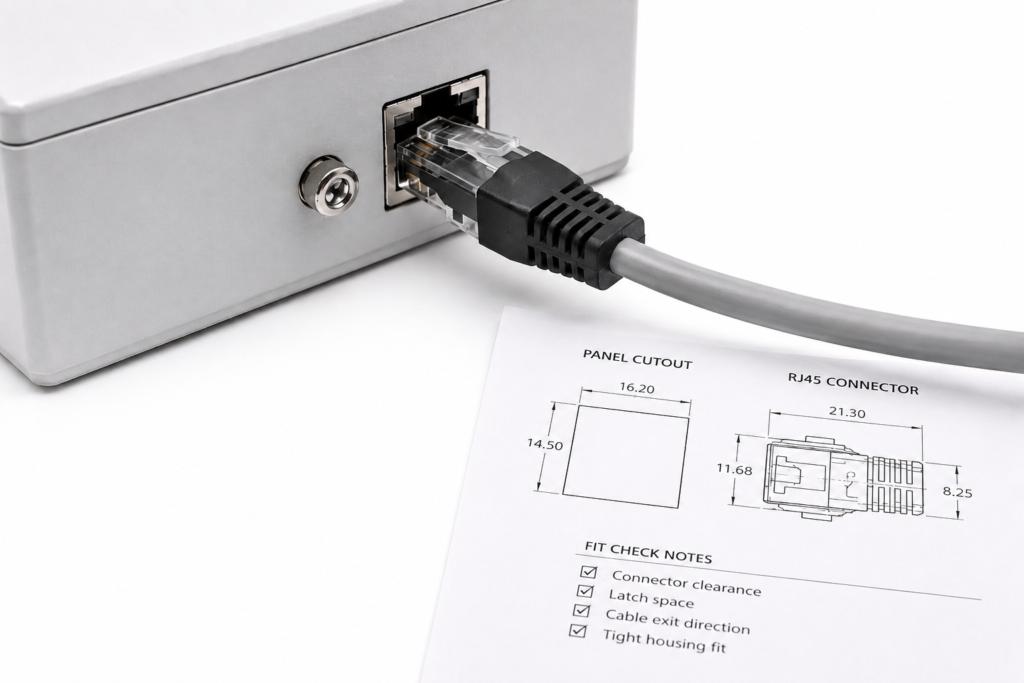
Two RJ45 interfaces should be identified separately rather than assumed to be identical. Connector A may be a conventional modular plug while Connector B is a panel-mount jack, shielded bulkhead interface, right-angle component, coupler-style part, or molded connector. Even when both ends are RJ45 plugs, differences in shield construction, housing geometry, cable-entry diameter, latch protection, boot shape, contact design, or approved component source can change both material cost and the assembly process.
For an existing design, the safest RFQ includes the manufacturer and part number of each approved connector. If those details are unavailable, clear front, side, rear, and cable-entry photographs can help establish the basic structure. The quotation should also state whether the exact component is mandatory or whether technically suitable alternatives can be discussed. That distinction matters when the original connector has a long sourcing cycle, a high minimum order, or mechanical features that are not obvious from a general description such as “shielded RJ45.”
How Are the Two RJ45 Interfaces Arranged?
The physical relationship between the two interfaces affects cable cutting, routing, termination, molding, inspection, and packaging. A straight RJ45-to-RJ45 cable is very different from a Y-shaped assembly, a two-branch cable, a panel-mounted configuration, or a larger equipment harness containing two RJ45 interfaces. The drawing should therefore show the complete path of the cable instead of listing only a total length.
For branched products, identify the split point and define how each branch length is measured. For panel-mounted assemblies, provide the panel thickness, mounting orientation, available installation space, and cable exit direction where these dimensions matter. A statement such as “one-meter cable” is not always enough because one meter could mean connector tip to connector tip, housing to housing, cable-only length, or the longest branch. A dimensional drawing removes that ambiguity and gives production and inspection teams a consistent reference.
What Is the Cable Used For?
Application information helps the manufacturer understand which details deserve closer review. A cable installed permanently inside a control cabinet has different mechanical demands from a cable that technicians connect and disconnect every day. An assembly routed near motors, power wiring, switching equipment, or other interference sources may require a more careful discussion of shielding, while a cable routed through a compact enclosure may be more sensitive to cable diameter, bend behavior, boot length, and connector orientation.
Useful application information includes the equipment type, indoor or outdoor use, fixed or moving installation, expected bending, connector mating frequency, nearby electrical equipment, installation space, and any known environmental concern. This information should guide questions rather than create unsupported assumptions. A manufacturer should not automatically assign Cat6A, a specific jacket material, or an environmental rating because the product is used in industrial equipment. The application simply helps determine which specifications need to be confirmed before the final quote and sample are approved.
Can a Reference Sample Clarify the Assembly?
A physical sample is particularly useful when replacing an existing supplier or reproducing an established cable. It can reveal connector geometry, boot shape, cable diameter, label position, molded details, cable exit direction, branch layout, and other features that may be difficult to describe in an email. Clear sample photographs can also support an initial review when shipping the original part is not practical during the early quotation stage.
A sample should still be paired with the information that cannot be verified from appearance alone. Internal pinout, conductor size, shielding structure, cable category, material specification, electrical performance, and test criteria may not be visible from the outside. Cablivo’s documented project-information process therefore treats drawings, sample photos, BOMs, connector models, cable length, AWG, pinout, application, target quantity, testing, and packaging as related inputs rather than relying on a product name or photograph alone.
| Assembly Item | Information to Provide | Practical Check | Why It Matters |
| Connector A | Model, plug/jack type, shielding, photos | Confirm mating part and orientation | Prevents the wrong connector from being quoted |
| Connector B | Define independently from Connector A | Check whether both ends are actually identical | Controls component and processing cost |
| Overall layout | Straight, panel-mounted, split or branched | Use a drawing showing all interfaces | Defines manufacturing structure |
| Finished length | Length plus measuring reference | State exact measuring points | Reduces dimensional disputes |
| Branch lengths | Each branch separately | Define the split-point reference | Critical for Y-shaped assemblies |
| Installation space | Cabinet, panel, equipment or rack | Check connector and cable clearance | Reduces installation mismatch |
| Reference sample | Physical sample or clear photos | Pair with hidden electrical data | Useful for replacement projects |
| Application | Fixed, moving, telecom, automation, industrial | Describe real operating conditions | Helps identify missing requirements |
Which Cable and Connector Specs Are Required?
The quotation should define the cable and connector construction clearly enough that different suppliers are pricing the same product. Important inputs include both RJ45 connector models, Ethernet category, finished length, conductor or AWG requirement, shielding structure, jacket material, cable diameter limitations, color, boot or strain relief, and any panel-mount or overmolded features included in the design.

Which RJ45 Connectors Are Required?
The term “RJ45 connector” covers more constructions than a short RFQ often suggests. Each interface should be defined as a plug, jack, panel-mount component, shielded connector, right-angle connector, molded interface, coupler-style part, or another confirmed configuration. When an exact connector has already been qualified in the customer’s equipment, providing the manufacturer and part number is much safer than asking the supplier to choose a visually similar component.
If the exact part is still open, describe the mating connector, orientation, shielding, mounting method, latch accessibility, cable exit direction, required boot, and available mechanical space. Connector selection can influence much more than component price. It affects termination method, cable OD compatibility, shield connection, strain relief, molding feasibility, tooling, sample preparation, and long-term repeatability. Cablivo’s documented engineering-review process includes connector confirmation together with pinout and wire-sequence review before sampling and production preparation.
Which Ethernet Category Is Needed?
The required Ethernet category should come from the real equipment or network requirement rather than from a preference for a higher specification. Cat5e, Cat6, Cat6A, and other categories can involve different cable constructions, performance targets, dimensions, shielding arrangements, and validation requirements. An RFQ that simply says “RJ45 cable” leaves too much room for suppliers to price different technical solutions.
A higher category is not automatically the best fit for every assembly. Increased cable diameter or a different shield construction can affect flexibility, enclosure routing, connector compatibility, and installation space. The correct question is whether the selected construction satisfies the system requirement while remaining practical for the equipment. Cablivo’s Network/Ethernet testing facts specifically state that Cat5e, Cat6, Cat6A, Cat7, Cat8, and related transmission claims must be confirmed against the actual specification and test requirement rather than assumed from the connector appearance.
What Cable Length and AWG Are Required?
Finished cable length should always include a measurement reference when the assembly structure is not completely obvious. Straight cables may be defined connector to connector, while panel-mounted, branched, or molded assemblies may require dimensions between specific housing faces or defined branch points. If equipment installation is sensitive to cable routing, length tolerance should also be stated so the supplier knows how the finished dimension will be inspected.
AWG or conductor size should be specified when it is controlled by the design. Cable outside diameter should not be used as a substitute for AWG because overall diameter also reflects insulation, shielding, separators, fillers, and jacket thickness. If the conductor requirement is still unknown, the customer can provide the application, existing sample, required Ethernet category, equipment information, and any available electrical specification. Cablivo’s material and structure framework considers cable length, wire gauge, conductor, insulation, shielding, jacket, connector, pinout, application, testing, and packaging as interconnected project inputs.
Is Shielding or a Special Jacket Required?
Shielding should be defined according to the actual application and network requirement. An RFQ may call for an unshielded cable, foil shielding, braided shielding, a combined structure, or another approved design. Connector shielding and cable shielding should also be considered together because specifying a shielded connector does not, by itself, define how the complete assembly manages shielding or grounding.
Cablivo’s documented manufacturing system includes braiding and foil-wrapping capability for network, signal, communication, and other cable structures where interference control or structural protection is required. Jacket requirements should similarly be tied to real use conditions. PVC, TPE, TPU, PUR, PE, or another material may be considered depending on flexibility, abrasion, environment, diameter, appearance, and project requirements. If custom overmolding or strain relief is needed, the RFQ should also define the shape, dimensions, color, cable exit direction, connector exposure, and any tooling requirement before the initial price is treated as final.
| Specification | Common Options | What Must Be Confirmed | Selection Value |
| RJ45 interface | Plug, jack, panel mount, shielded | Exact model or mating requirement | Controls mechanical compatibility |
| Ethernet category | Cat5e, Cat6, Cat6A or project-defined | System and test requirement | Prevents over- or under-specification |
| Finished length | Project-specific | Measuring points and tolerance | Ensures installation fit |
| Conductor | Project-specific AWG | Gauge and construction | Affects electrical and physical design |
| Shielding | Unshielded, foil, braid, combined | Required shield structure | Supports interference-control needs |
| Jacket | PVC, TPE, TPU, PUR, PE or specified | Application and material requirement | Affects flexibility and protection |
| Cable OD | Depends on construction | Installation and connector limits | Important for routing and boots |
| Strain relief | Standard boot or custom design | Shape and bend direction | Protects connector transition area |
| Overmold | Optional/custom | Dimensions, color and tooling | Changes sample and production scope |
How Should Pinout and Performance Be Defined?
The connector shell does not tell the factory how the conductors should be wired or what the completed assembly must achieve. The RFQ should identify T568A, T568B, or a controlled custom pinout, define how Connector A maps to Connector B, state any PoE or shield-termination requirements, specify the required network performance, and agree on the tests used to verify the finished product.

Is T568A, T568B, or a Custom Pinout Required?
The wiring standard should appear explicitly in the drawing or RFQ. If the product follows T568A or T568B, state which one is required instead of asking the factory to infer it from an existing cable or a photograph. Industrial equipment, test systems, embedded products, adapters, and proprietary devices may use RJ45 hardware while following a completely custom pin assignment, so the connector type alone cannot define the wiring.
For a custom design, a pin-to-pin table is usually the clearest reference. The drawing should also identify the viewing orientation used when numbering the connector contacts because a front mating view and a rear termination view can make the same positions appear reversed. Wire colors can be included as supporting information, but pin numbers provide a more reliable production reference. This same controlled pinout can later support sample approval, production instructions, electrical testing, troubleshooting, and repeat-order quality control.
How Are Both RJ45 Ends Wired?
For every conductor used in the assembly, the engineering team should be able to state where it starts and where it terminates. A conventional straight-through cable may be simple, but a custom Dual RJ45 assembly can use crossover wiring, mirrored mapping, unused contacts, split branches, special shield termination, drain wires, or proprietary conductor assignments. Those relationships should be shown explicitly instead of described with phrases such as “standard wiring” or “same as sample.”
A controlled connection table also makes supplier comparison more meaningful. If three manufacturers are pricing the same Connector A-to-Connector B pin map, the prices represent comparable products. If each supplier interprets the wiring independently, a lower price may simply reflect a simpler internal assumption. Cablivo’s documented engineering scope includes both wire-sequence confirmation and pinout review before sampling and mass-production preparation, which helps establish one electrical reference for quotation, sample validation, and production.
Does the Assembly Need PoE or Defined Network Performance?
If the assembly carries both network data and power, the PoE requirement should be identified while the cable structure is being reviewed. The customer should provide the applicable system or equipment requirement, together with any confirmed electrical or network specification. A general phrase such as “PoE cable” is less useful than a clear description of what the finished assembly must support within the customer’s system.
The same approach applies to network performance. Cable category, equipment requirement, intended transmission performance, and acceptance method should be based on the actual project rather than on marketing language. An RJ45 connector does not automatically make an assembly Cat6 or Cat6A, and a shielded connector does not define the complete shield performance of the cable. Projects that are still in development can clearly separate confirmed specifications from open engineering items. Keeping those open items visible is safer than hiding them inside quotation assumptions that may have to be changed later.
Which Tests Must Be Performed?
Testing should match both the product specification and the practical risk of the application. Cablivo’s documented Network/Ethernet inspection framework identifies continuity testing, wire-sequence checking, RJ45 mating inspection, cable-length verification, shielding-structure inspection, label inspection, and packaging inspection as important areas for network cable projects. Those checks address common issues such as opens, wrong wiring, connector mismatch, dimensional errors, incorrect shield construction, and SKU identification mistakes.
Additional testing should be defined according to the customer’s actual performance requirement. A project may require category-related network testing, electrical measurements, customer-specific validation, or connector durability evaluation. The phrase “100% tested” has limited value unless the quotation or quality agreement states what is tested and what constitutes acceptance. Cablivo’s equipment facts also include connector insertion and withdrawal life testing applicable to RJ45-related projects when repeated mating durability is part of the requirement.
| Technical Item | Typical Definition | Useful Verification | Procurement Concern |
| Wiring standard | T568A, T568B or custom | Pin-to-pin comparison | Prevents functional mismatch |
| Pin orientation | Front, mating or rear view | Controlled connector drawing | Avoids reversed numbering |
| Connection type | Straight-through or custom | Wire-sequence test | Clarifies actual wiring |
| Shield termination | Project-defined | Visual/electrical inspection | Important for shield continuity |
| PoE requirement | Equipment/project specification | Project-specific validation | Must be known before final design |
| Ethernet category | Cat5e, Cat6, Cat6A or specified | Required network test | Keeps quotations comparable |
| Continuity | Pass/fail electrical connection | Cable tester | Detects open circuits |
| Wire sequence | Correct conductor mapping | Pinout tester | Detects miswiring |
| RJ45 mating | Correct physical fit | Mating check | Reduces installation failures |
| Cable length | Drawing requirement | Dimensional inspection | Controls equipment fit |
| Shielding structure | Foil, braid or specified design | Process/finished inspection | Confirms required construction |
| Connector durability | When required | Insertion/withdrawal life test | Relevant for frequent mating |
Which Commercial Requirements Affect the Quote?
Technical specifications define what the cable is, while commercial requirements define how the project must be sampled, sourced, produced, inspected, identified, packed, and delivered. Target quantity, sample scope, tooling, SKU count, labels, packaging, documentation, and destination can materially change a quotation even when the electrical design remains exactly the same.

What Quantity Do You Need?
Quantity should reflect the project stage instead of being reduced to a request for the “best price.” Material purchasing, connector sourcing, production setup, testing, packaging, and tooling behave differently at different volumes. A more useful RFQ separates engineering sample quantity, initial production quantity, current purchase quantity, and expected recurring demand where that information is available.
Cablivo’s documented general MOQ starts from 500 pieces for many custom cable projects, while the final MOQ depends on connector type, cable structure, materials, overmolding, tooling, packaging, and order quantity. The correct MOQ for a Dual RJ45 project should therefore be confirmed against the actual design rather than treated as a fixed rule for every network cable. Multi-SKU projects should also list the quantity of each version separately. Five thousand identical assemblies and five thousand assemblies divided across ten lengths, labels, or connector variants create very different sourcing, setup, inspection, inventory, and packing requirements.
Are Samples Needed Before Production?
A sample stage can reduce risk before a customized Dual RJ45 cable enters volume production. Samples may be used to verify connector fit, cable routing, finished length, pinout, label position, overmold appearance, panel installation, or the interaction between the cable and the customer’s actual equipment. The RFQ should state the required sample quantity and what the customer intends to validate so the sample scope can be priced separately from the mass-production order.
Sample timing also depends on the actual project. Cablivo’s factual guidance states that sample time can be affected by connector availability, material preparation, product structure, tooling, and testing requirements. Complex molded or multi-connector products therefore need to be reviewed before a realistic sample schedule is confirmed. A structured sample approval also creates a cleaner reference for final drawings, BOMs, labels, packaging files, and production instructions before the bulk order starts.
Are Labels, Packaging, or Documentation Customized?
Labels and packaging can become important project-control elements, particularly when a customer manages several cable SKUs, equipment models, distributors, warehouses, or regional programs. The RFQ should state whether the assembly requires a wire label, barcode, customer SKU, serial identification, model number, warning label, or another customer-specific mark. Label content, position, material, and artwork responsibility should be confirmed before production if they are part of the finished product.
Packaging requirements should likewise be defined early. Assemblies may be bulk packed, individually bagged, coiled, tied, boxed, retail packed, or protected using another approved method. Depending on the product structure, the RJ45 latch or exposed connector area may also need transportation protection. Documentation requirements can include project-specific inspection records, test records, packing files, material documents, or other customer-controlled paperwork. These requirements consume real materials and quality-control time, so they belong in the quotation rather than being introduced only after the price is approved.
Where Will the Order Be Delivered?
The delivery destination becomes relevant whenever the quotation includes freight, export packing, carton planning, shipment coordination, or destination-specific handling. At minimum, the destination country should be provided when logistics are part of the requested commercial scope. For a delivered quotation, the city and required trade term may also be needed so the supplier understands what is included.
Destination can influence packaging decisions even when the cable itself does not change. An assembly moving directly to a nearby equipment plant may have different handling requirements from one traveling through international freight, distributor storage, and multiple warehouse transfers. Cablivo’s project-information framework includes shipping destination together with drawings, connector details, cable length, quantity, testing, and packaging because logistics may become part of the overall commercial scope. Comparing suppliers is much easier when each quotation clearly separates product price, tooling, labels, packaging, testing records, and freight-related services.
| Commercial Factor | Information to Provide | Typical Quote Impact | Procurement Check |
| Sample quantity | Number of engineering samples | Material and setup effort | Separate sample cost from production |
| Initial production | Real first-order quantity | Sourcing and production planning | Avoid unrealistic volume pricing |
| Repeat demand | Forecast when available | Supports material planning | Identify forecast as non-binding where needed |
| SKU count | Quantity by variant | Setup, inventory and labeling | Do not combine all versions into one total |
| Tooling | Mold or custom tooling requirement | Possible one-time cost | Confirm whether quoted separately |
| Cable labels | SKU, barcode, model or serial | Material and inspection work | Confirm artwork and position |
| Packaging | Bulk, bag, box or retail | Material and labor | Compare equivalent packaging |
| Test records | Required format and frequency | QA/documentation workload | Define before final quote |
| Carton marks | Customer-specific requirements | Packing control | Important for multiple SKUs |
| Destination | Country, city and trade term | Logistics scope | Confirm whether freight is included |
How Do You Prepare a Complete RFQ?
A complete Dual RJ45 RFQ brings the latest technical and commercial information into one controlled package. It should include the assembly drawing or sample information, both connector definitions, cable construction, finished length, pinout, application, performance target, test requirements, quantity, labels, packaging, and revision status. Any item that is still undecided should be identified openly rather than left for suppliers to interpret differently.

Do You Have a Drawing or BOM?
A controlled drawing is usually the strongest starting point for a custom cable quotation because it can place Connector A, Connector B, cable specification, finished length, tolerances, pinout, branch dimensions, molding, labels, and other critical details in one reference. A BOM complements the drawing by identifying approved connector models, cable materials, terminals, labels, packaging components, and any customer-controlled parts.
Revision status matters just as much as the document itself. If purchasing requests a price using Revision A while engineering is already working from Revision C, the supplier may quote a product that no longer represents the current design. The quotation should therefore identify which drawing or BOM revision was used as its technical basis. When a later revision changes the connector, cable construction, pinout, tooling, length, test requirement, or packaging, the commercial effect can then be reviewed transparently instead of appearing as an unexplained price change.
Can Sample Photos Be Used Instead?
Clear sample photographs can support an early quotation when a formal drawing does not yet exist, particularly for replacement projects or assemblies being transferred from another source. Useful photographs show each RJ45 interface, the mating face, side profile, cable entry, boot or overmold, label position, cable diameter, branch structure, and the complete assembly. Photographs are most effective when Connector A and Connector B are clearly distinguished.
They should not be expected to reveal internal specifications. Pinout, AWG, category, shielding, conductor construction, material grade, and electrical performance usually cannot be confirmed visually. The photographs should therefore be paired with the known cable length, application, target quantity, wiring, category, shielding, testing, and other available project information. Cablivo’s engineering guidance allows an initial review to begin with sample photos, connector photos, cable length, application information, and target quantity when complete drawings are unavailable, after which the remaining details can be identified before sampling.
Which Files Help Prevent Requoting?
Requoting often happens because the real specification arrives gradually. The first email may request a Cat6 cable at a certain length, a second message may add shielded connectors, engineering may later send a custom pinout, packaging may add barcode labels, and quality may finally request test records. None of these requirements is unreasonable, but together they describe a different product and commercial scope from the first quotation.
A stronger RFQ groups the latest product drawing, BOM, pinout, connector datasheets, cable specification, test criteria, quantity list, label files, packaging instruction, and relevant documentation requirements into one package. Open decisions should be visibly marked as pending rather than left blank. This makes supplier comparison much more meaningful because every manufacturer is pricing the same known scope and clearly identifying any alternatives or exclusions. The lowest price then has a technical basis instead of simply reflecting the largest number of hidden assumptions.
What Should Be Confirmed Before the Final Quote?
Before approving the final commercial quotation, compare it against the RFQ item by item. Connector A, Connector B, category, AWG, cable length, shielding, jacket, OD, pinout, overmolding, testing, sample scope, tooling, production quantity, labels, packaging, documentation, and delivery terms should all be consistent with the latest technical reference. Any alternative component or exclusion should be identified before the quotation becomes an order basis.
Once the sample and specification are approved, the final drawing, BOM, approved sample status, test requirement, label file, and packaging instruction should become the production reference. Cablivo’s documented production framework follows this controlled progression through approved sample, final drawing, final BOM, material preparation, production scheduling, manufacturing processes, functional testing, inspection, labeling, packaging, OQC, and shipment coordination. That continuity is important because the real goal is not merely to obtain an accurate first price; it is to keep the quoted specification aligned with the product that is ultimately produced and reordered.
| RFQ Item | Preferred Input | Final-Quote Check | Risk If Unclear |
| Assembly drawing | Latest controlled revision | Revision shown on quotation | Wrong version priced or produced |
| Connector A | Exact model or approved alternative | Confirm source and orientation | Mating failure |
| Connector B | Exact model or approved alternative | Review independently from A | Incorrect assumption of identical ends |
| Cable category | Confirmed project requirement | Match drawing/specification | Performance mismatch |
| AWG/conductor | Defined where required | Verify against BOM | Wrong cable construction |
| Finished length | Drawing plus measuring points | Confirm tolerance | Installation mismatch |
| Pinout | Controlled pin-to-pin table | Same revision used for testing | Functional failure |
| Shielding | Defined structure | Cable and connector design aligned | Technical or cost mismatch |
| Jacket | Material/application requirement | Confirm final material | Environmental mismatch |
| Overmold/tooling | Drawing and tooling scope | Included or excluded clearly | Unexpected development cost |
| Testing | Defined test list and criteria | Quote identifies included tests | Incomplete validation |
| Sample scope | Quantity and purpose | Separate from mass production | Approval-stage confusion |
| Production quantity | Quantity by SKU | Match price tier | Incorrect price basis |
| Labels | Approved content and position | Artwork status confirmed | Identification errors |
| Packaging | Packing method and protection | Quote reflects final method | Added cost after approval |
| Documentation | Required records and files | Included scope visible | Late quality workload |
| Destination | Country/city/trade term | Freight scope confirmed | Commercial comparison error |
| Open items | Explicit pending list | Closed before approval | Requoting and schedule disruption |
An accurate Dual RJ45 cable assembly quotation is not created by sending the longest possible specification. It comes from identifying the information that genuinely affects connector selection, cable construction, wiring, performance, production, inspection, packaging, and repeatability. When those requirements are clear, engineering teams can evaluate the product correctly, procurement teams can compare equivalent quotations, and the manufacturer can prepare a sample that represents the commercial offer instead of discovering major differences after the project has already moved forward.
Cablivo is the overseas-facing brand of Shenzhen Tianxiaowei Electronics Co., Ltd., a Shenzhen-based custom cable, wire harness, and cable assembly manufacturer supporting overseas projects from requirement and drawing review through sampling, production, testing, packaging, labeling, and shipment coordination. The company’s documented manufacturing base includes 18 years of industry experience, more than 20,000 square meters of factory space, a team of more than 1,500 people, and three manufacturing bases. These resources are intended to support project-based cable development rather than simply supplying an unspecified standard cable.
If you are preparing a Dual RJ45 Cable Assembly project, send the available drawing, BOM, sample photos, Connector A and Connector B information, finished length, AWG, pinout, network category, shielding requirement, application, testing specification, target quantity, label files, and packaging requirements. If some specifications are still open, submit the information already available and identify the unresolved items. The project can then be reviewed around the real engineering and commercial requirements before quotation, sampling, and production are discussed.