...

Custom Cat5 Ethernet Cable Factory

Project-based Ethernet cable manufacturing for brands, engineering teams, system integrators, distributors, and long-term network equipment programs worldwide.

Cable experience
0 +Years
Factory space
0 + m²
organization support
0 + People
Manufacturing bases
0 Bases

Built Around Different Ethernet Cable Procurement Roles

Different project roles evaluate an Ethernet cable factory from different angles. Cablivo organizes specifications, sampling, manufacturing, testing, labeling, packaging, and repeat-order information so each team can review the points that affect its own approval process.

Network Equipment Brands

Network equipment brands often need cable programs that remain consistent across product releases, regional versions, and repeat orders. Typical discussions include network category, connector construction, cable length, jacket, color, boot, labeling, packaging, and target application. Cablivo can review drawings, reference samples, connector information, quantity plans, and packaging files before sample development, helping the brand establish a clearer basis for quotation, approval, bulk production, and future replenishment.

Engineering Teams

Engineering teams usually begin with drawings, equipment interfaces, connector details, length requirements, shielding needs, or an existing sample. Their priority is reducing specification ambiguity before a prototype is built. Cablivo can review available files, confirm cable structure questions, identify missing information, discuss connector fit, and define sample-check points. The goal is not to replace the engineering specification, but to turn approved technical inputs into a manufacturable cable sample and later production files.

Procurement Teams

Procurement teams need more than a unit price. Factory evaluation normally includes MOQ, specification control, sample approval, production consistency, testing scope, packaging files, delivery planning, and repeat-order management. Cablivo starts custom cable programs from 500 pieces, while the actual MOQ depends on cable structure, connector, materials, overmolding needs, packaging, and SKU mix. Quotation becomes more reliable when quantities, length breakdowns, testing expectations, and packaging requirements are supplied together.

System Integrators

System integrators frequently work with multiple cable lengths, equipment locations, labels, and installation sequences. A useful supply program therefore needs clear identification as well as correct electrical connection. Cablivo can discuss custom Ethernet cable length lists, cable labels, project packaging, quantity breakdowns, and carton identification alongside connector and application requirements. For installation-oriented projects, a structured SKU list and packing plan can reduce mix-ups when cables arrive at the staging area or job site.

Distributors

Distributors often purchase several lengths, colors, packaging versions, or market-specific SKUs in one program. The cable itself is only part of the supply task; barcode files, SKU labels, carton marks, quantity breakdowns, and repeat-order references also matter. Cablivo can organize multi-SKU network cable requirements around a shared specification set, while keeping length, color, label, packaging, and quantity differences visible. That structure supports clearer warehouse identification and more controlled replenishment.

Private Label Programs

Private-label programs combine cable manufacturing with brand presentation. Color, boot appearance, product labeling, barcode, insert card, retail or bulk packaging, and outer-carton information may all require approval before mass production. Cablivo can coordinate product and packaging requirements as part of one project file set. Brand artwork, packaging format, SKU plan, quantity by version, and sample references should be shared early so product approval and packaging approval do not become separate late-stage problems.

Custom Ethernet Cable Formats for Different Supply Programs

A custom Ethernet cable program can involve far more than one standard patch lead. Product format should follow the equipment interface, cable category, installation method, SKU structure, visual requirement, packaging route, and testing expectations defined for the project.

Coiled Black Ethernet Cable Assembly with RJ45 Connectors

RJ45 Patch Cables

RJ45 patch cable programs can be developed around the specified network category, cable length, connector construction, boot style, jacket, color, label, quantity, and packaging plan. Cablivo reviews the project requirement before quotation rather than assuming one standard construction fits every application. For programs identified as Cat5, Cat5e, or another category, the final category and related test requirement should follow the drawing, BOM, existing sample, equipment specification, or other approved project documentation.

Blue customizable Ethernet cable with RJ45 connectors

Custom Length Cables

Custom-length Ethernet cables are useful when standard retail lengths create excess cable, poor routing, or SKU gaps. A length list should show each required length, quantity per length, color or label differences, and packaging method. Cablivo can use the approved length breakdown as part of sample and production planning. Length tolerance, connector orientation, labeling position, and packing sequence should be discussed before mass production whenever installation space or multi-SKU control makes those details important.

Blue Shielded Ethernet Cable with Braided and Foil Shielding Structure

Shielded Cable Projects

Shielded Ethernet cable requirements should be driven by the application and the approved technical specification, not by a general assumption that more shielding is always better. Cablivo can discuss shielding structure together with cable category, connector, jacket, length, termination, installation environment, and testing expectations. A drawing, reference cable, equipment information, or written shielding requirement gives engineering teams a clearer basis for sample review and helps avoid unnecessary structure, cost, or validation work.

Shielded Ethernet cable with braided shielding, aluminum foil and four twisted pairs

Unshielded Cable Projects

Unshielded Ethernet cable projects may suit applications where the approved design does not require additional shielding. Selection still depends on the specified network category, conductor and cable construction, connector, length, jacket, use environment, and required testing. Cablivo can review available information and develop a sample around the confirmed specification. The decision between shielded and unshielded construction should remain tied to the actual project requirement rather than marketing labels or generic performance claims.

Green Industrial Ethernet Cable with M12 Circular Connector and RJ45 Plug

Equipment Ethernet Leads

Equipment Ethernet leads may require more application-specific attention than an ordinary office patch cable. Connector fit, cable exit direction, length, routing space, jacket, color identification, labeling, and packaging can affect installation and service. Cablivo can review interface photos, connector information, drawings, existing cables, or equipment requirements before sample development. The manufacturing plan can then follow the approved sample and final files, keeping the cable linked to the equipment interface instead of treating it as a generic accessory.

Gray Ethernet patch cable with RJ45 connectors

Multi-SKU Cable Programs

Network cable programs for distributors, brands, or system integrators can contain several lengths, colors, labels, barcodes, or packaging versions. Cablivo can organize those differences through a SKU list, quantity breakdown, packaging file set, and carton identification plan. Product construction should remain consistent where the specification is shared, while SKU-specific fields stay clearly separated. Early control of the SKU matrix reduces the risk of correct cables being packed under the wrong label, barcode, or market version.
Specifications Needed Before a Cat5 Ethernet Cable Quote

A useful quotation starts with a defined cable specification. Existing drawings, BOMs, samples, equipment notes, or SKU lists can be used as the starting point. Missing details can be identified during review instead of being guessed during production.

Specification
What to Confirm
Why It Matters
Cable Category
Cat5, Cat5e, or another category according to approved project documents
Defines the network-cable construction and related test discussion.
Connector
RJ45 or another specified connector, plug construction, orientation, boot needs
Prevents interface mismatch and supports sample fit review.
Wiring / Pinout
Approved wiring requirement, pinout table, drawing, or reference sample
Avoids connection errors caused by assumptions.
Cable Length
Exact length, tolerance discussion, quantity per length
Affects installation, SKU control, packing size, and quotation.
Shielding
Shielded or unshielded structure according to application
Keeps structure aligned with the actual environment and specification.
Jacket
Material direction, color, flexibility or application needs
Affects handling, appearance, packaging, and use conditions.
Boot / Appearance
Boot style, cable exit, color, surface expectation
Supports equipment fit and brand consistency.
Labeling
Label content, position, barcode or SKU reference
Improves installation, warehouse identification, and repeat ordering.
Packaging
Bulk bag, project packing, private-label or retail format
Affects quotation, approval work, carton planning, and channel readiness.
Quantity
Total quantity and quantity per SKU
Supports MOQ review, material planning, production planning, and pricing.
Application
Equipment, network environment, installation route, target use
Provides context for structure and test discussions.
Testing
Continuity, fit, length, transmission-related or other project requirements
Defines what needs to be validated before release.

Customize the Ethernet Cable Around the Approved Specification

Custom manufacturing should begin with the application and approved specification, not a catalog of random options. Cablivo can discuss the following dimensions together so the cable, sample, labeling, packaging, and production files remain connected to one project requirement.

Cable Category

Network category is a specification item, not a marketing decoration. If a project calls for Cat5, Cat5e, or another category, the requirement should be confirmed from drawings, BOMs, reference samples, equipment documentation, or written technical criteria. Cablivo uses the confirmed category as part of engineering review, sample planning, and testing discussions. Unverified category or performance claims are not substituted for missing project information.

Cable Length

Length can be discussed for single-SKU and multi-SKU programs. Engineering and procurement teams should provide the nominal length, quantity per length, and any tolerance or installation constraint that matters. A clear length list supports cutting control, sample verification, packaging size planning, labeling, and repeat ordering. Where several lengths share the same construction, one controlled matrix can separate the SKU differences without turning each version into an unrelated product.

RJ45 or Connector

RJ45 and other connector requirements should be identified by specification, datasheet, drawing, interface photo, approved sample, or other reliable reference. Appearance alone can be misleading when housing, orientation, boot, or termination details differ. Cablivo can review connector information before sample development and use the sample stage to validate fit where needed. Early connector confirmation reduces the risk of building a correct cable around the wrong interface.

Shielding Structure

Shielding can be discussed together with application environment, network category, connector, jacket, length, termination, and test requirements. Cablivo does not treat shielding as an automatic upgrade for every Ethernet cable. The structure should follow the approved requirement. A reference sample, drawing, written shielding specification, or equipment need gives the project team a clearer basis for selecting and validating the cable construction.

Jacket Requirement

Jacket selection affects handling, appearance, flexibility, routing, packaging, and the way a finished cable fits the intended use. Project teams can provide material direction, reference feel, color, environment, sample photos, or application notes. Cablivo can discuss jacket options as part of the complete cable structure rather than as an isolated material choice. Any compliance or special material requirement should be identified and verified against the actual project documentation.

Color and Boot

Color and boot details can support product identification, brand presentation, installation organization, or SKU separation. A brand may require a matched cable color, defined boot color, specific cable exit, or consistent appearance across several lengths. Cablivo can review color references, sample photos, artwork, and other approved visual references during development. Final appearance should be tied to the approved sample or agreed production file rather than a vague color name alone.

Labels and Barcodes

Labels turn a cable into a controlled SKU or installation item. Content may include product codes, length identification, barcode, batch information, or project-specific references supplied by the brand or system integrator. Cablivo can coordinate label content, position, file version, and packaging relationship as part of the project. Clear label files reduce warehouse confusion and help repeat orders follow the same approved identification method.

Packaging Format

Packaging can range from bulk project packing to private-label or retail presentation, depending on the sales and installation route. Options may involve bags, boxes, insert cards, barcode labels, SKU labels, and export cartons when required by the program. Cablivo can review artwork, packaging size, quantity breakdown, carton marks, and packing instructions before production release. Packaging approval should be managed with the product, not left until the cables are finished.

What Procurement Teams Should Verify Before Selecting a Factory

Factory selection becomes easier when the review is tied to project risk. A credible Ethernet cable source should be able to explain how specifications, samples, production files, testing, SKU identification, and packaging move from inquiry into controlled bulk manufacturing.

Specification Review

A quote based only on a product photo leaves too many variables open. Cable category, connector, wiring, length, shielding, jacket, labeling, packaging, and quantity can all affect the manufacturing plan. Cablivo asks for available drawings, BOMs, sample photos, connector information, length lists, application details, and testing requirements so missing points can be identified before sampling. A supplier evaluation should therefore check whether the factory reviews the specification or merely repeats the inquiry back as a price.

Connector Confirmation

Connector mistakes can stop a cable project even when the wire itself is correct. Similar-looking RJ45 or other interfaces may differ in housing, boot, orientation, termination, or fit requirement. Procurement and engineering teams should look for a supplier that asks for connector identification, interface photos, datasheets, or a reference sample when needed. Cablivo incorporates connector confirmation into project review and sample validation instead of treating the connector as an afterthought.

Sample Control

A sample is useful only when it represents the intended production requirement. The evaluation should examine how the supplier records cable category, connector, length, structure, color, labels, packaging, and test points before approval. Cablivo uses sample development and revision as a verification stage, followed by an approved sample or agreed final files for production reference. The aim is a repeatable manufacturing basis rather than a one-off prototype that cannot be reproduced reliably.

Testing Scope

Statements such as “strict quality” provide little value without a defined inspection scope. Network cable programs may require continuity, connector fit, length, transmission-related testing, shielding checks, appearance inspection, label checks, packaging inspection, or other criteria supplied by the project. Cablivo discusses the applicable checks according to the actual specification. During supplier screening, the stronger question is not “Do you test?” but “What will be tested for our approved cable and how will that requirement be communicated?”

SKU Management

Large brands and distributors often order several lengths, colors, labels, or packaging versions together. A supplier can manufacture each cable correctly and still create a costly problem by mixing SKUs, labels, barcodes, or carton marks. Cablivo can work from an SKU matrix and quantity breakdown so differences remain visible from quotation through packing. Supplier screening should therefore include multi-SKU identification, packaging-file control, and repeat-order reference management, especially for channel programs.

Packaging Control

Packaging errors can delay a program even when the cable passes functional inspection. Artwork version, barcode, SKU label, insert card, quantity per pack, carton mark, and outer-carton information may all require control. Cablivo can review packaging files together with product requirements and include packaging inspection before shipment where applicable. Procurement teams should ask whether the factory manages packaging as part of manufacturing or hands the task to the end of the process without an approved reference.

Engineering Review Before Ethernet Cable Sample Development

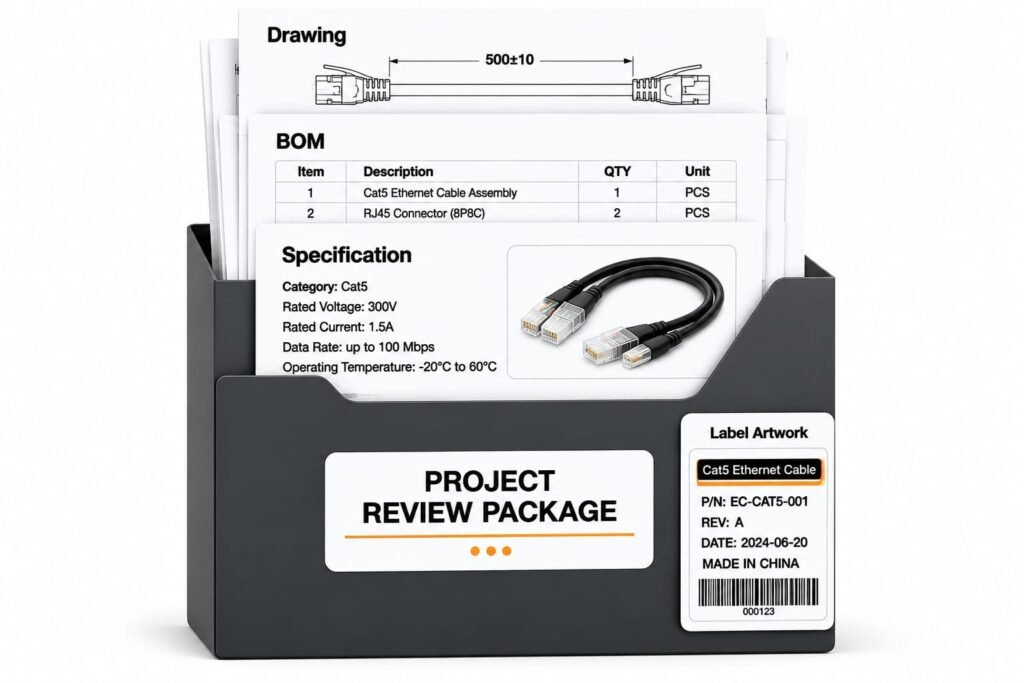
Engineering review turns available project information into a clearer manufacturing basis. Cablivo can work from drawings, BOMs, existing cables, connector data, interface photos, length lists, packaging files, or other approved references instead of asking every project to start from a perfect document set.

Start With Existing Project Evidence

A network cable inquiry often arrives with an uneven mix of information. One engineering team may have a complete drawing and BOM. Another may have an existing cable, an RJ45 requirement, a length list, and an equipment interface photo. A distributor may have a current SKU list and packaging artwork but limited internal construction data. Cablivo can begin by reviewing the evidence already available and identifying which items need confirmation before a sample is built.

The review should connect every important field to a production or approval decision. Cable category establishes the intended network-cable requirement. Connector information supports fit and termination review. Length and tolerance affect cutting, installation, SKU separation, and packaging. Shielding and jacket decisions should follow the application and approved specification. Labels, barcodes, and carton marks belong to the same project record because a correctly built cable under the wrong SKU can still fail a commercial release.

When a drawing is available, Cablivo can review items such as length, connector, wiring or pinout, material notes, label position, and packaging requirements. When the starting point is an old sample, photos and measurable references help frame the discussion. Missing information is not silently guessed. It is identified for confirmation so the sample has a documented purpose and the quotation reflects the actual scope.

Cat5 Ethernet Cable Project Review Package with Technical Drawings and Specifications

Turn Reviewed Specifications Into Sample Criteria

After the initial file review, the project should move toward a defined sample basis. The sample is not merely a visual demonstration; it is a controlled opportunity to verify the cable against the agreed specification before bulk production. Sample criteria can include connector fit, cable length, structure, color, boot appearance, label position, packaging direction, and the tests relevant to the project. The exact set depends on the approved requirement.

Cablivo can use drawings, BOM information, connector references, existing samples, length lists, label files, and packaging instructions to prepare the sample discussion. Engineering questions should be resolved as early as possible because late connector, pinout, length, or packaging changes can affect both cost and schedule. Where several SKUs share the same construction, the review can separate common technical requirements from SKU-specific differences such as length, color, label, or packaging.

Once the sample or sample set is approved, the agreed references can feed production files, quality checkpoints, and packaging instructions. The value of engineering review is therefore visible later in the project: fewer ambiguous decisions remain on the production floor, and procurement teams have a clearer record of what was approved. Sample timing is confirmed after the required specifications, materials, tooling needs, test scope, and packaging work are understood.

Ethernet patch cables in blue, black, yellow, green, white and red

Confirm RJ45 and Interface Details Before Sample Approval

Connector selection deserves its own review because a cable can meet length and appearance requirements yet fail at the equipment interface. Cablivo can evaluate connector references, interface photos, drawings, datasheets, boot requirements, orientation, and existing samples before production release.

Identify the Connector From Reliable References

A familiar connector shape does not always provide enough information for manufacturing. Housing geometry, plug construction, contact arrangement, boot style, orientation, cable exit, termination details, and device clearance can change the result even when two connectors look similar in a photo. Cablivo therefore prefers connector identification based on a datasheet, drawing, approved sample, interface photo, part reference, or another source that gives the project team a common technical reference.

For an RJ45 Ethernet cable program, the connector discussion should remain linked to the cable category, shielded or unshielded construction, jacket, overall cable diameter, boot requirement, and intended equipment interface. If a molded or special strain-relief arrangement is requested, dimensional and appearance requirements should be reviewed before tooling or sampling decisions are made. Cablivo has injection molding and overmolding capability within its broader cable manufacturing operations, but any specific molded construction for an Ethernet cable should be confirmed from the actual project requirement.

Engineering teams can send close-up interface photos, connector samples, equipment drawings, or old cables when formal documentation is incomplete. The purpose is not to force every inquiry into one document format. The purpose is to remove connector uncertainty before the sample is judged, reducing the risk of an otherwise correct cable failing because the plug, boot, or cable exit does not fit the equipment.

RJ45 Ethernet connector boots and protective strain relief covers in multiple colors

Use the Sample Stage to Validate Fit

Connector confirmation should continue through the sample stage whenever physical fit matters. The approved sample can be checked for insertion, orientation, cable exit, boot clearance, housing dimensions, appearance, and other project-specific points. Cablivo can discuss connector-fit checks together with continuity, cable length, labeling, and packaging inspection so the sample is reviewed as a complete item rather than as separate unrelated features.

Equipment makers often have installation constraints that are difficult to express in a short RFQ. A connector may need to clear a recessed port, route through a narrow opening, exit in a preferred direction, or fit next to neighboring components. Interface photos and installation notes can therefore be as valuable as a connector model number. If an existing cable already fits the device, sending that cable or clear reference photos can shorten the identification discussion.

Once fit and appearance are approved, the connector reference should remain linked to the final production files and approved sample. Procurement teams gain a clearer repeat-order basis, while production and quality teams know what physical reference matters. No generic promise of universal compatibility is needed. Compatibility is established against the specified interface and the approved project evidence.

Cable assemblies undergoing multiple electrical and mechanical tests

Select Shielding According to the Ethernet Cable Application

Shielding should follow the approved application and cable specification. Cablivo discusses shielded or unshielded construction together with cable category, connector, jacket, installation environment, length, termination, and testing needs instead of presenting shielding as an automatic performance upgrade.

Start With the Application, Not a Marketing Label

A shielded cable can be appropriate for one installation and unnecessary for another. The correct direction depends on the network requirement, surrounding environment, equipment design, connector construction, termination method, routing, and the test criteria used to approve the cable. Cablivo therefore treats shielding as an engineering discussion rather than a generic “better cable” option. Project teams should provide the approved cable category, application notes, equipment information, drawing, existing sample, or written shielding requirement whenever available.

The review can consider where shielding sits in the cable structure, how it relates to the connector, and whether the proposed construction matches the requested application. Jacket material and overall cable dimensions may also influence routing, handling, connector fit, and packaging. For distribution programs, the same technical construction may then be offered in different lengths, colors, labels, or packaging versions without changing the approved internal requirement.

Cablivo does not publish unverified claims such as universal EMI protection, fixed attenuation values, or guaranteed transmission performance for every project. If a target market, equipment platform, or internal engineering specification requires defined performance or compliance documentation, the requirement should be submitted for review. That approach keeps the manufacturing proposal tied to evidence rather than promotional language.

Shielded Ethernet cable cross section showing jacket, ripcord, twisted pairs, foil and drain wire

Define What the Sample Needs to Prove

Once the shielding direction is agreed, the sample stage can be used to verify the physical construction and the checks that matter to the project. Depending on the approved requirement, review points may include connector fit, cable length, continuity, shielding structure, appearance, labeling, packaging, and transmission-related testing discussion. The exact validation plan should be established from the project specification rather than copied from another cable program.

A sample can also reveal handling issues that are difficult to judge from a drawing alone. Cable flexibility, diameter, routing, boot clearance, and packaging space may influence the final production decision. Brands and equipment makers can provide feedback before mass production, while procurement teams can connect approved sample status to the final BOM, production files, SKU list, and packaging artwork.

Where several cable versions share one shielded construction, Cablivo can separate common technical approval from variable commercial fields such as length, color, label, and packaging. That distinction helps avoid repeated engineering work while keeping SKU control clear. Production lead time is confirmed only after the final structure, materials, quantities, testing, packaging, and approved sample status are known.

Comparison of UTP, S/UTP, SF/UTP, S/FTP and SF/FTP cable shielding structures

Validate the Ethernet Cable Before Moving Into Production

Sample development gives engineering, procurement, and brand teams a physical reference before bulk manufacturing. Cablivo can turn available drawings, old samples, connector information, length requirements, labeling, packaging, and test expectations into a sample-review process built around the approved project scope.

Build the Sample From Reviewed Inputs

A useful Ethernet cable sample begins with reviewed project inputs. The starting package may include a drawing, BOM, existing cable, interface photo, RJ45 requirement, cable category, length list, shielding direction, jacket request, label file, packaging artwork, quantity plan, or test requirement. Cablivo can identify gaps and confirm which details must be settled before the first sample is made. The objective is not to collect paperwork for its own sake; every requested field should support a manufacturing or approval decision.

During sample preparation, common technical fields should be separated from SKU-specific fields. For example, several lengths may share one cable construction and connector while differing only in length label, color, barcode, or packaging. A structured sample set can therefore help a distributor or brand verify both the core cable and the commercial variations without losing control of the matrix.

Sample timing is not presented as one fixed number for every network cable project. The schedule depends on specification completeness, connector availability, material requirements, tooling or molding needs where applicable, test scope, packaging work, and the number of versions being developed. After those factors are reviewed, the project team can receive a schedule appropriate to the actual scope.

Transparent RJ45 Ethernet connectors with internal gold-plated contact pins

Use Approval as the Production Reference

Sample approval should create a stronger production reference, not simply close the sampling stage. The approved cable or approved sample set can be tied to the final drawing, BOM, connector reference, length list, label files, packaging version, and quality checkpoints used for mass production. Cablivo can then prepare production around the agreed references and inspect the finished goods against the defined requirements rather than relying on memory or informal messages.

Feedback during sampling may involve connector fit, cable length, jacket feel, color, boot appearance, label position, packaging layout, or testing results relevant to the approved specification. Revisions should be reflected in the latest project files so obsolete information does not remain active when production begins. For programs with several SKUs, approval records should clearly identify which fields are shared and which fields vary by SKU.

The value becomes especially important for repeat orders. A brand or distributor does not want every replenishment to restart from zero. Approved sample references, final BOM information, label and packaging files, and prior inspection records can support more controlled repeat production. Any future design change should be reviewed as a change rather than silently introduced into the existing version.

RJ45 Ethernet Cable Connector Dimensions and Measurements

Move From Approved Sample Into Controlled Bulk Manufacturing

Bulk production should reproduce the approved requirement, not reinterpret it. Cablivo connects sample approval, production files, material preparation, manufacturing instructions, quality checkpoints, labeling, packaging, and shipment preparation so the cable remains tied to one controlled project version.

Approved Sample

The approved sample provides a physical reference for the cable construction, connector fit, length, appearance, labeling, packaging, and other project-specific points that were validated. Cablivo can link sample approval to the current drawing, BOM, connector information, SKU list, and packaging files before production starts. If a change is requested after approval, the change should be reviewed and reflected in the active project documentation rather than introduced informally on the production floor.

Production Files

Final production files should clearly separate common cable requirements from SKU-specific differences. A program may use one technical construction across several lengths, colors, labels, or packaging versions. Cablivo can organize final drawings, BOM information, connector references, length lists, label files, packaging instructions, and quantity breakdowns so each production batch follows the approved version. Clear files reduce the chance of outdated sample notes, old packaging artwork, or an obsolete SKU label reappearing during mass production.

Material Preparation

Material preparation connects the approved BOM and structure to the actual production batch. Cable, connectors, jacket or sleeve requirements, labels, packaging materials, and other approved items should be checked against the active project version before assembly moves forward. Cablivo uses material preparation as part of the larger manufacturing path rather than waiting until finished inspection to discover a mismatch. For custom network cables, material availability and approved substitutions, if any, should be confirmed before they affect sample-to-production consistency.

Production Setup

Production setup turns the approved specification into repeatable manufacturing instructions. Cutting lengths, connector assembly, termination, molding where applicable, labels, and packaging steps need to correspond with the current SKU and quantity plan. Cablivo has a broader cable manufacturing system covering cable assembly, terminal processing, injection molding, overmolding, testing, labeling, and packing. The exact process used for a Cat5 Ethernet cable project is selected according to its confirmed construction rather than by applying every available process to every cable.

Quality Checkpoints

Quality checkpoints should be defined around the approved cable and the risks identified during engineering review. Depending on the project, checks may cover continuity, connector fit, length, transmission-related testing discussion, shielding structure, appearance, labels, packaging, or other supplied requirements. Cablivo can connect those checkpoints to the active production version. The objective is to detect deviations during the manufacturing flow and before shipment, rather than relying on a broad final statement that the finished goods were “strictly inspected.”

Packaging and Release

Finished cables still need correct SKU identification, quantity, label version, packaging version, carton mark, and shipment preparation. Cablivo can review packaging and labeling as part of the same manufacturing program so a cable that passes functional inspection does not leave under the wrong commercial identity. For multi-SKU orders, the release stage should match product, label, quantity, packaging, and carton information against the approved order breakdown. Shipment timing is then coordinated from the completed production and release status.

Quality Checks Follow the Cable From Material to Shipment

Quality control works best as a sequence of defined checks. Cablivo can connect incoming material review, in-process control, connector and assembly checks, cable testing, finished inspection, and packaging/OQC with the approved specification and project file set.

Incoming Materials

Incoming material review helps protect sample-to-production consistency before assembly begins. Cable material, connectors, labels, packaging items, and other project-specific components should correspond with the active BOM or approved requirement. Cablivo can use material checks as an early control point, especially where appearance, connector specification, or packaging version affects the finished SKU. If a material or component needs to change, the change should be discussed and confirmed rather than silently substituted into an approved program.

In-Process Control

In-process control focuses on the manufacturing steps that can create variation before the cable is finished. Cutting length, stripping or preparation where applicable, termination, assembly, molding where specified, labeling, and other process points can be checked against the production instruction. Cablivo uses the approved sample and final files as the reference. Catching a mismatch during the process reduces the risk of discovering the same issue only after a large quantity has already been assembled or packed.

Connector and Assembly

Connector and assembly checks address one of the highest-risk areas in a custom cable project: the interface. Connector type, orientation, cable exit, boot, housing, and physical assembly should match the approved requirement. Depending on the cable, fit validation may also be included during sample or inspection. Cablivo does not rely on visual similarity alone when a connector needs identification. Datasheets, drawings, interface photos, or reference samples provide stronger evidence for the manufacturing and inspection teams.

Cable Testing

Testing should reflect the approved network cable requirement. Cablivo can discuss continuity, connector fit, cable length, transmission-related testing, shielding structure, appearance, label inspection, packaging inspection, and other project-specific checks. Not every cable automatically receives every possible test, and no unverified performance value is substituted for a missing specification. Engineering or quality teams can provide required test criteria, target-market needs, or internal acceptance conditions so the inspection plan corresponds with the actual program.

Finished Inspection

Finished inspection verifies the completed cable against the approved product reference before packing or release. Depending on the project, checkpoints can include length, connector appearance, cable appearance, color, boot, label position, SKU identification, and the applicable functional or fit requirements. Cablivo can combine visual and product checks with the approved sample or final files. The aim is a defined release basis that procurement and quality teams can understand, rather than a generic “100% perfect” marketing claim.

Packaging and OQC

Packaging and outgoing checks protect the commercial identity of the approved cable. SKU label, barcode, quantity, packaging version, carton mark, and order breakdown should match the correct product. Multi-SKU network cable programs are especially vulnerable to mix-ups after manufacturing because several cables may look similar while carrying different lengths or labels. Cablivo can include packaging inspection and OQC within the project release process, helping brands, distributors, and system integrators receive the intended version under the intended identification.

Testing and Inspection Points for Custom Ethernet Cable Projects

Testing should answer a defined project question. Cablivo discusses inspection items according to the confirmed cable construction, application, target market, and supplied acceptance criteria. The following areas can be reviewed when relevant to the approved Ethernet cable specification.

Continuity Test

Continuity testing can confirm that the intended conductors and terminations form the required electrical paths. It is a basic check for many cable and wire-harness products, but the test setup should still follow the approved wiring or connection requirement. Engineering teams should provide the relevant drawing, pinout, reference sample, or specification when connection details matter. Cablivo can include continuity requirements in the sample or production inspection discussion rather than assuming an undocumented wiring arrangement.

Connector Fit Check

Connector fit checking focuses on whether the specified plug or interface matches the intended equipment connection and approved physical reference. Review points can include connector type, orientation, boot clearance, housing dimensions, cable exit, and insertion where appropriate. Cablivo can use interface photos, datasheets, existing cables, or equipment samples to support the discussion. Fit is confirmed against the project interface; no universal compatibility statement replaces a defined connector and device requirement.

Cable Length Check

Cable length affects installation, routing, SKU identity, packaging, and quotation. Length checking should therefore follow the approved nominal length and any tolerance discussion for the project. For multi-SKU programs, the inspection reference should make each length easy to identify and connect it to the correct label and packaging version. Cablivo can use the submitted length list and quantity breakdown as part of production and finished inspection, reducing the risk of correct construction being supplied in the wrong size.

Transmission Test Discussion

Transmission-related testing may be relevant to a network cable program, but the exact test method and acceptance criteria must follow the approved cable category, target application, target market, or engineering specification. Cablivo does not publish one universal performance promise for every Cat5 or Ethernet cable project. Engineering and quality teams should provide the required category and test criteria so the appropriate test discussion can occur before sample approval or production release.

Shielding Structure Check

Where a shielded construction is specified, the physical shielding structure should correspond with the approved project requirement. The check can consider the cable construction, connector relationship, termination direction, jacket, and visible assembly details relevant to the sample. Cablivo treats shielding verification as part of the complete cable specification, not as a standalone claim of interference protection. Any required electrical performance or compliance result should be defined through the project’s actual testing criteria.

Appearance Inspection

Appearance inspection can cover jacket condition, color, connector or boot finish, molding appearance where applicable, label position, surface defects, and other agreed visual criteria. Brand programs often use the approved sample, color reference, artwork, or product specification as the comparison basis. Cablivo can include appearance checks in sample and production review. Visual approval should be linked to an agreed reference, because generic words such as “premium” or “high quality” do not provide an inspectable standard.

Label Inspection

Label inspection checks whether the correct content, SKU, barcode, position, and file version are applied to the intended cable. The need becomes stronger when multiple lengths or packaging versions look similar. Cablivo can review label artwork and position before production and use the active SKU matrix during packing and outgoing checks. Brands and distributors should provide final label files, SKU references, barcode data, and any placement requirement in a controlled format to reduce wrong-label and repeat-order errors.

Packaging Inspection

Packaging inspection verifies that the approved cable is paired with the correct bag, box, insert, barcode, SKU label, quantity, carton mark, and other required packing information. Cablivo can inspect packaging as part of the release process for private-label, distributor, project, and export programs. Packing criteria should be supplied before mass production whenever artwork or channel requirements are involved. Correct electrical performance does not solve a commercial problem created by wrong packaging or mixed SKUs.

Control Custom Lengths and Multi-SKU Ethernet Cable Orders

Network cable programs often combine several lengths under one technical construction. A controlled length matrix keeps quantity, label, packaging, and repeat-order information connected to the correct SKU while giving production a clear cutting and inspection reference.

Control Item
Information to Provide
Production / Delivery Value
Length List
Nominal length for each SKU
Creates a controlled cutting and inspection reference.
Quantity per Length
Pieces required for every length
Supports material, production, packing, and quotation planning.
Tolerance Requirement
Any project-specific tolerance that must be discussed
Prevents installation assumptions and unclear acceptance criteria.
Color by SKU
Shared or different color requirements
Separates product identity where color is used for grouping.
Label / SKU Code
Label content, barcode, SKU number, placement
Links the physical cable to the warehouse or installation identity.
Packaging Version
Bulk, private-label, project, or retail packaging by SKU
Prevents the right cable being packed under the wrong version.
Carton Mark
Outer-carton identification and quantity references
Supports receiving, warehouse handling, and shipment preparation.
Repeat Order Reference
Approved sample / current file version
Helps the next production batch follow the same controlled basis.

Packaging and Identification for Multi-SKU Ethernet Cable Programs

Packaging is part of the supply specification for brands, distributors, system integrators, and import programs. Cablivo can coordinate product labels, SKU references, barcodes, packing formats, carton marks, and artwork so each cable version remains identifiable through shipment and repeat ordering.

Workers inspecting and packing cable assemblies in a warehouse

Bulk Project Packing

Bulk packing can suit installation, equipment, or industrial programs where retail presentation is unnecessary. The packing plan should still define quantity per bag or group, cable protection, SKU identification, carton quantity, and any project sequence required for receiving or installation. Cablivo can review a packing list or project requirement together with the cable specification. Simple packaging works best when identification remains clear; “bulk” should not mean cables arrive without controlled quantity or version references.

Black Cat5 Ethernet Patch Cable with RJ45 Connectors

Product Labels

Product labels can carry length, SKU, project code, cable identification, or other approved information. Label content and position should be provided before production when the label supports installation, warehouse control, or repeat ordering. Cablivo can review the file version and placement alongside the sample. For programs with visually similar cables, a clear product label reduces the risk of the right construction being used in the wrong equipment location or sales SKU.

Custom cable specification label with barcode and QR code

SKU and Barcode

SKU and barcode control becomes important when several lengths, colors, labels, or packaging versions are produced together. Brands and distributors should provide the final SKU table and barcode files rather than relying on informal text in email. Cablivo can connect each SKU to quantity, cable length, label, and packaging version during project setup. Outgoing checks can then compare the packed item against the approved matrix, reducing mixed-version problems during receiving and replenishment.

White Flat CAT6 Ethernet Patch Cable in Clear Plastic Packaging

Private Label Packs

Private-label Ethernet cable programs may require branded bags, boxes, inserts, stickers, barcodes, or other packaging assets. Cablivo can coordinate packaging files with the approved cable sample and SKU list so product and brand presentation move through approval together. Artwork, packaging dimensions, quantity per pack, and market version should be discussed before mass production. Any unapproved brand logo or confidential artwork should remain protected and should not be used as public marketing material without authorization.

Shipping carton with product identification label for cable orders

Carton Marks

Carton marks help receiving teams identify product, SKU, quantity, carton number, destination, or other approved shipment information. Cablivo can work from a supplied carton-mark template or packing requirement and compare the finished outer cartons against the active order breakdown. For multi-SKU programs, carton identification should make the contents understandable without opening every box. Cablivo supports manufacturing-side shipment coordination but does not promise customs clearance or platform-specific warehouse acceptance without a defined service scope.

Cable assembly packaging and final shipment inspection

Repeat Order Files

Repeat orders become easier when packaging and identification files remain connected to the approved product version. Cablivo can retain project references such as approved samples, final BOM information, label files, packaging versions, and prior order records to support follow-up production. A repeat order should still confirm quantity, active SKU list, and any design change. Stable file references reduce the chance of an obsolete barcode, old packaging artwork, or discontinued SKU returning during replenishment.

Manufacturing Evidence Behind Cablivo Ethernet Cable Projects

Cablivo is the overseas-facing brand of Shenzhen Tianxiaowei Electronics Co., Ltd. The manufacturing base is supported by 18 years of cable-industry experience, 20,000+ square meters of factory space, a 1,500+ person team, and three manufacturing bases.

Technician handling cable components beside an automated assembly machine

Production Areas

Real production evidence should show how cable projects move through manufacturing rather than relying on exterior factory photos. Cablivo’s wider cable operations cover custom cables, wire harnesses, cable assemblies, terminal processing, assembly, injection molding, overmolding, testing, labeling, packing, and shipment preparation. For a specific Ethernet cable program, only the processes required by the approved construction are used. Production imagery should therefore focus on relevant cable-making and assembly work rather than unrelated machinery.

Cable connector assembly station with multiple red cable connectors

Material Preparation

Material preparation is where approved cable, connector, label, packaging, and other project inputs are organized before production. Factory evidence should show actual material handling and sample references without exposing confidential brand information. Cablivo can connect material preparation to the final BOM or approved specification so the manufacturing team works from the current project version. The commercial value is consistency: material control supports the transition from an approved sample into repeatable mass production.

Technician holding a digital cable tester during quality inspection

Sample Development

Sample areas, reference samples, connector samples, material options, and engineering files can demonstrate development capability more clearly than generic claims of innovation. Cablivo supports drawing review, sample review, BOM review, connector confirmation, prototype development, sample revision, and sample-to-production transition across its custom cable operations. Public images should avoid unapproved logos, confidential drawings, or sensitive project details while still showing that development work happens before mass production.

Cable flex and swing durability testing machine with multiple samples

Testing Areas

Testing evidence should show real inspection activity and the type of question being checked. Cablivo’s broader quality capabilities include continuity, polarity, pinout, connector-related checks, pull-force discussion where applicable, bending or connector-life testing for relevant projects, appearance inspection, packaging checks, and OQC. For Network / Ethernet Cables, the confirmed test discussion can include continuity, connector fit, cable length, transmission-related testing, shielding structure, appearance, labeling, and packaging according to the project.

Cable assembly packaging and final shipment inspection

Packaging Areas

Packaging evidence matters because labels, barcodes, SKU versions, and carton marks can fail a program after the cable itself is complete. Cablivo supports bulk packing, private-label packaging, retail packaging, SKU labeling, barcode application, carton marks, and shipment coordination according to the approved project scope. Real packaging photos should use non-confidential or authorized products. The important proof is the controlled relationship among product version, label version, quantity, packaging file, and outer-carton identification.

Cable Shipment Packaging with Carton Labels, Pallet Information and Export Loading

Shipment Preparation

Shipment preparation connects finished inspection with packing lists, carton information, freight-forwarder coordination, and release of the approved order. Cablivo supplies overseas markets including Europe, North America, South America, Oceania, and other regions. Manufacturing-side coordination can support carton marks, packing information, and forwarder requirements supplied by the project. Public content should not promise customs clearance, guaranteed transit times, or every destination requirement without a confirmed logistics scope.

Built for Brand, Engineering, and Enterprise Cable Programs

Large programs need controlled information across engineering, procurement, quality, packaging, and repeat ordering. Cablivo supports project-based cable manufacturing so technical files, approved samples, production references, inspection points, and packaging versions can move through one coordinated supply program.

Engineering Review

Engineering review provides a common technical basis before quotation and sampling. Cablivo can work from drawings, BOMs, interface photos, existing cables, connector information, pinout or wiring references, length lists, application notes, and testing requirements. The review identifies missing or conflicting information for confirmation. Large organizations benefit because engineering decisions are recorded in project files instead of remaining only in individual emails, helping procurement and manufacturing work from the same approved requirement.

Approved Sample Control

Approved samples give different internal teams a physical reference for the cable version entering mass production. Connector fit, length, appearance, label, packaging, and project-specific tests can be reviewed before release. Cablivo can connect sample approval with final files and SKU records. For enterprise programs, the sample stage also creates a change-control point: later revisions should be treated as new approved changes rather than silently altering the construction already accepted by engineering or procurement.

Final BOM and Files

Final BOM information, drawings, connector references, SKU matrices, label artwork, and packaging files help make the approved program reproducible. Cablivo can organize project information so production and quality teams work from the active version. Enterprise procurement gains clearer cost and repeat-order references, while engineering reduces ambiguity around obsolete revisions. A controlled file set is especially valuable when several lengths or packaging versions share one cable construction and only selected fields vary by SKU.

Quality Checkpoints

Enterprise programs often have internal acceptance requirements that need to be visible before production begins. Cablivo can discuss quality checkpoints around continuity, connector fit, cable length, transmission-related testing, shielding structure, appearance, labels, packaging, or other supplied criteria. The test plan should follow the approved project requirement rather than a universal checklist. Quality teams can provide internal standards, target-market needs, or inspection points so the manufacturing proposal reflects the program’s real release conditions.

Packaging File Control

Brands and distributors may manage packaging with the same rigor as product engineering. Artwork versions, barcodes, SKU labels, inserts, quantity per pack, carton marks, and market versions can all affect launch readiness. Cablivo can connect packaging approval to the active cable and SKU list before mass production. Enterprise teams gain a clearer handoff from brand or channel management to manufacturing, and outgoing inspection can compare the packed item against the approved product and packaging references.

Repeat Order Support

Long-term supply becomes easier when approved samples, final files, packaging versions, and prior order references remain available for repeat production. Cablivo can support repeat-order review by confirming the active SKU list, quantity, packaging, and any requested change before production restarts. The objective is not to claim every repeat order is automatic; it is to reduce unnecessary redefinition while preserving change control. Stable references also help investigate later quality feedback against the correct product and shipment version.

Prepare an Accurate Custom Ethernet Cable RFQ

A complete RFQ shortens specification review and reduces quotation revisions. Send the information already available; missing fields can be discussed. Cablivo starts custom cable projects from 500 pieces, while actual MOQ, sample schedule, and production lead time depend on the confirmed project scope.

Cable Category

State the required network category exactly as shown in the drawing, BOM, specification, existing product, or internal requirement. If the program is described as Cat5, Cat5e, or another category, Cablivo will use the confirmed project documentation as the review basis rather than assuming the category from the search term alone. Any required transmission or compliance testing should also be identified so quotation and sample planning reflect the correct validation scope.

Connector Details

Provide the RJ45 or other connector requirement using a model, datasheet, drawing, equipment interface photo, approved sample, or clear reference whenever possible. Include boot, shielding relationship, orientation, cable exit, or fit constraints that matter to the application. Cablivo can review the connector information before sample development. Accurate connector identification improves quotation quality because connector construction, assembly method, molding needs where applicable, and fit-validation work can all affect the manufacturing scope.

Length Breakdown

Send the required cable length or a complete length list for multi-SKU programs. Quantity per length, tolerance requirements, color differences, labels, and packaging versions should be included when they vary. Cablivo can use the matrix for cutting control, sample review, quotation, packaging planning, and finished inspection. A single statement such as “various lengths” leaves too much uncertainty for a reliable quote, while a simple spreadsheet or drawing usually gives procurement a much stronger basis.

Structure and Jacket

Describe shielded or unshielded construction, jacket direction, color, flexibility, routing environment, and any physical structure requirement already defined by engineering. Reference samples and application notes are useful when formal material specifications are incomplete. Cablivo can discuss structure according to the project rather than assuming the most complex option. If a special material, target-market document, or compliance requirement is mandatory, include the requirement for review so sourcing and testing expectations are visible before quotation.

Quantity by SKU

Provide total quantity and quantity per SKU. Cablivo’s confirmed custom-cable MOQ starts from 500 pieces, while the actual MOQ depends on product type, connector, structure, materials, overmolding or tooling needs, packaging, and the number of SKUs. A quantity breakdown also helps evaluate whether several lengths or colors can share one technical construction. Forecast or repeat-order information can be added when relevant, but it is not required before the first technical discussion can begin.

Application Details

Explain where the cable will be used: network equipment, communication equipment, industrial network, security system, IoT device, automation equipment, system integration, or another defined application. Include installation space, routing, interface, environment, or handling constraints that affect the cable. Cablivo uses application context to understand why connector, shielding, jacket, length, label, or packaging requirements matter. Application information supports engineering discussion without replacing the approved technical specification.

Testing Requirements

List any required continuity, connector fit, length, transmission-related, shielding, appearance, label, packaging, or other project-specific tests. If internal acceptance criteria, target-market requirements, or third-party test expectations apply, provide the relevant documents or notes for review. Cablivo does not assume every network cable receives every possible test. Clear test requirements improve quotation accuracy because inspection work, sample approval, documentation, and external testing needs can change the cost and project schedule.

Packaging and Labels

Share the required packing method, product label, SKU label, barcode, insert card, retail box, bulk pack, carton mark, and artwork files that apply to the program. For multi-market or multi-SKU launches, identify which packaging version belongs to each cable version. Cablivo can review packaging as part of the RFQ rather than treating it as a later add-on. Packaging complexity influences sample work, material preparation, unit cost, carton planning, and production lead-time discussion.

Custom Cat5 Ethernet Cable Frequently Asked Questions

The questions below cover specification review, network category, connectors, length, shielding, MOQ, sampling, lead time, testing, and packaging before a custom Ethernet cable program moves into quotation or production.

Can Cablivo manufacture custom Cat5 Ethernet cable projects?

Cablivo manufactures Network / Ethernet Cables as part of its custom cable portfolio and can discuss cable category, connector, length, shielding, jacket, color, boot, labeling, packaging, application, and testing requirements. For a project identified as Cat5, the exact category, construction, and test requirement should be confirmed from the drawing, BOM, sample, equipment specification, or other approved project documentation before quotation and sample approval.

The network category should come from the approved project requirement rather than an assumption. Send a drawing, BOM, existing cable, equipment document, internal specification, or other reference showing the required category. Cablivo can review the information and discuss the related structure and testing needs. No unverified claim that one cable meets Cat5, Cat5e, Cat6, or another category is added without project evidence.

Yes, cable length can be discussed according to the project. Send the required nominal length, quantity per length, and any tolerance or installation constraint. Multi-SKU programs can use a length matrix that also records color, label, barcode, and packaging differences. The approved length list then supports quotation, sample verification, cutting control, finished inspection, and repeat-order identification.

RJ45 and boot requirements can be discussed using a connector model, datasheet, drawing, equipment interface photo, reference sample, or other approved information. Review can include connector construction, boot style, orientation, cable exit, fit, and appearance. Any special molding or overmolding requirement must be confirmed according to the actual cable design before tooling, sample, and production planning.

Cablivo can discuss shielded or unshielded network-cable structures according to the approved application and technical requirement. Shielding is not treated as an automatic upgrade. Send the cable category, connector information, installation environment, equipment need, drawing, existing sample, and test expectations so the structure can be evaluated before sampling.

Useful RFQ information includes cable category, connector or RJ45 details, length or length list, shielding and jacket requirement, quantity per SKU, application, testing needs, labels, packaging, and target market. Drawings, BOMs, sample photos, connector datasheets, barcode files, and packaging artwork can be uploaded when available. Existing information is enough to start a review; missing fields can be discussed.

Cablivo’s confirmed MOQ starts from 500 pieces. The actual MOQ depends on product type, connector, structure, materials, overmolding or tooling needs, packaging, quantity, and SKU mix. A multi-SKU order should include quantity per version so production and packaging requirements can be reviewed together. MOQ should be confirmed for the specific project before an order is planned.

Sample timing is confirmed after cable category, connector, length, structure, materials, tooling or molding needs where applicable, testing scope, packaging work, and the number of versions are reviewed. Cablivo does not publish one fixed sample time for every Ethernet cable because project complexity varies. A clearer schedule can be discussed after the available RFQ files and sample requirements are understood.

Production lead time is discussed after sample approval or specification confirmation, material preparation, quantity, SKU mix, testing, packaging, and shipment-preparation requirements are known. Cablivo does not use one universal lead-time promise for every cable program. Sharing the target delivery date during RFQ review helps the team evaluate the schedule against the actual manufacturing scope.

Yes, Cablivo can support private-label packaging, SKU labels, barcodes, inserts, retail or bulk formats, carton marks, and multi-SKU cable programs according to approved project files. Brands and distributors should provide the SKU list, quantity breakdown, artwork, barcode data, packaging version, and carton requirements. Packaging and labeling can then be connected to product approval and outgoing inspection.

Send Your Custom Cat5 Ethernet Cable Project

Send the project information already available and Cablivo can review the next steps for quotation, sample development, or manufacturing discussion. Useful inputs include the required network category, RJ45 or other connector details, cable length or length list, shielding and jacket direction, quantity per SKU, application, testing expectations, labels, and packaging. Drawings, BOMs, existing-cable photos, connector datasheets, barcode files, and packaging artwork can be uploaded when available. Cablivo’s confirmed MOQ starts from 500 pieces, while the actual MOQ depends on product structure, connector, materials, tooling or overmolding needs, packaging, quantity, and SKU mix. Sample timing and production lead time are confirmed after the specification, material, testing, packaging, and approval requirements are reviewed. A complete document set is helpful but not mandatory for the first discussion; the engineering review can identify missing items and clarify which information is needed before a sample or final quotation is released.

Send inquiry

Send your drawing / sample photos for a quick quote

Seraphinite AcceleratorOptimized by Seraphinite Accelerator
Turns on site high speed to be attractive for people and search engines.