...

Custom HDMI 2.1 Cable Factory

Custom HDMI cable development for global brands, AV hardware companies, engineering teams, distributors, and long-term private label programs.

  • Start from a specification, reference sample, application requirement, or existing SKU that needs a new manufacturing source.
  • Review cable length, construction, shielding, connector housing, appearance, performance targets, testing needs, packaging, and order quantity before sampling.
  • Move from prototype review to approved sample, production files, bulk manufacturing, quality inspection, labeling, and export packing under one project workflow.
  • For Ultra High Speed HDMI requirements, submit the target length, performance goal, market, and certification needs so the verification plan can be confirmed before production.
Cable experience
0 +Years
Factory space
0 + m²
organization support
0 + People
Manufacturing bases
0 Bases

Built for Brands, Engineers and Long-Term HDMI Programs

Different HDMI programs create different sourcing priorities. Product brands may focus on retail presentation, while engineering and procurement teams need clear specifications, validation records, stable production files, and repeatable supply across multiple lengths or SKUs.

Consumer Electronics Brands

Accessory and electronics brands often need more than a standard black cable. A new HDMI line may involve several lengths, housing finishes, cable jackets, retail boxes, barcode files, and launch schedules. Cablivo can review the product specification together with appearance and packaging requirements, then organize sample approval before bulk production. Brand files should be supplied early so connector appearance, cable color, label position, packaging artwork, SKU names, and carton information can be checked as one program rather than as separate late-stage tasks.


AV Equipment Companies

AV equipment companies usually care first about signal requirements, cable length, connector fit, installation conditions, and consistency between the validated sample and later production. The sourcing discussion should therefore begin with equipment use, target performance, intended lengths, connector orientation, mechanical constraints, and required testing. Cablivo can use those inputs to structure a project review before a prototype is made. Any certification or high-speed performance claim should be tied to the actual model, length, construction, and agreed verification plan rather than treated as a generic website statement.

Engineering Teams

Hardware and product engineers may arrive with a drawing, old sample, interface photos, a requirement sheet, or only an application target. The most useful factory response is not an immediate unit price; it is a technical review that identifies missing specifications before money and time are committed to samples. Cablivo can discuss cable construction, length, shielding, connector housing, material direction, installation limits, sample checkpoints, and testing requirements, then use the approved sample and final files as the reference for production preparation.

Procurement Teams

Procurement teams need a supplier that can turn engineering requirements into a commercially manageable program. Important questions include MOQ, cost drivers, sample conditions, material availability, tooling, production scheduling, packaging, SKU management, and repeat-order control. Cablivo uses a project-based approach in which specifications, samples, files, testing requirements, labels, and packing details are confirmed progressively. MOQ starts from 500 pcs for many custom cable projects, while the final quantity requirement depends on structure, materials, tooling, packaging, SKU mix, and order volume.

Molded Distributors and ImportersCables

Distributors and importers commonly manage several cable lengths or packaging versions at the same time. The main risk is not only product performance; it is also wrong SKU identification, barcode mismatch, mixed packing, carton-mark errors, or inconsistent repeat orders. A clean HDMI program should link each product code to its length, appearance, packaging version, quantity, label file, and carton requirement. Cablivo can support packaging and labeling coordination as part of the manufacturing discussion, while shipment timing remains subject to final sample approval, material readiness, order quantity, testing, and packing plans.

Private Label Programs

Private label projects combine product engineering with retail execution. Logo placement, molded or printed branding, cable color, connector appearance, box artwork, insert cards, barcodes, SKU labels, and export cartons need to work together. Cablivo can review brand files alongside cable specifications so the sample stage validates both the physical product and the sales-ready presentation. Production should then follow approved product and packaging files. Unverified certification marks or third-party logos should never be added merely for visual effect; applicable requirements must be confirmed for the actual product program.

What Serious HDMI Cable Programs Need From a Factory

A reliable HDMI sourcing program depends on more than receiving a sample that looks correct. Specification control, measurable validation, production consistency, labeling, packaging, and repeat-order files all influence whether a new supplier can support a scalable product line.

Specification Accuracy

Cable length, connector form, conductor and insulation structure, shielding direction, jacket, housing, color, logo, testing requirements, packaging, and quantity should be defined before the project moves too far. Even a visually similar cable can represent a different electrical or mechanical construction. Cablivo reviews available specifications, samples, drawings, and project notes to identify missing information before sampling. Clear inputs reduce quotation changes, sample revisions, and production misunderstandings, especially when several lengths or retail SKUs are planned together.

Performance Target

HDMI 2.1 searches often involve demanding display and AV applications, but a target such as 48Gbps, 8K60, or 4K120 should never be treated as a decorative label. The expected performance has to be connected to cable length, product construction, target equipment, and the selected verification or certification route. When sending an RFQ, state the intended application and performance goal for every planned length. Cablivo can then review what must be confirmed during development instead of relying on broad claims that do not identify a model or test basis.

Connector Fit

The connector must fit the intended equipment, enclosure space, cable exit direction, and handling condition. Housing dimensions, straight or angled orientation, molding geometry, shell appearance, and strain-relief design can affect both installation and product presentation. Reference samples or interface photos are valuable when space is limited. Cablivo can review available drawings, sample images, connector requirements, and installation notes before making a prototype, helping reduce the risk of receiving a cable that is electrically suitable but mechanically inconvenient for the final product.

Sample Validation

A prototype should validate the agreed specification rather than serve as a one-off demonstration. Length, connector fit, appearance, cable feel, label position, packaging, and the required functional or performance checks should be reviewed against the project requirements. Feedback needs to be recorded clearly before a revised sample is made. Once the accepted version is confirmed, the approved sample, final specification, BOM where applicable, packaging file, and inspection requirements become production references. Sample time depends on structure, connector availability, material preparation, tooling, and testing needs.

Bulk Consistency

A good prototype has limited value if bulk production changes the material, cable dimensions, housing, color, label, or packaging. The transition to volume manufacturing should therefore use approved references and controlled files. Cablivo can organize material preparation, production instructions, in-process checks, finished-product inspection, packaging verification, and OQC around confirmed project requirements. Production schedules are discussed after the final sample and order details are settled, because connector sourcing, materials, tooling, test plans, quantity, and packaging can all influence timing.

Testing Evidence

The useful question is not whether a factory says it performs strict testing; the useful question is what is checked, when it is checked, and which evidence applies to the quoted cable. Basic dimensional, continuity, fit, appearance, labeling, and packaging checks may be relevant, while high-speed HDMI verification or certification must be defined for the actual product and length. Cablivo can discuss a project-specific inspection and testing checklist before sampling or production. Specific performance records should only be presented when they genuinely correspond to the model under review.

Packaging Accuracy

Retail HDMI programs can fail commercially even when the cable itself is correct. A wrong barcode, mixed SKU, outdated artwork, incorrect carton quantity, or mismatched insert can cause warehouse and channel problems. Packaging should be approved with the same discipline as the product. Cablivo can coordinate retail boxes, insert cards, labels, barcode files, SKU identification, packing quantity, and carton marks according to approved files. For multi-length programs, maintain a simple SKU matrix so every product version remains linked to the correct packaging and quantity.


Repeat Supply

Long-term supply depends on version control. A repeat order should not rely on memory or a sales chat history; it should refer back to the approved sample, final product specification, relevant BOM, testing requirements, label version, packaging artwork, SKU list, and previous order records. Cablivo’s broader custom cable manufacturing system supports project documentation across engineering, quality, production, packaging, and shipment coordination. When a specification changes, the revised version should be confirmed before the next production run so old and new requirements are not mixed.

HDMI Cable Programs for Different AV and Display Applications

Application conditions determine what should be reviewed before an HDMI cable is sampled. Cable length, target signal requirement, installation space, product appearance, channel packaging, and verification needs can differ significantly across consumer, gaming, professional AV, and distribution programs.

Computer Workstation with Monitors and Headphones

Display Product Lines

Monitor, display, docking, and home-entertainment product lines often need an HDMI cable selected as part of the finished equipment experience rather than as an unrelated accessory. Define intended resolution and refresh-rate targets, planned cable lengths, connector clearance, cable flexibility, housing dimensions, and packaging format before sampling. If a program targets Ultra High Speed HDMI requirements, include the certification and verification expectations in the RFQ. Cablivo can review the specification, sample direction, appearance, and packing files together so the cable matches both the product and the sales program.

Gaming Hardware Programs

Gaming-related HDMI programs commonly focus on high-bandwidth display use, flexible desktop routing, durable connector handling, and premium retail presentation. Product claims such as 4K120 or other demanding modes should be tied to the exact cable construction and length selected for the program. A 1 m SKU and a longer SKU should not be assumed identical from a verification standpoint. Supply the target lengths, devices, performance requirement, housing direction, cable finish, and packaging plan. Cablivo can use those inputs to organize prototype review and production preparation without turning marketing claims into unsupported guarantees.

Professional AV Equipment

Professional AV projects may involve racks, displays, switchers, control environments, or fixed installations where connector clearance, bend direction, cable routing, labeling, and length control matter alongside signal performance. The RFQ should identify the installation condition, equipment interfaces, exact length list, handling constraints, and required test or certification evidence. Cablivo can review available drawings, interface photos, reference samples, and packaging or project-label requirements before sampling. Longer cable requirements should receive specific feasibility and performance discussion rather than being grouped automatically with short retail lengths.

Retail and Distribution

Retail and distribution programs often combine several lengths, finishes, and packaging versions under one product family. A typical SKU matrix might include 1 m, 2 m, 3 m, or other market-driven lengths, but every version should be evaluated against its intended construction and performance requirement before claims are finalized. Cablivo can support product color, housing appearance, logo placement, retail packaging, insert cards, barcode files, SKU labels, carton marks, and quantity planning. A clean version-control system is especially important when the same cable family is sold across different channels or regions.

Custom HDMI Cable Options Built Around Project Requirements

Customization should serve performance, installation, brand presentation, production feasibility, and channel delivery. Cablivo reviews product variables together rather than treating length, materials, appearance, testing, and packaging as independent choices that can be changed without consequence.

Cable Length

Length affects cost, packaging, installation, and high-speed performance verification. Build a length list before quotation instead of using a single vague range. Multiple lengths can be planned as separate SKUs, but each version should retain a clear product specification and validation basis.

  • Provide every planned length and quantity.
  • Identify the longest or most critical version.
  • State the target application and performance requirement.
  • Confirm packaging dimensions after the cable construction is selected.

Cable Construction

Internal construction influences flexibility, outside diameter, shielding arrangement, manufacturing complexity, and performance. The appropriate structure depends on the target application rather than on appearance alone. Reference samples, requirement sheets, or cross-section information can help the engineering discussion.

  • Share the intended function and device use.
  • State any diameter or flexibility constraints.
  • Identify required performance or certification targets.
  • Confirm the proposed structure through sample review.

Conductor and Gauge

Wire size and conductor construction should be selected with the complete cable design in mind. Gauge influences cable diameter, flexibility, connector termination, material usage, and potentially performance over different lengths. Avoid selecting AWG only because a competitor uses it.

  • Provide target length and performance goal.
  • Share any maximum cable-diameter requirement.
  • Identify handling and flexibility expectations.
  • Confirm the selected construction before production.

Shielding Design

High-speed cable projects require a clear shielding discussion, but more shielding is not automatically better. Structure, termination, cable diameter, flexibility, cost, and validation all interact. The shielding plan should support the selected product construction and test target.

  • State the application and equipment type.
  • Provide target cable lengths.
  • Identify any EMI or certification requirements.
  • Confirm termination and connector-shell details where relevant.

Jacket and Braiding

The outer jacket and optional braid influence cable feel, visual position, flexibility, packing space, and the final retail impression. Material selection should also consider target market and document requirements rather than assuming one jacket suits every project.

  • Share desired flexibility and surface feel.
  • Provide color or Pantone references when needed.
  • Identify whether a braided finish is part of the product design.
  • Confirm the sample appearance before volume production.

Connector Housing

Connector housing can become a major part of a branded HDMI product. Shape, size, grip, cable exit, strain relief, surface finish, color, and logo area should match the intended use and packaging. Custom tooling may be required for some molded structures.

  • Send housing drawings or visual references.
  • State straight, angled, or space-limited installation needs.
  • Provide logo files and placement requirements.
  • Confirm the molded or assembled sample before bulk production.

Color and Appearance

Color helps establish brand identity and separates SKUs, but appearance control needs more than a color name. Cable jacket, braid, connector housing, printed or molded marks, label color, and packaging should be coordinated.

  • Provide Pantone or physical references where possible.
  • Identify matte, glossy, textured, or other desired finish.
  • Confirm logo size and location.
  • Review the physical sample under normal viewing conditions.

Branding and Packaging

Private label work extends beyond placing a logo on the connector. Product identification, retail packaging, barcodes, insert cards, SKU labels, carton marks, and repeat-order version control all need attention.

  • Send editable logo and packaging artwork files.
  • Provide barcode and SKU lists.
  • State packing quantity per SKU and carton requirements.
  • Approve a packaging sample or clear packaging reference before bulk packing.

Engineering the Structure Behind a High-Speed HDMI Cable

High-speed cable construction is a system of conductors, insulation, pair arrangement, shielding, jacket, connector transition, and termination details. Each layer should support the target length, application, mechanical feel, manufacturability, and agreed performance-verification plan.

Start With the Required Length and Performance Target

An HDMI cable specification should begin with what the finished product must do, not with a copied cross-section from another supplier. Intended resolution or refresh-rate targets, maximum bandwidth requirement, cable length, installation condition, flexibility, outside-diameter limits, connector clearance, and certification needs all influence the construction discussion. If a product family contains several lengths, the longest or most demanding SKU deserves early attention because a construction that works comfortably at a short length may need different validation at a longer length.

Cablivo can review available requirement sheets, old samples, interface photos, drawings, and packaging plans before a prototype is made. The engineering conversation may cover conductor direction, wire gauge, pair structure, shielding arrangement, overall shield, cable jacket, braid, connector housing, cable exit, and strain relief. Material selections are discussed according to application, flexibility, cost, target market, and testing needs. No single construction should be described as universally suitable for every HDMI 2.1 program.

For projects seeking Ultra High Speed HDMI performance, include the target cable length and certification requirement at the start. The useful output of the review is a production-oriented specification that can be sampled and verified, not a collection of marketing labels. Once the sample direction is agreed, inspection points and test requirements can be attached to the same product version.

Shielding and Connector Transition Need One Design Logic

Shielding is often discussed as if it were a simple material upgrade, yet the real result depends on how the shield is arranged and how the cable transitions into the connector. Foil, braid, pair shielding, overall shielding, shell connection, termination method, cable diameter, flex characteristics, and molding geometry can all influence manufacturability and the final product. Adding layers without a clear reason can increase diameter, stiffness, cost, and sample complexity without proving the intended performance.

A better RFQ explains the application, target equipment, cable length, expected performance, installation environment, preferred cable feel, connector housing design, and any applicable EMI or certification requirement. Cablivo can then discuss structure and sample direction within the broader custom cable manufacturing process. Connector fit, cable exit, housing dimensions, label or logo position, and package size should be considered alongside the internal construction so late mechanical changes do not undermine the approved electrical design.

During sample review, the physical cable can be checked for length, connector fit, appearance, cable feel, assembly quality, and the project-specific functional or performance items agreed for the program. Shielding claims should remain tied to real structure and verification. The most credible supplier presentation is not “maximum shielding,” but a clear explanation of the selected construction, why it fits the application, and how the final model will be validated before mass production.

HDMI 2.1 Performance, Terminology and Certification Review

HDMI programs need precise language because a search phrase, a performance target, and a certified cable category are not the same thing. Product claims should be connected to the exact model, length, construction, target market, and applicable verification records.

Topic

What It Means for the Program

What to Confirm Before Sampling

“HDMI 2.1 Cable”

A common market and search phrase used to describe cables intended for equipment built around HDMI 2.1 features.

Define intended equipment, target modes, lengths, connector configuration, construction, and required evidence instead of using the phrase alone.

Ultra High Speed HDMI Cable

The official HDMI cable category introduced for high-bandwidth HDMI applications.

State whether the program requires official Ultra High Speed HDMI certification and provide the target lengths and sales market.

Up to 48Gbps

A maximum bandwidth figure associated with the Ultra High Speed HDMI cable category and HDMI 2.1 system capabilities.

Treat 48Gbps as a performance requirement to verify for the actual product, not as a generic factory capability statement.

8K60 / 4K120

Common high-resolution and high-refresh application targets associated with HDMI 2.1 systems.

Confirm the actual equipment use, target cable length, construction, and validation method for every commercial SKU.

Cable Length

Electrical behavior and verification requirements can change as length changes.

List every planned length. A 1 m, 2 m, 3 m, or 5 m SKU should not be assumed equivalent without review.

Certification Label / QR

Officially certified Ultra High Speed HDMI products use an authentication label system.

Only display or claim applicable certification after the exact model and length documentation is verified.

Material Compliance

RoHS, REACH, or other material/document requirements may apply according to market and program.

Send target market and required documents. Compliance should be confirmed against actual materials and supplier documentation.

Third-Party Testing

Some programs require independent verification or client-specific testing beyond routine factory inspection.

Agree scope, sample quantity, responsibility, timing, and pass criteria before sampling or production.

Engineering Review Before an HDMI Cable Sample Is Made

A reference photo is rarely enough for a serious custom program. Before sampling, the available product specification, length list, interface information, appearance requirements, test targets, packaging files, and commercial quantities should be reviewed together.

Turn Project Inputs Into a Sample-Ready Specification

A strong HDMI RFQ can start from several forms of input: a formal specification, an existing cable, product photos, connector drawings, a length list, a packaging file, or a set of application requirements. The goal of engineering review is to identify what is known, what is missing, and what must be confirmed before the prototype becomes a manufacturing reference. For HDMI programs, the review should cover intended use, target lengths, connector type and orientation, cable construction, conductor and gauge direction, shielding, jacket, housing geometry, color, logo area, performance targets, certification needs, packaging, and quantity.

Cablivo can organize the available information and discuss unclear points before sampling. If the program includes several lengths, each length should be listed with its quantity and performance requirement. If a reference sample is supplied, the new cable should not be described as an exact reproduction until the relevant construction and performance requirements have been confirmed. If connector housing or overmold geometry is custom, tooling requirements and sample expectations need separate review.

The commercial benefit is simple: quotation and sample decisions become more stable when engineering inputs are clear. It also gives procurement teams a record of the agreed product instead of relying on fragmented emails. Final sample time cannot be responsibly fixed before the structure, connector availability, materials, tooling, and test requirements are understood.

Define Verification and Packaging Before the Prototype Leaves Engineering

Product development should not wait until a finished sample exists before deciding how it will be checked. The sample plan should already identify key dimensions, connector fit, visual requirements, cable feel, functional checks, performance-validation needs, and any certification path required for the commercial program. Packaging can also influence sample decisions because coiling method, cable diameter, connector size, insert design, and box dimensions need to work together.

For private label programs, the engineering file set may therefore include product specification, length matrix, housing reference, color reference, logo file, label position, barcode list, packaging artwork, carton requirements, and the intended verification plan. When artwork is not ready at the first electrical sample stage, the product sample and packaging sample can be managed as separate approvals, but their versions should eventually be linked before volume packing.

Cablivo’s role is to help move available inputs toward a buildable and reviewable product definition. The factory should never replace missing technical requirements with assumptions simply to issue a fast quotation. A clear engineering review also makes later revisions easier: feedback can be tied to a specific sample version, updated specification, or packaging file. Once the approved sample and final project files are confirmed, the program can move into material preparation and bulk-production planning with fewer unresolved points.

From Project Files to an Approved HDMI Cable Sample

A useful sample proves the agreed product direction and creates a reference for bulk manufacturing. The process should document the specification, materials, construction, inspection points, performance targets, packaging, and feedback rather than treating the prototype as an isolated piece.

Project Review

Start with the information already available: specification sheet, target cable lengths, existing sample photos, interface requirements, appearance direction, performance target, target market, quantity, and packaging plan. Cablivo reviews the project inputs to identify missing information before material preparation begins. For a multi-SKU program, a simple table linking each length and quantity to its intended packaging version is especially useful. Sample timing is discussed only after product structure, connector availability, materials, tooling, testing, and artwork status are sufficiently clear.

Specification Confirmation

Before a prototype is built, the working specification should identify the selected cable direction, connector form, length, material and jacket requirements, shielding discussion, housing appearance, logo position when applicable, and the checks expected during sample review. High-speed performance targets and any Ultra High Speed HDMI certification requirement should be stated explicitly instead of being assumed. Clear written confirmation reduces the chance that engineering, purchasing, and manufacturing teams interpret the same product differently, particularly when a reference sample and new brand appearance are being combined.

Material Preparation

The selected cable materials, connector components, housing parts, jacket or braid direction, labels, and any molding requirements must be reviewed for availability and feasibility. Custom molded structures may require tooling, while specific colors or surface finishes may require physical approval. Material selection should reflect application, flexibility, appearance, cost, target market, and test needs. Cablivo can coordinate the preparation stage within its broader cable manufacturing system, but material compliance and special certificates are confirmed according to actual supplier documents and project requirements rather than assumed for every part.

Prototype Sample

The first physical sample should follow the agreed project version closely enough to evaluate connector fit, cable length, appearance, flexibility, housing, branding placement, and the defined functional or performance items. If retail packaging is already available, a packaging sample can be reviewed at the same stage or as a linked follow-up approval. The objective is not to claim a perfect first attempt. A prototype is valuable because it reveals the remaining differences between the written requirement and the real product before the cost and risk of volume manufacturing begin.

Testing and Feedback

Sample feedback should be specific. Instead of saying “make it better,” record measurable or visible points such as cable length, housing dimension, connector direction, jacket feel, color, logo position, packaging fit, or a defined performance requirement. Cablivo can review confirmed feedback and discuss a revised sample when necessary. Testing requirements should also remain connected to the actual application and model. Any third-party or certification test should have a clear scope, sample quantity, timing, responsibility, and acceptance basis before the sample is submitted.

Sample Approval

The approved sample becomes valuable only when its supporting files are also controlled. Final product specification, applicable BOM or material list, length, appearance reference, packaging version, label files, test checklist, and any certification documents should be linked to the approved version. Once approval is complete, procurement and production can use the same reference when preparing materials and manufacturing instructions. Cablivo can then discuss the production schedule based on material readiness, connector sourcing, order quantity, testing needs, packaging plan, and other confirmed order details.

From First Files to Approved Sample

Sample development should create a confirmed reference for bulk production. Clear revision records help avoid appearance, wiring or packaging changes later.

Validation Item

Purpose

Sample Stage

Bulk / OQC Stage

Recommended Evidence

Cable Length

Confirm each SKU matches the approved specification.

Measure every development sample.

Use defined inspection frequency according to project plan.

Measurement record / inspection sheet

Connector Fit

Check physical mating, housing clearance, orientation, and cable exit.

Verify with intended interface or approved reference.

Inspect appearance and fit according to agreed method.

Sample approval / fit check

Continuity / Basic Circuit

Identify open or incorrect basic connections where applicable.

Include when relevant to product design.

Apply according to confirmed testing checklist.

Test record

Appearance

Control jacket, braid, housing, logo, label, surface finish, and workmanship.

Approve color and visual reference.

IPQC / OQC against approved reference.

Sample photos / inspection record

Packaging / SKU

Prevent barcode, label, artwork, quantity, and carton mismatch.

Approve packaging version.

Check product-SKU-packaging correspondence.

Packing checklist / OQC record

High-Speed Performance

Confirm the actual product meets the agreed HDMI performance target.

Define method for each required model and length.

Apply agreed production or sampling controls based on program requirements.

Applicable test report or project record

Ultra High Speed Certification

Verify official certification when required by the commercial program.

Confirm certification route and exact lengths before launch.

Use only applicable certified product/length identification.

Official certificate / authentication label where applicable

Third-Party / Client Test

Meet market, channel, or internal engineering requirements.

Agree scope and pass criteria before submission.

Repeat or audit according to agreed program.

Third-party report / client-approved record

Quality Control From Incoming Materials to Packed HDMI Cables

Quality control works best as a sequence of checkpoints rather than a final visual inspection. Cablivo’s broader cable manufacturing process can include incoming checks, in-process inspection, finished-product testing, packaging verification, and outgoing inspection according to product and project requirements.

Warehouse Inventory Inspection and Quality Control

Incoming Materials

Incoming control begins with the material and component specifications linked to the approved project. Cable materials, connector parts, housing components, jackets, braids, labels, and packaging materials should correspond to the confirmed version before production starts. The exact inspection items depend on the product and supplier documentation. Cablivo can use incoming inspection as one layer of risk control, especially for repeat programs where material substitution or version confusion could change appearance, fit, or performance. Special compliance documents remain subject to the actual material and target-market requirements.

In-Process Control

Production control should catch problems before an entire batch reaches final inspection. Depending on the HDMI cable construction, checkpoints may cover cable cutting, stripping, conductor or assembly operations, shielding or termination work, connector assembly, molding, cable length, housing orientation, label application, and appearance. The project’s approved sample and final files provide the comparison basis. Cablivo can define in-process checkpoints according to the selected manufacturing route. A first-piece or early-production review is especially useful when a new housing, color, label position, packaging version, or other custom feature enters volume production.

Cable Connector Quality Inspection at Workstation

Finished Cable Inspection

Finished inspection should match the real project risks. Length, connector fit, workmanship, appearance, logo, label, continuity or other applicable functional checks, and the agreed high-speed performance plan should be considered according to the model. Cablivo does not need to claim every test for every cable. A better approach is to create a project-specific checklist before production. High-speed HDMI evidence should be tied to the exact quoted model and length, while dimensional, visual, basic electrical, or mechanical checks can be defined separately based on the approved specification and intended application.

Packaging and OQC

The last quality layer includes more than placing cables into cartons. OQC can confirm product version, SKU, barcode, label, retail box or bag, insert card, packing quantity, carton mark, and overall appearance according to approved files. Multi-length HDMI programs are particularly vulnerable to mixed packing because products can look similar once coiled. A clear SKU matrix and packaging version number reduce the risk. Cablivo can coordinate product and packing inspection before shipment, while final schedule and shipment arrangements remain subject to confirmed order, packing, and forwarding details.
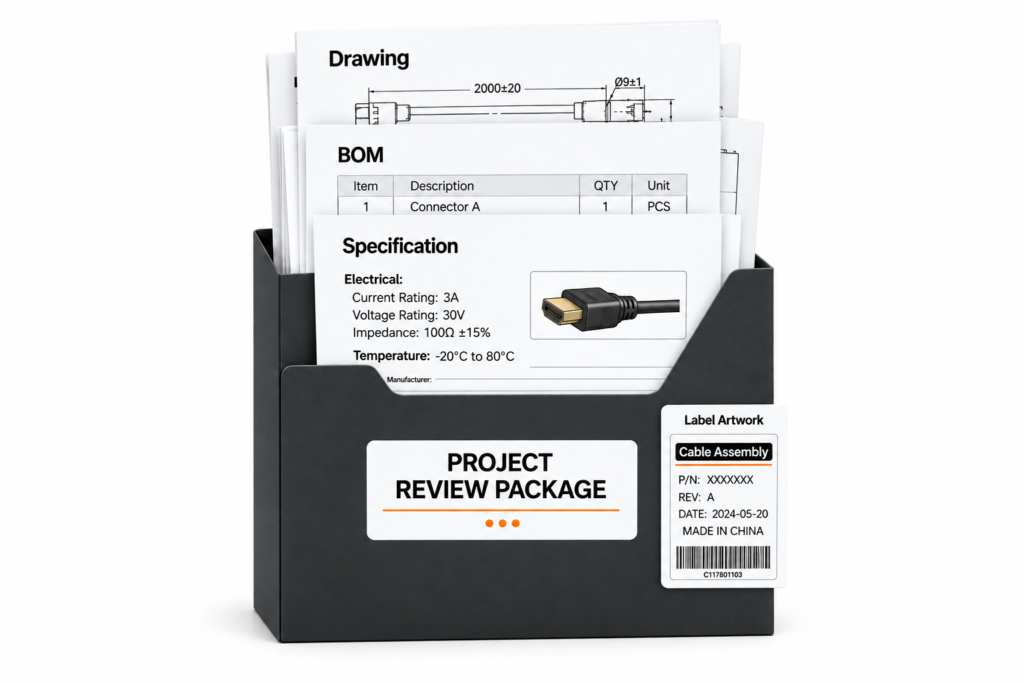
Move From Approved HDMI Sample to Controlled Bulk Production

Volume manufacturing should repeat a confirmed product version, not reinterpret the project after the sample is approved. Final specifications, material references, test requirements, branding files, SKU mapping, and packaging versions need to remain connected throughout production.

Lock the Approved Version Before Material Preparation

The safest time to clarify a cable specification is before materials are committed to volume production. Once the HDMI sample is approved, the project should have a clear set of references: final product specification, intended lengths, connector housing, material direction, color or appearance reference, logo placement, applicable BOM or material list, testing checklist, packaging version, barcode and SKU files, and any certification requirement tied to the final model. If a program contains multiple lengths, every SKU should be listed separately with its quantity and packing requirement.

Cablivo can use those confirmed inputs when coordinating material preparation, production scheduling, and work instructions. Incoming materials can be checked against the project version before the main production flow begins. Where custom molding is involved, mold shape, connector position, cable exit, logo area, surface finish, and appearance reference should already have been approved. Material substitutions, connector changes, or packaging changes should be discussed rather than introduced silently.

Lead time cannot be responsibly reduced to a single website number. Product structure, connector availability, material preparation, tooling, sample approval, order quantity, testing requirement, SKU complexity, and packaging plan all influence scheduling. Production timing should therefore be confirmed after the final sample and order details are settled. For a serious brand program, a realistic schedule based on actual inputs is more useful than an attractive but unsupported promise.

Cable Project Review and Technical Specification Documents

Control Production, Inspection and Packing Against the Same Files

Once production starts, the program should remain tied to the approved version. Relevant processes may include cable preparation, cutting, stripping, shielding or termination operations, connector assembly, molding or overmolding, final assembly, inspection, testing, labeling, coiling, retail packing, carton packing, and OQC. The exact route depends on the product construction. Cablivo’s broader manufacturing base covers conductor preparation, extrusion, braiding, cutting, stripping, crimping, soldering, injection molding, overmolding, assembly, testing, mold work, warehousing, and packing support across custom cable programs.

For HDMI projects, the inspection plan should separate routine production checks from model-specific high-speed verification or certification requirements. The factory should be able to state what is checked on the line, what is sampled, and what evidence applies to the exact model. Packaging should be controlled using the same SKU and version logic. A 1 m and 2 m cable that share the same color and connector can easily be mixed if barcode, label, bag, box, and carton references are not disciplined.

Before shipment, OQC can verify the agreed product, appearance, labels, packaging, quantity, and carton information. Repeat orders should refer to the previously approved files unless a revision is intentionally introduced. That file-based approach helps brands and procurement teams reduce avoidable sample-to-production and repeat-order variation.

Private Label HDMI Cables Ready for Brand and Channel Requirements

A branded HDMI product is a coordinated set of cable, connector appearance, identification, packaging, SKU data, and carton information. Managing those elements together helps reduce artwork revisions, mixed products, wrong labels, and repeat-order version problems.

Product Appearance

Brand presentation starts on the cable itself. Jacket or braid color, connector housing shape, surface finish, logo position, cable diameter, and overall feel should fit the intended product line. A physical appearance sample is more reliable than approving color or texture from screen images alone. Cablivo can discuss color references, molded or printed branding, connector housing design, cable finish, and sample validation according to project requirements. Custom molded structures may involve tooling and should be reviewed before the sample schedule and cost are confirmed.

Retail Packaging

Retail boxes, color boxes, bags, insert cards, inner trays, and other packaging formats should be selected according to product size, cable-coiling method, channel needs, and cost. Packaging artwork should not be treated as a last-minute graphic task because connector size, cable diameter, and coil dimensions influence box design. Cablivo can coordinate packaging files and packaging samples alongside product development. Provide artwork, dielines where available, insert content, product dimensions, packing quantity, and any channel-specific labeling requirement early enough to avoid rework after the cable is already approved.

Barcode and SKU

Multi-length HDMI programs need disciplined identification. A product family may include several lengths or finishes that look nearly identical once packed. Link each SKU to product name, length, color, connector appearance, barcode, package version, quantity, and carton information. Cablivo can use the SKU list during sample, packing, and OQC discussions to reduce mixed-version risk. If a barcode or SKU code changes, the packaging file should be updated before packing begins. Repeat orders should reference the approved SKU matrix rather than relying on memory from a previous shipment.

Comparison of Inside and Outside Carton Dimensions

Carton and Reorders

Outer cartons are part of the supply program, especially for distributors, importers, and multi-SKU brands. Carton marks, quantity per carton, product code, SKU, and packing-list correspondence need to be clear before shipment. Cablivo can coordinate export packing and carton information according to approved files and order details. The factory does not need to promise customs clearance or a universal delivery time; manufacturing-side accuracy is the priority. For repeat orders, retain the approved product and packaging versions so the new order can be checked against the same reference unless a planned revision is introduced.

What Determines a Custom HDMI 2.1 Cable Quote

Custom HDMI pricing is built from the actual product program. Length, cable construction, components, molding, verification, packaging, SKU mix, and quantity can change material usage and manufacturing work, so a detailed RFQ produces a more useful quotation than a single product name.

Quote Factor

Information to Provide

Why It Matters

MOQ

MOQ starts from 500 pcs for many custom cable projects; send quantity per SKU.

Final MOQ depends on connector type, structure, materials, overmolding, tooling, packaging, SKU mix, and total order quantity.

Length Matrix

List every planned length and quantity, such as 1 m / 2 m / 3 m or the exact range required.

Length changes material usage, packaging, and potentially the performance-validation plan.

Cable Construction

Provide target function, diameter or flexibility limits, conductor/gauge direction, shielding requirement, and reference sample when available.

Construction drives materials, process complexity, sample work, and performance.

Connector / Housing

State connector type, straight or angled form, housing dimensions, surface finish, logo area, and any custom mold requirement.

Custom molded or special housings can affect tooling, sample cost, preparation time, and production method.

Performance Target

State required modes, bandwidth target, equipment use, length, and any Ultra High Speed HDMI requirement.

A clear target allows the factory to define a relevant verification route instead of pricing an unspecified “HDMI 2.1” cable.

Testing / Certification

Provide internal test requirements, target market, certification requirement, or third-party test scope.

Testing can affect sample quantity, schedule, documentation, and total project cost.

Branding

Send logo file, Pantone/color reference, marking method, and placement.

Branding may involve printing, molding, labels, color control, or sample approval.

Packaging

Send artwork, packaging type, insert card, barcode, SKU list, packing quantity, and carton requirement.

Packaging influences material, labor, dimensional planning, and multi-SKU control.

Sample Time

No fixed website number; confirm after specification review.

Timing depends on structure, connector availability, material preparation, tooling, artwork, and testing needs.

Production Lead Time

Confirm after approved sample and final order details.

Schedule depends on material readiness, connector sourcing, tooling, quantity, testing, SKU complexity, and packaging plan.

Manufacturing Scale Behind Cablivo Custom Cable Programs

Cablivo is the overseas-facing brand of Shenzhen Tianxiaowei Electronics Co., Ltd. The manufacturing foundation combines long-term cable experience, multi-base production resources, engineering and quality teams, molding capacity, and project support from specification review through packing.

18 Years Experience

Eighteen years in the cable industry means the manufacturing team has worked through the full sequence of custom cable projects: requirement review, material selection, drawing or sample interpretation, prototype development, revisions, production preparation, quality inspection, packaging, labeling, and shipment coordination. Experience is useful only when it reduces project uncertainty, so Cablivo applies the background to specification review and sample-to-production control rather than using the number as a standalone slogan. New HDMI programs still require model-specific engineering, testing, and certification decisions before final claims are approved.

20,000+ m² Factory Base

A 20,000+ square meter factory base provides the physical foundation for multiple cable categories, components, molding work, production preparation, testing, packaging, warehousing, and larger project orders. The figure should be understood as manufacturing infrastructure rather than as a promise of a fixed daily output. Cablivo can support custom cable, cable assembly, wire harness, molded and overmolded products across its wider business. For an HDMI project, the relevant production route and available evidence should still be reviewed against the exact construction instead of assuming every factory area is dedicated to HDMI.

1,500+ Person Team

A 1,500+ person team creates coordination capacity across engineering, quality, purchasing, production, warehousing, sales support, order follow-up, shipping, and related factory functions. Large brand programs often involve several departments because product specifications, packaging files, quantities, test requirements, and delivery planning change at different stages. Cablivo’s team structure supports project-based communication from sample development through bulk packing. The advantage is not simply headcount; it is the ability to connect technical files, manufacturing decisions, inspection points, and commercial order details within one supplier organization.

China Cable Manufacturing Locations and Factory Distribution Map

3 Bases / 80+ Molding

Cablivo’s broader manufacturing foundation includes three manufacturing bases and 80+ injection molding machines. Those resources are relevant to custom cable programs that involve connector housings, molded heads, strain relief, surface appearance, branding areas, or other molded components. Not every HDMI cable requires a custom mold, and a special housing may need tooling review before cost and timing are known. Multi-base capacity also supports parallel project coordination, although production location and schedule should be confirmed for the actual order rather than assumed from the company-level numbers alone.

From Cable Materials to Finished HDMI Assemblies and Packing

Manufacturing evidence is more useful when every process is connected to a product result. Cablivo’s broader equipment system covers conductor preparation, extrusion, braiding, cable preparation, assembly, molding, testing, mold work, warehousing, and packing support for custom cable programs.

Cable Preparation, Shielding and Connector Assembly

Cablivo’s equipment foundation extends beyond final cable assembly. we fact base includes wire drawing, stranding, extrusion, braiding, wrapping, cutting, stripping, crimping, soldering, heat-shrink processing, assembly, testing, and related cable-production support. For a custom HDMI program, the actual manufacturing route should be selected after the cable construction is confirmed. A high-speed design may require specific conductor preparation, pair structure, insulation, shielding, overall cable construction, and connector termination details that need to be maintained through production.

we presentation should therefore show relevant process evidence rather than an unrelated list of machines. Product images can be paired with close-ups of cable preparation, shielding or braiding work, connector assembly, cable exit control, and inspection points when those processes genuinely apply to the quoted HDMI model. Sensitive client drawings or unapproved brand markings should be removed from any public photography.

Engineering review and manufacturing evidence should also connect. If a target length, housing direction, cable diameter, or performance requirement changes after the first sample, the production route may need to change as well. Recording the revised version before volume manufacturing prevents old instructions from returning to the line. For mature brand programs, production documentation is as important as the physical equipment because it is what helps the factory repeat an approved result.

Molding, Inspection, Packing and Shipment Preparation

Cablivo has 80+ injection molding machines within its broader manufacturing resources, which can support cable projects involving molded connector heads, custom strain relief, housing geometry, logo areas, and other overmolded components. Molding should be used only when the product design requires it. A custom mold can add tooling work, sample preparation, appearance review, and dimensional control, so the housing design needs to be settled early. Surface finish, color, logo position, connector alignment, cable exit, and package dimensions may all depend on the final molded shape.

After assembly, project-specific inspection can cover the agreed dimensional, visual, electrical, functional, and packaging checkpoints. For HDMI programs, any high-speed performance verification or official certification must be tied to the exact model and length. Routine factory checks should not be presented as a substitute for the required HDMI performance evidence.

Packing then becomes part of production control. Cable coiling, protective packing, retail boxes or bags, insert cards, barcodes, SKU labels, carton marks, quantity per carton, and packing-list information can be checked against approved files. Cablivo can coordinate manufacturing-side shipment preparation and export packing. Delivery timing depends on the final product structure, material availability, connector sourcing, tooling, order quantity, testing, and packaging plan, so the production schedule is confirmed after the order details are complete.

Industrial Cable Manufacturing and Assembly Equipment

How to Evaluate a Custom HDMI 2.1 Cable Factory

A strong supplier shortlist should be built on evidence rather than search ranking alone. Compare the exact product capability, engineering review, model-specific validation, manufacturing process, packaging control, and RFQ discipline before approving an HDMI cable factory for a brand program.

Evaluation Point

What a Serious Brand Should Check

Red Flag During Supplier Review

Factory Identity

Legal entity, manufacturing location, relevant production areas, equipment, team, and process evidence.

Only stock photos, vague “factory direct” language, or no connection between the website and real production.

HDMI Product Knowledge

Correct distinction between search terms, performance targets, cable length, and applicable certification.

Every cable described as “48Gbps certified” without model, length, test, or label evidence.

Customization Depth

Length, construction, shielding, jacket, housing, appearance, branding, SKU, and packaging reviewed together.

Customization limited to color and logo while technical requirements are ignored.

Engineering Review

Supplier asks for application, length list, reference sample, performance target, housing, test plan, and packaging.

Immediate price from one photo with no questions about the actual specification.

Sample Process

Prototype version is reviewed, feedback is recorded, and an approved sample becomes the production reference.

No revision record, no final specification, or a sample that cannot be connected to production files.

Performance Evidence

Testing or certification evidence corresponds to the exact model and length under review.

Generic test screenshots or certificates that cannot be matched to the quoted product.

Bulk Consistency

Final files, material controls, in-process inspection, OQC, and packaging references follow the approved version.

Supplier cannot explain how sample requirements are transferred to volume manufacturing.

Private Label Control

Logo, color, packaging artwork, barcode, SKU label, carton mark, and repeat-order version are managed.

Brand files are handled as an afterthought after product production is already complete.

Commercial Clarity

MOQ, cost drivers, tooling, sample conditions, schedule factors, SKU quantities, and packaging are transparent.

Lowest-price promises, fixed lead times without specification review, or hidden tooling and packing assumptions.

Long-Term Support

Repeat orders use approved specifications, sample version, packaging files, and inspection requirements.

Every reorder starts from scratch or depends only on informal chat history.

Evidence to Review Before Approving an HDMI Cable Supplier

Supplier evidence should show how requirements become a sample, how an approved sample becomes production, and how the finished SKU is checked and packed. Applicable materials depend on the actual project and confidentiality requirements, so evidence must remain specific and verifiable.

Cable Project Review and Technical Specification Documents

Engineering Evidence

Ask to see the type of project files a factory can work with and how revisions are controlled. Useful evidence can include a neutralized requirement sheet, sample review checklist, approved product specification, length matrix, housing reference, or revision record without exposing another brand’s confidential information. Cablivo’s established custom cable workflow supports drawing review, sample development, connector confirmation, material discussion, and final production files. For HDMI-specific performance or certification claims, only evidence that can be matched to the actual quoted model and length should be used during supplier approval.

Wire Harness Assembly and Cable Processing Production Line

Manufacturing Evidence

Real production evidence should connect to the cable being discussed. Relevant photos or video may show cable preparation, shielding or braiding, connector assembly, molding when applicable, inspection, testing, labeling, and packing. Cablivo’s wider manufacturing base covers conductor processing, extrusion, braiding, cutting, stripping, crimping, soldering, injection molding, overmolding, assembly, testing, mold work, warehousing, and packing support. During an HDMI supplier review, ask which of those processes apply to the proposed model and request project-relevant evidence rather than assuming every factory process is used on every cable.

Cable Manufacturing Warehouse and Forklift Operations

Quality and Packing Evidence

A complete supplier review also looks beyond the product photo. Inspection checklists, approved sample references, length or appearance records, packaging-version controls, SKU mapping, barcode checks, carton marks, and OQC records can demonstrate how the factory manages bulk production. Cablivo can coordinate quality inspection, packaging, labeling, and shipment preparation within custom cable projects. Any public evidence should remove confidential client information and unauthorized logos. For a new HDMI program, agree in advance which records will be created and which documents will be available for sample approval, mass-production review, and repeat orders.

What Cablivo Brings to Custom HDMI Cable Programs

Cablivo combines a broad custom cable manufacturing base with project review, sampling, production, inspection, packaging, and export coordination. HDMI-specific performance and certification requirements are handled as model-based project inputs rather than unsupported universal claims.

Project Review

Cablivo can start from a specification, reference sample, interface photos, product requirements, length matrix, brand files, or packaging plan. The review identifies the commercial and engineering information needed before sampling, including target application, cable lengths, connector and housing, construction direction, shielding, appearance, performance goals, testing, certification, quantity, and packaging. The objective is to create a clearer manufacturing brief before materials and tooling are committed. Projects with incomplete information can still begin with available files, but missing points should be confirmed before the final sample becomes the production reference.

Custom Configuration

Custom HDMI work can involve more than length and color. Cable construction, conductor and gauge direction, shielding, jacket or braid, connector housing, cable exit, surface finish, logo placement, SKU structure, and retail packaging can all become part of the program. Cablivo discusses options according to application, manufacturing feasibility, cost, material availability, target market, and validation requirements. A change in one area may affect others; for example, a larger housing or thicker cable may influence package dimensions. Configuration decisions therefore need sample approval rather than isolated selections from a catalog.

Sample Development

The sample process moves through project review, specification confirmation, material or component preparation, prototype production, inspection, defined performance checks, feedback, revision when necessary, and final approval. Cablivo uses the approved sample and confirmed files as the bridge to bulk production. Sample time depends on product structure, connector availability, material preparation, tooling requirements, packaging artwork, and testing needs. For private label programs, product appearance and packaging may require separate but linked approvals. No fixed sample time or unlimited revision promise should replace an actual review of the project inputs.

Production Planning

After sample approval, the project can move into material preparation, production files, scheduling, manufacturing, inspection, packing, and OQC. Cablivo’s company-level resources include 18 years of industry experience, 20,000+ square meters of factory space, a 1,500+ person team, three manufacturing bases, and 80+ injection molding machines. Those facts describe the wider manufacturing foundation, while the actual HDMI production route depends on the selected construction. Lead time is confirmed after final product, material, quantity, testing, and packaging details are known.

Quality and Testing

Quality control can include incoming material inspection, in-process checks, finished-product inspection, packaging verification, and OQC according to the project. The testing checklist should identify the exact dimensional, visual, electrical, functional, and packaging risks for the model. HDMI high-speed performance or Ultra High Speed certification requires model- and length-specific evidence rather than a general factory statement. Cablivo can discuss the required validation plan before sampling, and any third-party or target-market testing should be confirmed with scope, samples, timing, and acceptance criteria before production.

Packaging and Supply

Cablivo supports packaging and labeling coordination for custom cable programs, including retail boxes or bags, insert cards, barcode files, SKU labels, carton marks, packing quantity, and export carton preparation according to approved files. Multi-SKU HDMI programs benefit from a simple matrix linking product length, appearance, barcode, package version, and quantity. Repeat orders should refer to the approved product and packaging versions so old and new specifications are not mixed. Shipment coordination is based on confirmed order and forwarding details rather than broad promises of universal delivery times or customs clearance.

Custom HDMI Cable Frequently Asked Questions

Answers below focus on quotation, customization, sampling, performance verification, certification, packaging, MOQ, and production planning for custom HDMI programs. Final requirements are confirmed against the actual model, length, application, and order details.

Can Cablivo customize HDMI cable lengths?

Yes, cable length can be discussed as part of a custom program. Send every required length and quantity rather than a broad range. Length affects material usage, packaging, cable construction, and the verification plan. If several SKUs are planned, each length should have a clear specification and product code. Final feasibility depends on the selected construction and required performance, so longer versions should be reviewed independently rather than assumed to perform exactly like short samples.

MOQ starts from 500 pcs for many Cablivo custom cable projects. The final MOQ depends on connector type, cable structure, material requirements, custom molding or tooling, packaging plan, SKU mix, and total order quantity. For a multi-length program, provide quantity per SKU so production and packing can be evaluated correctly. MOQ should be confirmed during quotation because a simple standard construction and a heavily customized private-label program may have very different preparation requirements.

Send whatever is already available: product specification, target lengths, reference sample photos, interface information, performance requirements, connector or housing references, color or logo files, target market, testing or certification requirements, quantity per SKU, and packaging artwork. A formal drawing is helpful but not mandatory for the first discussion. Cablivo can review the available inputs and identify what still needs confirmation before a precise sample or production quotation is prepared.

Sample development is part of Cablivo’s custom cable workflow. The process normally starts with requirement review, then specification confirmation, material or component preparation, prototype production, internal checks, feedback, revision when necessary, and final approval. Sample time is not fixed on the website because structure, connector availability, material preparation, tooling, packaging artwork, and testing needs can change the schedule. The approved sample and final files should become the reference for later bulk production.

Define the target performance, device use, cable length, and required evidence before sampling. Terms such as 48Gbps, 8K60, or 4K120 should be connected to the actual model and length rather than used as generic marketing claims. The project may require an agreed high-speed test plan, official Ultra High Speed HDMI certification, third-party verification, or client-specific testing. Cablivo can review the requirement, but a performance claim should only be published when the applicable evidence genuinely supports the quoted product.

Ultra High Speed HDMI Cable is the official HDMI cable category introduced for HDMI 2.1 high-bandwidth applications. The category is associated with system configurations up to 48Gbps and applications such as 8K60 and 4K120. If your brand requires official certification, specify the exact product lengths and market requirement in the RFQ. Certification should be verified for the actual model and length, and any authentication label or certificate should correspond to the product being sold.

Connector housing, cable exit, strain relief, surface finish, color, logo placement, and other appearance features can be discussed according to the project. Some molded structures may require tooling, so cost and sample time should be confirmed after the design is reviewed. Cablivo’s broader manufacturing base includes 80+ injection molding machines. For brand programs, provide drawings or visual references, logo files, color references, and package dimensions early so product appearance and packaging can be approved together.

Cablivo supports packaging and labeling coordination for custom cable projects. Options can include bulk packing, bags, retail boxes, insert cards, barcode labels, SKU labels, carton marks, and export cartons according to the approved program. Provide artwork, barcode files, SKU list, packing quantity, and carton requirements before bulk packing. Packaging should be version-controlled like the cable itself because a correct product with the wrong barcode or box can still create warehouse, retail, and repeat-order problems.

Lead time depends on product structure, connector sourcing, material availability, tooling requirements, final sample approval, order quantity, testing requirements, SKU complexity, packaging artwork, and packing plan. Cablivo does not use one fixed delivery number for every custom cable project. After the approved sample, final product files, quantities, test requirements, and packaging details are confirmed, the production schedule can be discussed against the actual order. Early approval of artwork and special components helps reduce avoidable scheduling uncertainty.

Certification and compliance documents are handled according to the actual product, materials, target market, and project requirements. Cablivo should only present a certificate as an existing product certificate when the document, scope, validity, and applicable model are verified. If Ultra High Speed HDMI certification, RoHS, REACH, third-party testing, or another document is required, include it in the RFQ so availability, test needs, sample quantity, cost, and timing can be reviewed before production.

Send Your Custom HDMI Cable Requirements

Start with the information already available. A useful RFQ can include the target HDMI application, cable lengths, reference sample photos, connector or housing requirements, performance target, cable construction preferences, appearance or color references, quantity per SKU, logo files, packaging artwork, and any certification or testing requirement. A formal drawing is helpful when available, but an existing sample or clear requirement sheet can also begin the review.

MOQ starts from 500 pcs for many custom cable projects. Final MOQ, sample conditions, tooling needs, quotation, and production schedule depend on the confirmed structure, materials, connector sourcing, packaging, SKU mix, testing, certification, and order quantity. Cablivo will review the project information before sampling so open items can be identified early. For Ultra High Speed HDMI requirements, include the exact commercial lengths and the evidence needed for your market or internal approval. Use the upload field for specifications, drawings, sample images, logo files, packaging artwork, or other project documents.

Send inquiry

Send your drawing / sample photos for a quick quote

Seraphinite AcceleratorOptimized by Seraphinite Accelerator
Turns on site high speed to be attractive for people and search engines.