
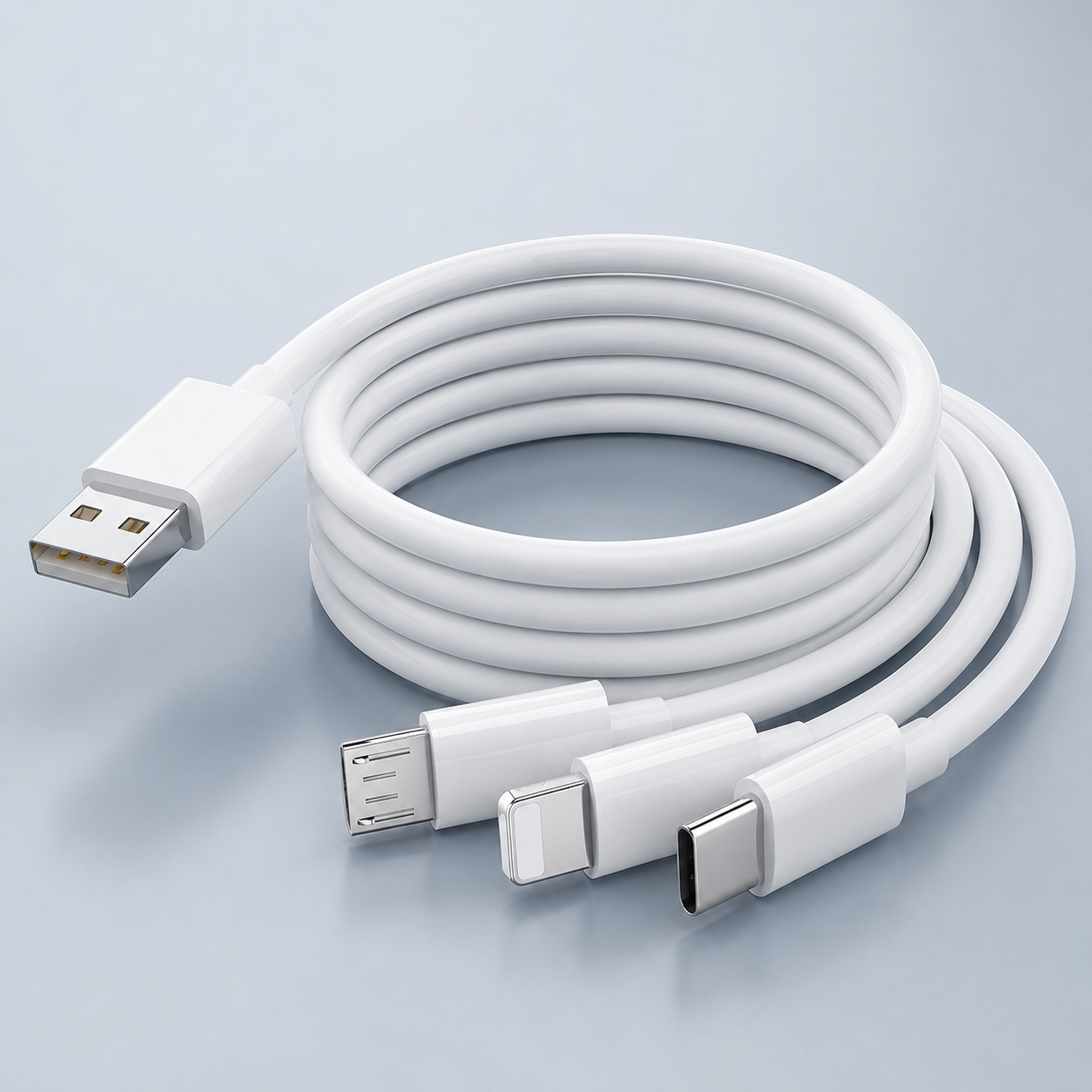
PVC vs TPE Cable: Which Material Is Better for Custom USB Cables?
Image suggestion: Close-up product photo showing PVC and TPE USB cables side by side, with smooth jacket texture, connector details, and clean studio lighting.
Choosing the wrong cable jacket can cause poor hand feel, weak durability, higher complaints, or unnecessary cost. Many buyers compare PVC and TPE too late. This guide explains how to choose the right material before custom USB cable production.
Snippet Answer:
PVC vs TPE cable selection depends on budget, flexibility, target market, and product positioning. PVC is usually more cost-effective, durable, and suitable for large promotional or standard cable orders. TPE feels softer, bends better, and is often preferred for premium USB cables, retail products, and markets that care about touch, flexibility, and user experience.
PVC and TPE are both common cable jacket materials. The better choice is not always the more expensive one. The right decision depends on how the cable will be used, sold, packaged, and tested before mass production.
Table of Contents
- What Are PVC and TPE Cable Jackets?
- How Does PVC Compare With TPE for Custom USB Cables?
- Which Material Is Better for Different Cable Applications?
- How Do PVC and TPE Affect Cost, Durability, and User Experience?
- What Should Buyers Confirm Before Choosing PVC or TPE?
- How Does the OEM/ODM Cable Process Change by Material?
- What Quality Tests Should Buyers Check for PVC and TPE Cables?
- What Mistakes Should Buyers Avoid Before Bulk Orders?
- FAQ
- Conclusion
What Are PVC and TPE Cable Jackets?
PVC and TPE are outer jacket materials used to protect USB cables. They affect flexibility, surface feel, cost, durability, color options, and the final customer experience.
Snippet Answer:
PVC is a widely used plastic cable jacket known for cost control, surface durability, and stable mass production. TPE is a softer thermoplastic elastomer that gives cables better flexibility, smoother hand feel, and a more premium impression. For custom USB cables, both materials can work well when matched with the right market and application.
What PVC Means in Cable Manufacturing
PVC stands for polyvinyl chloride. In USB cable manufacturing, PVC is often used for standard charging cables, promotional cables, wholesale cables, and cost-sensitive bulk orders.
From a factory perspective, PVC is popular because it is stable in production, easy to process, and suitable for many colors. It can provide a smooth surface and acceptable durability for everyday cable use.
What TPE Means in Cable Manufacturing
TPE stands for thermoplastic elastomer. It feels softer and more elastic than standard PVC. Many buyers choose TPE when they want a cable with better flexibility, a cleaner touch, and a more premium retail feel.
For private label cable projects, TPE can help improve perceived value. It is often used when the buyer wants a cable that feels better in the hand, bends more naturally, or fits a higher-positioned product line.
| <div align=”center”>Material</div> | <div align=”center”>Basic Meaning</div> | <div align=”center”>Common Cable Use</div> | <div align=”center”>Buyer Advice</div> |
|---|---|---|---|
| PVC | Standard plastic outer jacket | Promotional cables, wholesale cables, standard USB cables | Good when cost control matters |
| TPE | Soft thermoplastic elastomer | Premium USB cables, retail cables, flexible cables | Good when hand feel matters |
| Braided nylon | Woven outer surface over cable jacket | Retail, gaming, durable charging cables | Good when appearance and wear resistance matter |
| Silicone | Soft and flexible jacket material | Premium flexible cables | Good for soft-touch product lines |
If you are building a product line with several price levels, PVC and TPE can even be used together. PVC can serve the entry-level model, while TPE can support the premium version.
How Does PVC Compare With TPE for Custom USB Cables?
PVC and TPE differ most in flexibility, touch, cost, perceived value, and user experience. PVC is usually stronger for budget control, while TPE is better for softer and more flexible cable designs.
Snippet Answer:
PVC is usually better for cost-sensitive custom USB cables, promotional orders, and large-volume wholesale projects. TPE is usually better for flexible charging cables, premium retail products, and private label cable lines. Buyers should compare cost, flexibility, surface feel, color requirements, packaging level, and expected customer use before choosing either material.
Image suggestion: Macro comparison image showing PVC cable surface and TPE cable surface with soft highlights, labeled material samples, and USB-C connector ends.
Main Differences Between PVC and TPE
The biggest mistake buyers make is only asking, “Which material is better?” A better question is, “Which material is better for this cable’s target user, price point, and sales channel?”
| <div align=”center”>Comparison Point</div> | <div align=”center”>PVC Cable</div> | <div align=”center”>TPE Cable</div> | <div align=”center”>Buyer Decision</div> |
|---|---|---|---|
| Cost | Usually lower | Usually higher | Choose PVC for budget control |
| Flexibility | Medium | Better | Choose TPE for soft bending |
| Hand feel | Smooth but more plastic-like | Softer and more elastic | Choose TPE for premium feel |
| Durability | Good for standard use | Good flexibility under repeated use | Match with target use |
| Color options | Broad color support | Broad color support | Confirm color sample first |
| Retail appeal | Standard | More premium | TPE suits branded products |
| Bulk order stability | Stable | Stable when formula is confirmed | Approve sample before mass production |
When PVC Makes More Sense
PVC is often a practical choice for importers, wholesalers, promotional gift companies, and cost-sensitive distributors. If the buyer needs a large quantity of USB cables for basic charging, giveaway packs, bundles, or entry-level retail, PVC can be a strong choice.
In our production experience, PVC is also easier for buyers who need stable pricing and simple specifications. It can support many standard colors and common connector types.
When TPE Makes More Sense
TPE is a better fit when the cable is part of a higher-value product. Many electronics accessory brands, Amazon sellers, device manufacturers, and private label buyers prefer TPE because it gives a softer touch and better flexibility.
For North America and Europe, many buyers care about user experience, packaging impression, and product reviews. TPE can help when the cable is sold as a visible retail accessory.
Which Material Is Better for Different Cable Applications?
PVC is better for standard, promotional, and cost-sensitive USB cable orders. TPE is better for flexible, premium, private label, and retail-focused custom USB cables.
Snippet Answer:
PVC is usually better for standard charging cables, promotional cables, and wholesale projects where price and stable production matter most. TPE is usually better for retail USB cables, private label cable products, flexible charging cables, and applications where users touch and bend the cable often. Application should guide the material choice.
Application-Based Material Selection
A cable used inside a device assembly may have different needs from a cable sold in retail packaging. Overseas manufacturers may care more about connector compatibility and consistent dimensions, while retail brands may care more about touch, color, and packaging.
| <div align=”center”>Application</div> | <div align=”center”>Better Material</div> | <div align=”center”>Reason</div> | <div align=”center”>Buyer Advice</div> |
|---|---|---|---|
| Promotional USB cable | PVC | Better cost control | Good for giveaway orders |
| Entry-level retail cable | PVC | Balanced cost and function | Use good packaging to improve value |
| Premium retail cable | TPE | Softer feel and better flexibility | Confirm hand feel sample |
| Private label cable | TPE or PVC | Depends on brand positioning | Match material with price tier |
| Device accessory cable | TPE | Better user experience | Confirm connector and length tolerance |
| Product assembly cable | PVC or TPE | Depends on internal use environment | Confirm application before quotation |
| Fast charging cable | TPE or braided | Better perceived quality | Confirm current rating first |
| Gift set cable | PVC | Cost-effective in bulk | Good for bundle packaging |
For Brand Owners
Brand owners should consider how the cable feels in the customer’s hand. If the cable is sold with premium packaging, a low-cost jacket may reduce the perceived value of the full product.
For a branded charging cable, TPE often gives a more refined result. For a low-price accessory line, PVC may be enough.
For Overseas Manufacturers
Overseas manufacturers often buy cables as components for finished products. For them, the material decision should also include device compatibility, cable routing, bending space, assembly process, and long-term supply stability.
If the cable is hidden inside a device package and not frequently touched, PVC may work well. If the user handles the cable daily, TPE may reduce complaints about stiffness.
How Do PVC and TPE Affect Cost, Durability, and User Experience?
PVC usually helps reduce unit cost, while TPE usually improves flexibility and hand feel. Both materials can be durable when the cable structure, connector, strain relief, and quality testing are properly confirmed.
Snippet Answer:
PVC and TPE affect more than material cost. PVC can lower unit price and support large-volume orders, while TPE can improve flexibility, touch, and retail value. Durability depends not only on the jacket but also on conductor design, connector quality, strain relief, bending performance, and pre-shipment inspection.
Cost Factors Buyers Should Understand
Cable price is not decided by jacket material alone. Connector type, cable length, conductor structure, charging current, data function, logo method, packaging, and order quantity also affect cost.
| <div align=”center”>Cost Factor</div> | <div align=”center”>How It Affects Price</div> | <div align=”center”>Buyer Advice</div> |
|---|---|---|
| Jacket material | TPE usually costs more than PVC | Choose based on product positioning |
| Cable length | Longer cable uses more material | Confirm exact length before quote |
| Connector type | USB-C, Lightning, Micro USB differ in cost | Confirm connector combination early |
| Charging current | Higher current may need better internal structure | Confirm power requirement |
| Data transfer | Data cable needs proper wiring | Do not assume all cables support data |
| Logo method | Printing or molding affects setup | Confirm artwork before sample |
| Packaging | Retail box costs more than bulk pack | Match packaging to sales channel |
| Quantity | Larger orders usually reduce unit cost | Compare sample cost and bulk cost separately |
Durability Is Not Only About PVC or TPE
Many buyers assume TPE is always more durable because it feels softer. That is not always true. Durability also depends on inner conductor, connector welding, strain relief design, and bending test performance.
A good PVC cable can perform better than a poorly designed TPE cable. A good TPE cable can feel better than PVC and still maintain strong bending performance.
User Experience Matters More in Retail
For Amazon sellers, electronics accessory brands, and retail buyers, user experience is very important. Customers often judge a cable by touch, flexibility, connector fit, and packaging before they understand technical details.
TPE can help create a softer and cleaner first impression. PVC can still work well when the product is positioned as practical and affordable.
What Should Buyers Confirm Before Choosing PVC or TPE?
Buyers should confirm cable application, target market, connector type, cable length, charging current, data function, color, logo, packaging, and expected order quantity before choosing PVC or TPE.
Snippet Answer:
Before choosing PVC or TPE, buyers should confirm how the cable will be used, who will buy it, what device it connects to, and what price level it must meet. Key details include connector type, cable length, current rating, data transfer, jacket color, logo method, packaging, samples, and bulk quantity.
Cable Specification Checklist
Before quotation, send clear information to the supplier. This avoids wrong samples, inaccurate pricing, and delays before mass production.
| <div align=”center”>Specification</div> | <div align=”center”>What to Confirm</div> | <div align=”center”>Why It Matters</div> |
|---|---|---|
| Connector type | USB-A to USB-C, USB-C to USB-C, etc. | Affects structure and price |
| Cable length | 0.3m, 1m, 1.5m, 2m, custom length | Affects material usage |
| Jacket material | PVC or TPE | Affects cost and feel |
| Charging current | 2A, 3A, fast charging requirement | Affects internal design |
| Data function | Charging only or charging + data | Affects wiring |
| Color | Standard or custom Pantone color | Affects sample approval |
| Logo | Printed, molded, or no logo | Affects tooling and process |
| Packaging | Bulk pack, polybag, retail box | Affects final cost |
| Quantity | Sample quantity and bulk quantity | Affects unit price |
| Target market | Europe, North America, South America | Affects buyer expectations |
For Custom Cable Projects
For Custom USB Cable Manufacturing, material choice should happen early. If a buyer changes PVC to TPE after sample approval, the supplier may need to remake samples, adjust costing, and confirm color again.
For Cable Material Pages
If your website has a material section, link buyers to Cable Material Options so they can compare PVC, TPE, braided nylon, and silicone before requesting a quote.
How Does the OEM/ODM Cable Process Change by Material?
The OEM/ODM process is similar for PVC and TPE cables, but material choice affects sample feel, color confirmation, extrusion settings, cost review, and final quality inspection.
Snippet Answer:
PVC and TPE cables follow a similar OEM/ODM production flow, including specification review, quotation, sample making, approval, mass production, testing, and packing. The main differences are material formula, surface feel, flexibility, color matching, extrusion control, and sample confirmation. Buyers should approve physical samples before bulk production.
Image suggestion: Factory-style image showing custom USB cable samples, material swatches, connector parts, and packaging mockups on a sample approval desk.
Typical OEM/ODM Cable Process
| <div align=”center”>Step</div> | <div align=”center”>What Happens</div> | <div align=”center”>PVC Focus</div> | <div align=”center”>TPE Focus</div> |
|---|---|---|---|
| Requirement review | Buyer shares specifications | Cost and function | Feel and flexibility |
| Quotation | Supplier calculates price | Unit cost control | Material premium review |
| Sample making | Factory prepares sample | Color and structure | Softness and touch |
| Sample approval | Buyer checks cable | Surface and connector | Flexibility and hand feel |
| Mass production | Bulk order starts | Stable extrusion | Stable softness |
| Quality inspection | Cable is tested | Connector and charging | Bending and surface |
| Packing | Final packaging | Bulk or simple pack | Retail or private label pack |
Why Sample Approval Is Important
During sample confirmation, buyers should physically compare PVC and TPE if they are unsure. Photos cannot fully show softness, flexibility, and hand feel.
For private label cable projects, we often suggest checking the cable together with the final packaging. A premium box with a very stiff cable may create a mismatch. A soft TPE cable with clean packaging usually feels more consistent.
OEM/ODM Service Link
If the buyer needs logo, color, packaging, and connector customization together, the article can naturally link to OEM/ODM Cable Service.
What Quality Tests Should Buyers Check for PVC and TPE Cables?
Buyers should check charging performance, connector fit, cable bending, tensile strength, surface appearance, color consistency, logo durability, and packaging inspection before PVC or TPE cable shipment.
Snippet Answer:
PVC and TPE USB cables should be tested for charging performance, data function if required, connector fit, bending resistance, tensile strength, surface quality, color consistency, logo durability, and final packaging. TPE cables need extra attention to flexibility and surface feel, while PVC cables need stable jacket finish and connector strain relief.
Quality Control Table
| <div align=”center”>Test Item</div> | <div align=”center”>Purpose</div> | <div align=”center”>Buyer Advice</div> |
|---|---|---|
| Charging test | Confirms power performance | Match with product requirement |
| Data test | Confirms data transfer if needed | Do not skip for data cables |
| Connector fit | Checks plug compatibility | Test with target devices |
| Bend test | Checks repeated bending | Important for daily-use cables |
| Pull test | Checks cable strength | Useful for retail products |
| Surface inspection | Checks scratches and defects | Important for visible products |
| Color check | Confirms color consistency | Use approved sample as reference |
| Logo inspection | Checks logo position and durability | Important for private label orders |
| Packaging check | Confirms pack style and label | Important for retail and import |
Image suggestion: Quality control scene showing USB cables connected to charging testers, bend testing equipment, and workers checking connector details.
PVC Quality Focus
For PVC cables, buyers should pay attention to surface smoothness, cable roundness, connector strain relief, and stable color. PVC is often used in large quantities, so consistency matters.
TPE Quality Focus
For TPE cables, buyers should check softness, flexibility, surface cleanliness, and bending performance. Since TPE is often used for premium products, small surface defects may affect customer perception.
Pre-Shipment Inspection
For bulk cable orders, pre-shipment inspection helps reduce after-sales complaints. This is especially important for buyers in Europe, North America, and South America, where return costs and customer reviews can directly affect business.
What Mistakes Should Buyers Avoid Before Bulk Orders?
Buyers should avoid choosing material only by price, skipping sample approval, ignoring charging requirements, forgetting packaging details, and assuming PVC or TPE alone determines cable quality.
Snippet Answer:
The biggest mistakes are choosing PVC or TPE only by price, approving samples too quickly, ignoring connector quality, not confirming charging current, forgetting data transfer needs, and changing packaging late. Buyers should confirm material, function, logo, packaging, color, and inspection requirements before placing bulk custom USB cable orders.
Common Buyer Mistakes
| <div align=”center”>Mistake</div> | <div align=”center”>Possible Problem</div> | <div align=”center”>How to Avoid It</div> |
|---|---|---|
| Choosing only by lowest price | Poor user experience | Compare material and structure |
| Skipping physical samples | Wrong hand feel | Approve real samples |
| Not confirming current rating | Charging complaints | State power requirement |
| Ignoring data function | Cable may only charge | Confirm charging + data need |
| Changing color late | Production delay | Approve color before bulk order |
| Forgetting packaging | Wrong retail presentation | Confirm packaging mockup |
| No inspection requirement | Higher complaint risk | Request pre-shipment checks |
| Comparing quotes unfairly | Wrong supplier decision | Compare same specifications |
Better Buying Process
A better buying process is simple:
- Define the product position.
- Choose PVC or TPE based on use and budget.
- Confirm connector, length, charging, and data function.
- Request samples.
- Review material feel and cable performance.
- Approve packaging and logo.
- Start mass production.
- Check quality before shipment.
If you are preparing a new project, you can send specifications through Request a Quote or contact the team through Contact Our Team.
FAQ
Is TPE always better than PVC for USB cables?
No. TPE is softer and usually feels more premium, but PVC can be the better choice for cost-sensitive orders, promotional cables, and standard wholesale projects. The better material depends on the target market, price level, cable application, and required user experience.
Is PVC cable cheaper than TPE cable?
PVC is usually more cost-effective than TPE. However, final cable price also depends on cable length, connector type, charging current, data function, logo method, packaging, and order quantity. Buyers should compare complete specifications, not just jacket material.
Which material is better for private label USB cables?
TPE is often a good choice for private label USB cables because it gives a softer touch and a more premium feel. PVC can also work for entry-level private label products if the buyer wants better price control and simple packaging.
Can I customize both PVC and TPE cables?
Yes. Both PVC and TPE cables can support custom length, color, connector type, logo, and packaging. Buyers should confirm samples before mass production because color, surface feel, and flexibility can look different in real products.
Which material is better for overseas manufacturers?
Overseas manufacturers should choose based on product use. If the cable is used as an accessory for a finished device, TPE may improve user experience. If the cable is used in a cost-sensitive bundle or internal accessory package, PVC may be enough.
What should I send for a PVC or TPE cable quotation?
Send connector type, cable length, jacket material, charging current, data function, color, logo method, packaging style, estimated quantity, target market, and application scenario. These details help the supplier recommend the right structure and material.
How can I check PVC or TPE cable quality before shipment?
Check charging performance, connector fit, cable bending, tensile strength, surface appearance, color consistency, logo position, and packaging. For retail orders, also compare the final product with the approved sample before shipment.
Conclusion
PVC and TPE can both be good choices for custom USB cables. PVC is practical for cost control, standard use, and large-volume orders. TPE is better when flexibility, hand feel, and retail value matter more. The right decision depends on product positioning, target market, connector type, cable length, charging requirement, packaging, and inspection plan. Send your cable specifications to request a production-ready material recommendation and custom cable quote.
SEO Metadata
| <div align=”center”>Item</div> | <div align=”center”>Content</div> |
|---|---|
| SEO Title | PVC vs TPE Cable for Custom USB Cables |
| Meta Description | Compare PVC vs TPE cable materials for custom USB cables. Learn cost, flexibility, durability, quality testing, and buyer selection tips. |
| URL Slug | pvc-vs-tpe-cable |
| Primary Keyword | PVC vs TPE cable |
| Search Intent | comparison / commercial |
| Suggested Category | Cable Materials |
| Suggested Tags | PVC cable, TPE cable, custom USB cable, cable jacket material, USB cable manufacturer |
| Suggested Featured Image | PVC and TPE USB cables displayed side by side with connector details and clean lighting |
Schema Suggestions
| <div align=”center”>Schema Type</div> | <div align=”center”>Use Case</div> | <div align=”center”>Recommended?</div> |
|---|---|---|
| Article | Main blog article | Yes |
| FAQPage | FAQ section | Yes |
| Product | If linked to PVC or TPE cable product pages | Optional |
| HowTo | If turning the checklist into a step-by-step guide | Optional |
| BreadcrumbList | Blog navigation structure | Yes |
Suggested Image List
| <div align=”center”>Position</div> | <div align=”center”>Image Idea</div> | <div align=”center”>Purpose</div> |
|---|---|---|
| Featured image | PVC and TPE USB cables side by side on a clean desk | Show the comparison topic clearly |
| Material section | Close-up texture comparison of PVC and TPE cable jackets | Explain surface and hand-feel difference |
| Application section | USB cables used with phones, chargers, and retail packaging | Show real use cases |
| OEM/ODM section | Cable samples, connectors, and packaging mockups on a worktable | Explain customization process |
| Quality section | Cable bending test and charging performance test scene | Build factory trust |
| CTA section | Custom USB cable samples with logo and packaging | Encourage quotation inquiry |
Suggested Internal Links
| <div align=”center”>Anchor Text</div> | <div align=”center”>URL</div> | <div align=”center”>Placement</div> |
|---|---|---|
| Custom USB Cable Manufacturing | /custom-usb-cable/ | Specification confirmation section |
| USB-C Cable Products | /usb-c-cable/ | Product type or application section |
| Cable Material Options | /cable-materials/ | Material comparison section |
| OEM/ODM Cable Service | /oem-odm-cable/ | Production process section |
| Contact Our Team | /contact/ | Final CTA section |
| Request a Quote | /request-a-quote/ | Buyer checklist or conclusion |
Suggested CTA Text
- If you are comparing PVC and TPE for a custom USB cable project, send us your connector type, cable length, jacket material preference, charging current, packaging style, and estimated quantity. We can help evaluate the right material before sampling.
- Need PVC or TPE USB cables for retail, wholesale, or device assembly? Share your target market, application scenario, color, logo method, and order quantity to request a custom cable quotation.
- For private label cable projects, our team can help review material choice, connector structure, packaging design, and quality inspection requirements before mass production.
WordPress Publishing Suggestions
| <div align=”center”>Item</div> | <div align=”center”>Suggestion</div> |
|---|---|
| WordPress Category | Cable Materials |
| WordPress Tags | PVC cable, TPE cable, custom USB cable, cable jacket material, USB cable supplier |
| Excerpt | Compare PVC and TPE cable materials for custom USB cables, including cost, flexibility, durability, user experience, quality testing, and buyer selection tips. |
| Featured Image Alt Text | PVC vs TPE cable material comparison for custom USB cables |
| Recommended URL Slug | pvc-vs-tpe-cable |